
- Buy Crypto
- Markets
 Futures
- Spot
- Copy Trade
 Earn
Earn- More
After Bitcoin reclaimed $90,000, what's next, Christmas or Christmas Crash?

Whether you are in China or abroad, no one can escape the traditional mindset of "reuniting with family for a good holiday." The fourth Thursday in November every year is the traditional and important holiday of Thanksgiving Day in the United States.
And this year's Thanksgiving, what people in the crypto community may be most thankful for is Bitcoin returning to $90,000.
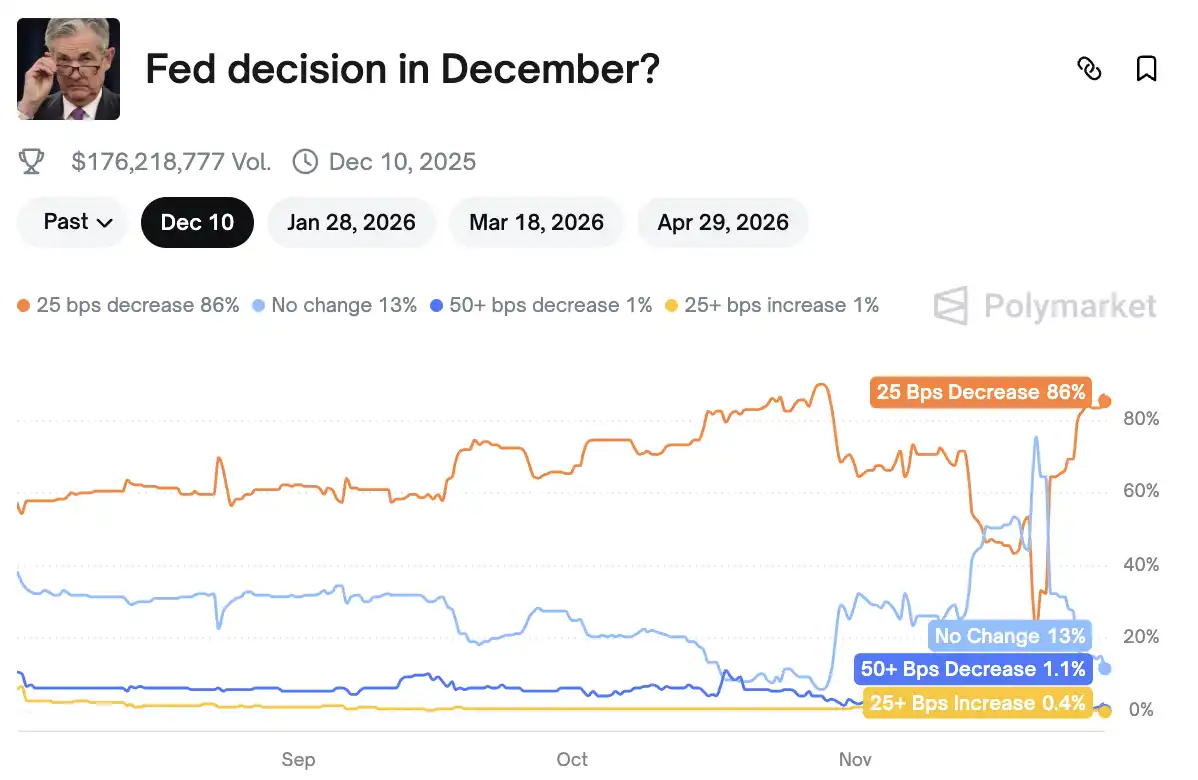
In addition to the influence of the "holiday market" factor, a Beige Book that unexpectedly became a key decision-making reference due to the government shutdown also helped rewrite the direction of the last monetary policy of the year. The probability of a Fed rate cut in December soared from 20% a week ago to 86%.
As the Fed's stance reverses, as major global economies simultaneously start the "money-printing mode," as the cracks in the traditional financial system widen, the crypto assets are standing at their most critical seasonal juncture. After the floodgates of global liquidity open, how will it affect the direction of the crypto industry? More importantly, in the upcoming next holiday, will it be Christmas or a Christmas Heist?
December Rate Cut Probability Soars to 86%
According to Polymarket data, the probability of a 25 basis-point rate cut by the Fed at the December monetary policy meeting has soared from about 20% a week ago to 86%. This should be one of the main reasons for the recent Bitcoin surge, as the turnaround in probability was due to an economic report, the Beige Book.
The Key Report Driving the Rate Cut Decision
On Wednesday, the Beige Book, compiled and collected by the Dallas Fed, reporting on the latest conditions in all 12 districts across the U.S., was officially released. As usual, it was just routine material, but due to the government shutdown causing a significant amount of key economic data not to be updated on time, this report instead became a rare comprehensive information source that the FOMC could rely on before making decisions.
In other words, in the absence of data, this was a rare window for the Fed to truly reflect the grassroots economic conditions.
The overall assessment given by the report was very direct: economic activity has hardly changed, labor demand is continuing to weaken, businesses are facing increased cost pressures, and consumer spending willingness is becoming cautious. Beneath the surface stability of the U.S. economy, some structural loosening is beginning to show.
The most closely watched part of the entire report is the description of changes in the labor market. Over the past six weeks, there haven't been many positive signs in the U.S. labor market. Roughly half of the district Feds stated that local businesses' willingness to hire is decreasing, and there is even a tendency to "if we can avoid hiring, we won't hire." The recruitment difficulty in multiple industries has significantly decreased, contrasting sharply with the severe labor shortage of the past two years. For example, in the Atlanta district of several states in the U.S. Southeast, many businesses are either laying off employees or only minimally replacing departing employees; and in Cleveland districts in Ohio, Pennsylvania, and other areas, some retailers are actively reducing their staff sizes due to declining sales. These changes suggest that labor market loosening is no longer an isolated phenomenon but is gradually spreading to more industries and regions.
At the same time, although inflation pressure has been described as "mild," the reality facing businesses is more complex than the numbers suggest. Some manufacturing and retail companies are still experiencing pressure from rising input costs, with tariffs being one of the reasons — for example, a brewery in the Minneapolis area reported that the significant increase in aluminum can prices has noticeably raised production costs. However, the more challenging issue is healthcare costs, mentioned by almost all districts. Providing healthcare coverage for employees is becoming increasingly expensive, and this cost, unlike tariffs, is not cyclical but rather a more difficult-to-reverse long-term trend. As a result, companies have to make a difficult choice between "raising prices" and "squeezing profits." Some companies pass the costs on to consumers, further increasing prices; while others choose to absorb the costs themselves, squeezing profit margins even further. Whichever path is taken, it will ultimately be reflected in the future months' CPI and corporate earnings.
Compared to the pressures on the business side, consumer-side changes are equally significant. While high-income groups continue to support strong performances in high-end retail, a broader segment of American households is tightening their spending. Several regions have mentioned that consumers are finding price increases increasingly difficult to accept, especially lower and middle-income families who tend to postpone or forego non-essential spending when facing tight budgets. Feedback from car dealerships is particularly typical: as federal tax incentives expire, sales of electric vehicles have rapidly slowed down, indicating that consumers are becoming more cautious when facing large expenses, even in industries that previously showed strong growth.
Among various economic disruptions, the impact of the government shutdown is prominently amplified in this report. The record length of the shutdown not only directly affected federal employees' incomes, but their reduced spending also dragged down local consumption — resulting in a significant decrease in car sales in the Philadelphia area. However, what was truly surprising was that the shutdown also had broader repercussions through other channels. Airports in some Midwest regions were thrown into chaos due to reduced passenger traffic, leading to a slowdown in commercial activities. Some businesses also experienced delays in orders. This chain reaction demonstrates that the economic impact of the government shutdown is far more profound than just the "suspension of government functions" itself.
At a more macro technical level, artificial intelligence is quietly reshaping the economic structure. The respondents of the "Beige Book" exhibit a subtle "dual-track phenomenon": AI is driving investment growth, for example, a manufacturer in the Boston area received more orders due to the strong demand for AI infrastructure development; yet, it is also causing some companies to start reducing entry-level positions as basic tasks are being partially taken over by AI tools. Even the education sector is experiencing similar concerns — colleges in the Boston area have stated that many students are worried that traditional jobs will be affected by AI in the future, thus they are more inclined to shift towards data science and other more "resilient to risk" professional directions. This signifies that AI's rewriting of the economic structure has penetrated from the industrial level to the talent supply side.
It is worth noting that these changes presented in the "Beige Book" are also corroborated by the latest data. Signs of weak employment have emerged simultaneously in multiple districts, and on the price front, the Producer Price Index (PPI) is only up 2.7% year-on-year, falling to the lowest level since July, while core prices continue to soften, showing no signs of any rekindled acceleration. Employment and inflation, two indicators directly related to monetary policy, are causing the market to begin reassessing the Fed's next steps.
Economic "Malaise" Spreads Across Regional Feds
National trends can be seen in macro data, but the reports from regional Feds are more like bringing the lens close to businesses and households, clearly showing that the cooling of the U.S. economy is not uniform but rather presents a "distributed malaise."
In the Northeast, businesses in the Boston district generally reported a slight expansion in economic activity, with housing sales gaining some momentum after a prolonged stall. However, consumer spending remains flat, employment has slightly declined, and wage growth has moderated. Rising food costs have pushed grocery prices upward, but overall price pressures remain manageable, with the overall outlook maintaining cautious optimism.
The situation in the New York district is noticeably cooler. There, economic activity is moderating, with many large employers starting to lay off workers, leading to a slight shrinkage in employment. Although the pace of price increases has slowed, it remains elevated; manufacturing has seen a slight recovery, but consumer spending continues to be weak, with only high-end retail maintaining resilience. Business expectations for the future are generally low, with many believing that there will be no significant improvement in the economy in the short term.
A bit further south, the Philadelphia Fed describes a reality where "weakness appeared before the shutdown." Most industries are experiencing moderate declines, with synchronized job cuts, price pressures squeezing the living space of low- to middle-income families, and recent government policy changes leaving many small and medium-sized enterprises feeling cornered.
The Richmond district further down appears slightly more resilient. The overall economy is maintaining moderate growth, consumers are hesitating on large purchases, but daily spending continues to grow slowly. Manufacturing activity is slightly contracting, while other industries are largely stable. Employment has not shown significant changes, with employers preferring to maintain their current team sizes, and wages and prices are both in moderate uptrends.
The southern region covered by the Atlanta Fed is more like a "standstill" state: overall economic activity is stable, employment is steady, and prices and wages are both gradually rising. Retail growth is slowing, tourism activities are slightly declining, real estate remains under pressure, but there are some signs of stabilization in commercial real estate. Energy demand is growing slightly, while manufacturing and transportation are operating at a low speed.
Meanwhile, in the St. Louis district in the Midwest, overall economic activity and employment are showing "no noticeable changes," but demand is further slowing due to the government shutdown. Prices are moderately rising, but businesses are generally worried that the rate of increase will widen over the next six months. Under the dual pressures of economic slowdown and rising costs, local business confidence has become slightly pessimistic.
Putting together these regional reports, one can see the outline of the U.S. economy: not a full-blown recession, nor a clear recovery, but rather a scattered display of varying degrees of fatigue. It is precisely this group of regionally disparate samples that forces the Federal Reserve to confront a more pressing issue before the next meeting—the cost of high-interest rates, brewing in every corner.
Fed Officials' Attitude Shift
If the Beige Book presents a clear enough "facial expression" of the real economy, then the public remarks of Federal Reserve officials over the past two weeks have further revealed a subtle shift in attitude among policymakers. The nuanced change in tone, which may appear as mere wording adjustments to outsiders, often signifies an internal shift in risk assessment at this stage.
Several high-profile officials have coincidentally begun to emphasize the same fact: the U.S. economy is cooling, prices are falling faster than anticipated, and the slowing of the labor market is "cause for concern." This is a noticeable softening of tone compared to their nearly unanimous stance over the past year of the need to maintain a sufficiently tight policy environment. Particularly, the expressions regarding employment have become notably cautious, with some officials frequently using terms like "stable," "slowing down," and "moving towards a more balanced direction," instead of emphasizing "still overheated."
This manner of description rarely appears in the later stages of a hawkish cycle. It is more like an oblique expression of "we see some initial signs, and current policy may already be tight enough."
Some officials have even begun to explicitly mention that excessive policy tightening could bring unnecessary economic risks. The appearance of this statement itself is a signal: when they start to guard against the side effects of "excessive tightening," it means the policy direction is no longer one-sided but has entered a stage that requires fine-tuning and balance.
These changes have not escaped the market's notice. Interest rate traders were the first to react, and pricing in the futures market saw significant movements within a few days. Expectations for a rate cut, originally thought to be "not until at least mid-next year," have gradually been brought forward to spring. The "rate cut before mid-year" that nobody dared to openly discuss in the past few weeks is now appearing in the benchmark forecasts of many investment banks. The market logic is not complicated:
If employment continues to weaken, inflation continues to decline, and economic growth remains stagnant near zero, maintaining high-interest rates will only exacerbate the issue. Ultimately, the Federal Reserve needs to choose between "persisting in tightening" and "preventing an economic hard landing," and from the current signs, this scale is starting to tip slightly.
Thus, as the Beige Book portrays the economy's temperature cooling to a "slight chill," the Fed's shifting attitude and the market's repricing behavior also begin to mutually confirm each other. The same narrative logic is taking shape: the U.S. economy is not sharply plummeting, but its momentum is slowly waning; inflation has not completely disappeared, but it is moving in a "manageable" direction; policy has not definitively shifted, but it is no longer in the unwavering tightening stance of last year.
The New Era of Global Liquidity
The Anxiety Behind Japan's ¥11.5 Trillion New Bond
While the U.S. is expecting internal loosening, major economies overseas are quietly pushing the curtain of "global reflation," such as Japan.
The scale of Japan's latest stimulus plan is much larger than outsiders imagined. On November 26, multiple media outlets cited sources familiar with the matter to report that the administration of Japanese Prime Minister Fumio Kishida will issue at least ¥11.5 trillion in new bonds (approximately $735 billion) for the latest economic stimulus package. This amount is almost equivalent to twice last year's stimulus budget under the Shinzo Abe administration. In other words, Japan's fiscal policy has shifted from "caution" to "must support the economy."
Although authorities expect tax revenue for this fiscal year to reach a record ¥80.7 trillion, the market is not reassured by this. Investors are more concerned about Japan's long-term fiscal sustainability. This also explains why the yen has been continuously sold off recently, Japanese government bond yields have surged to a twenty-year high, and the USD/JPY exchange rate has been hovering at a high level.
At the same time, this stimulus package is expected to bring a ¥24 trillion real GDP boost, with an overall economic impact close to $265 billion.
Internally, Japan is also attempting to curb short-term inflation with subsidies, such as a three-month continuous distribution of a ¥7,000 utility subsidy per household to stabilize consumer confidence. However, the deeper impact is on capital flows— the weakening yen is prompting more and more Asian funds to consider new allocation directions, and cryptocurrencies happen to be at the forefront of the risk curve they are willing to explore.
Crypto analyst Ash Crypto has already linked Japan's current "money printing" action to the Fed's policy shift, believing it will push the risk appetite cycle all the way to 2026. Dr. Jack Kruse, a long-time advocate of Bitcoin, interprets it more directly: the high yield of Japanese bonds itself is a signal of pressure on the fiat system, and Bitcoin is one of the few assets that can continuously prove itself in this cycle.
The UK's Debt Crisis Resembles 2008 Once Again
Now, let's look at the recent turmoil in the UK.
If Japan is pouring water, and China is stabilizing water, then the UK's fiscal operation at this moment seems more like adding weight to a ship's hold that is already leaking. The latest budget announcement has caused quite a stir in London's financial circles.
The analysis provided by the Institute for Fiscal Studies, considered one of the most authoritative analysis institutions, is unequivocal: "Spend now, pay later." In other words, expenditures are immediately laid out, while tax increases are delayed to take effect several years later, following a standard fiscal structure of "leaving the problem to future governments."
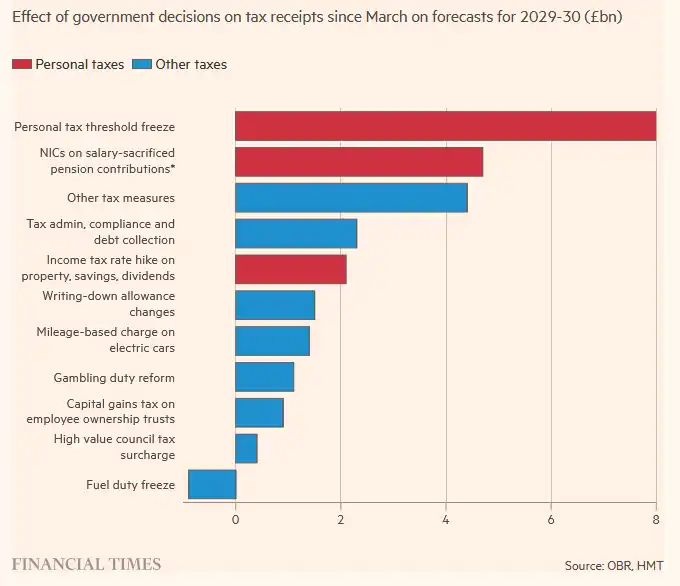
The most noteworthy aspect of the budget is the extension of the freeze on the personal income tax threshold. This seemingly inconspicuous technical maneuver will contribute £12.7 billion to the Treasury in the 2030-31 fiscal year. According to the Office for Budget Responsibility's forecast, by the end of the budget cycle, one-quarter of workers in the UK will be pushed into the 40% higher tax bracket. This means that even though Labour MPs applaud increases in landlord taxes and dividend taxes, the real sustained pressure is still on the most ordinary wage earners.
In addition, one tax-raising measure after another has been announced: the tax relief on pension salary sacrifice schemes has been limited, expected to contribute nearly £5 billion by 2029-30; starting in 2028, properties worth over £2 million will be subject to an annual "mansion tax"; the dividend tax will increase by two percentage points from 2026, with the basic and higher rates rising to 10.75% and 35.75%, respectively. All these seemingly "tax-the-rich" policies will ultimately filter down to the entire society in a more discreet way.
What the tax increases bring is an immediate expansion of welfare spending. According to the OBR's calculations, by 2029-30, annual welfare spending will exceed previous forecasts by £16 billion, including the additional costs brought by reversing the "two-child benefit cap." The profile of fiscal pressure is becoming increasingly clear: short-term political dividends lead to long-term fiscal black holes.
The backlash triggered by this budget is fiercer than in previous years, partly because the UK's fiscal deficit is no longer just "slightly expanding," but approaching crisis levels. Over the past 7 months, the UK government has borrowed £117 billion, almost equivalent to the scale of the bailout of the entire banking system during the 2008 financial crisis. In other words, the debt black hole created by the UK now, without a crisis, has reached crisis proportions.
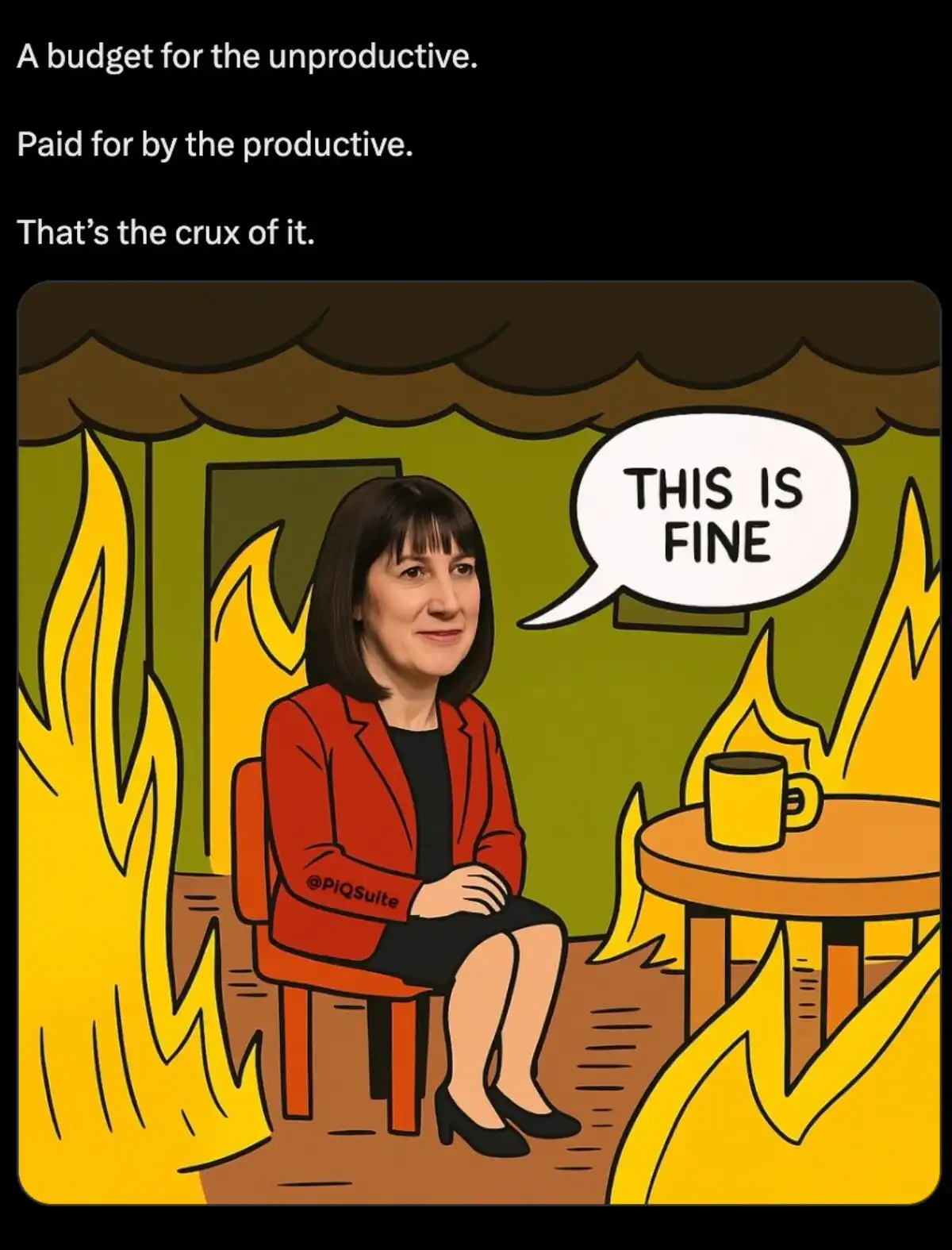
Even the usually moderate Financial Times has rarely used the term "brutal" to describe the government's lack of understanding of a fundamental issue: in a situation of long-term economic stagnation, relying on repeated tax rate hikes to fill the gap is destined to fail.
The market's judgment on the UK has become extremely pessimistic: the UK "is out of money," and the ruling party seems to have no viable growth path, only pointing towards higher taxes, lower productivity, and higher unemployment. After the fiscal deficit continues to widen, debt is highly likely to be "monetized by fact"—the final pressure will fall on the pound, becoming the market's "escape valve."
This is also why more and more analysis has recently spread from traditional finance to the crypto community. Some have directly provided a summary conclusion: when currency begins to passively devalue, when the working class and asset-less groups are slowly pushed toward the cliff, the only thing that will not be arbitrarily diluted is hard assets. This includes Bitcoin.
Christmas or Christmas Robbery?
Every year-end, the market habitually asks: is this year a "Christmas" or a "Christmas Robbery"?
As Thanksgiving is coming to an end, its "seasonal bullishness" on the US stock market has been talked about by the market for decades.
The difference this year is: the correlation between the crypto market and the US stock market has now reached 0.8, with the ups and downs on both sides almost in sync. On-chain accumulation signals are strengthening, and the low liquidity during the holidays tends to amplify any uptrend into a "vacuum rebound."
The crypto community is also emphasizing one thing repeatedly: the holidays are the window where short-term trend rallies are most likely to occur. Low trading volume means that lighter buying pressure can drive prices out of tight trading ranges, especially in the current scenario of cold sentiment and stable chips.
I can feel the market consensus quietly forming. If a minor rebound is initiated in US stocks after Black Friday, crypto will be the most dramatically responsive asset class; and Ethereum is seen by many institutions as "the equivalent of a small-cap stock high-beta species."
Furthermore, shifting focus from Thanksgiving to Christmas, the core of the discussion has changed from "will the market rise" to "will this wave of seasonal rebound continue into next year."
The so-called "Christmas rally" was first proposed in 1972 by Yale Hirsch, founder of the Stock Trader's Almanac. It has gradually become one of the many seasonal effects of the US stock market, referring to a typical uptrend in the last five trading days of December and the first two trading days of the following year.
The S&P index has closed higher in around 58 out of 73 years around Christmas, with a success rate of nearly 80%.
More importantly, if the Christmas rally occurs, it may be a precursor to a good performance in the stock market the following year. According to Yale Hirsch's analysis, if the Christmas rally, the first five trading days of the new year, and the January Barometer are all positive, then the US stock market in the new year is likely to perform well.
In other words, these days at the end of the year are the most indicative micro-windows of the year.
For Bitcoin, the fourth quarter itself is historically the easiest period for it to start a trend. Whether it's the early mining cycle or the later institutional allocation rhythm, Q4 has made it a natural "bull market season." This year, it is combined with new variables: US rate cut expectations, Asian liquidity improvement, enhanced regulatory clarity, and institutional holdings returning.
So the question has become a more practical one: If the US stock market enters a Christmas rally, will Bitcoin surge even higher? And if the US stock market doesn't rally, will Bitcoin make its own move?
All of this will determine whether those in the crypto industry are about to have a Merry Christmas or a Christmas heist.
You may also like

Token Cannot Compound, Where Is the Real Investment Opportunity?

February 6th Market Key Intelligence, How Much Did You Miss?

China's Central Bank and Eight Other Departments' Latest Regulatory Focus: Key Attention to RWA Tokenized Asset Risk
Foreword: Today, the People's Bank of China's website published the "Notice of the People's Bank of China, National Development and Reform Commission, Ministry of Industry and Information Technology, Ministry of Public Security, State Administration for Market Regulation, China Banking and Insurance Regulatory Commission, China Securities Regulatory Commission, State Administration of Foreign Exchange on Further Preventing and Dealing with Risks Related to Virtual Currency and Others (Yinfa [2026] No. 42)", the latest regulatory requirements from the eight departments including the central bank, which are basically consistent with the regulatory requirements of recent years. The main focus of the regulation is on speculative activities such as virtual currency trading, exchanges, ICOs, overseas platform services, and this time, regulatory oversight of RWA has been added, explicitly prohibiting RWA tokenization, stablecoins (especially those pegged to the RMB). The following is the full text:
To the people's governments of all provinces, autonomous regions, and municipalities directly under the Central Government, the Xinjiang Production and Construction Corps:
Recently, there have been speculative activities related to virtual currency and Real-World Assets (RWA) tokenization, disrupting the economic and financial order and jeopardizing the property security of the people. In order to further prevent and address the risks related to virtual currency and Real-World Assets tokenization, effectively safeguard national security and social stability, in accordance with the "Law of the People's Republic of China on the People's Bank of China," "Law of the People's Republic of China on Commercial Banks," "Securities Law of the People's Republic of China," "Law of the People's Republic of China on Securities Investment Funds," "Law of the People's Republic of China on Futures and Derivatives," "Cybersecurity Law of the People's Republic of China," "Regulations of the People's Republic of China on the Administration of Renminbi," "Regulations on Prevention and Disposal of Illegal Fundraising," "Regulations of the People's Republic of China on Foreign Exchange Administration," "Telecommunications Regulations of the People's Republic of China," and other provisions, after reaching consensus with the Cyberspace Administration of China, the Supreme People's Court, and the Supreme People's Procuratorate, and with the approval of the State Council, the relevant matters are notified as follows:
(I) Virtual currency does not possess the legal status equivalent to fiat currency. Virtual currencies such as Bitcoin, Ether, Tether, etc., have the main characteristics of being issued by non-monetary authorities, using encryption technology and distributed ledger or similar technology, existing in digital form, etc. They do not have legal tender status, should not and cannot be circulated and used as currency in the market.
The business activities related to virtual currency are classified as illegal financial activities. The exchange of fiat currency and virtual currency within the territory, exchange of virtual currencies, acting as a central counterparty in buying and selling virtual currencies, providing information intermediary and pricing services for virtual currency transactions, token issuance financing, and trading of virtual currency-related financial products, etc., fall under illegal financial activities, such as suspected illegal issuance of token vouchers, unauthorized public issuance of securities, illegal operation of securities and futures business, illegal fundraising, etc., are strictly prohibited across the board and resolutely banned in accordance with the law. Overseas entities and individuals are not allowed to provide virtual currency-related services to domestic entities in any form.
A stablecoin pegged to a fiat currency indirectly fulfills some functions of the fiat currency in circulation. Without the consent of relevant authorities in accordance with the law and regulations, any domestic or foreign entity or individual is not allowed to issue a RMB-pegged stablecoin overseas.
(II)Tokenization of Real-World Assets refers to the use of encryption technology and distributed ledger or similar technologies to transform ownership rights, income rights, etc., of assets into tokens (tokens) or other interests or bond certificates with token (token) characteristics, and carry out issuance and trading activities.
Engaging in the tokenization of real-world assets domestically, as well as providing related intermediary, information technology services, etc., which are suspected of illegal issuance of token vouchers, unauthorized public offering of securities, illegal operation of securities and futures business, illegal fundraising, and other illegal financial activities, shall be prohibited; except for relevant business activities carried out with the approval of the competent authorities in accordance with the law and regulations and relying on specific financial infrastructures. Overseas entities and individuals are not allowed to illegally provide services related to the tokenization of real-world assets to domestic entities in any form.
(III) Inter-agency Coordination. The People's Bank of China, together with the National Development and Reform Commission, the Ministry of Industry and Information Technology, the Ministry of Public Security, the State Administration for Market Regulation, the China Banking and Insurance Regulatory Commission, the China Securities Regulatory Commission, the State Administration of Foreign Exchange, and other departments, will improve the work mechanism, strengthen coordination with the Cyberspace Administration of China, the Supreme People's Court, and the Supreme People's Procuratorate, coordinate efforts, and overall guide regions to carry out risk prevention and disposal of virtual currency-related illegal financial activities.
The China Securities Regulatory Commission, together with the National Development and Reform Commission, the Ministry of Industry and Information Technology, the Ministry of Public Security, the People's Bank of China, the State Administration for Market Regulation, the China Banking and Insurance Regulatory Commission, the State Administration of Foreign Exchange, and other departments, will improve the work mechanism, strengthen coordination with the Cyberspace Administration of China, the Supreme People's Court, and the Supreme People's Procuratorate, coordinate efforts, and overall guide regions to carry out risk prevention and disposal of illegal financial activities related to the tokenization of real-world assets.
(IV) Strengthening Local Implementation. The people's governments at the provincial level are overall responsible for the prevention and disposal of risks related to virtual currencies and the tokenization of real-world assets in their respective administrative regions. The specific leading department is the local financial regulatory department, with participation from branches and dispatched institutions of the State Council's financial regulatory department, telecommunications regulators, public security, market supervision, and other departments, in coordination with cyberspace departments, courts, and procuratorates, to improve the normalization of the work mechanism, effectively connect with the relevant work mechanisms of central departments, form a cooperative and coordinated working pattern between central and local governments, effectively prevent and properly handle risks related to virtual currencies and the tokenization of real-world assets, and maintain economic and financial order and social stability.
(5) Enhanced Risk Monitoring. The People's Bank of China, China Securities Regulatory Commission, National Development and Reform Commission, Ministry of Industry and Information Technology, Ministry of Public Security, State Administration of Foreign Exchange, Cyberspace Administration of China, and other departments continue to improve monitoring techniques and system support, enhance cross-departmental data analysis and sharing, establish sound information sharing and cross-validation mechanisms, promptly grasp the risk situation of activities related to virtual currency and real-world asset tokenization. Local governments at all levels give full play to the role of local monitoring and early warning mechanisms. Local financial regulatory authorities, together with branches and agencies of the State Council's financial regulatory authorities, as well as departments of cyberspace and public security, ensure effective connection between online monitoring, offline investigation, and fund tracking, efficiently and accurately identify activities related to virtual currency and real-world asset tokenization, promptly share risk information, improve early warning information dissemination, verification, and rapid response mechanisms.
(6) Strengthened Oversight of Financial Institutions, Intermediaries, and Technology Service Providers. Financial institutions (including non-bank payment institutions) are prohibited from providing account opening, fund transfer, and clearing services for virtual currency-related business activities, issuing and selling financial products related to virtual currency, including virtual currency and related financial products in the scope of collateral, conducting insurance business related to virtual currency, or including virtual currency in the scope of insurance liability. Financial institutions (including non-bank payment institutions) are prohibited from providing custody, clearing, and settlement services for unauthorized real-world asset tokenization-related business and related financial products. Relevant intermediary institutions and information technology service providers are prohibited from providing intermediary, technical, or other services for unauthorized real-world asset tokenization-related businesses and related financial products.
(7) Enhanced Management of Internet Information Content and Access. Internet enterprises are prohibited from providing online business venues, commercial displays, marketing, advertising, or paid traffic diversion services for virtual currency and real-world asset tokenization-related business activities. Upon discovering clues of illegal activities, they should promptly report to relevant departments and provide technical support and assistance for related investigations and inquiries. Based on the clues transferred by the financial regulatory authorities, the cyberspace administration, telecommunications authorities, and public security departments should promptly close and deal with websites, mobile applications (including mini-programs), and public accounts engaged in virtual currency and real-world asset tokenization-related business activities in accordance with the law.
(8) Strengthened Entity Registration and Advertisement Management. Market supervision departments strengthen entity registration and management, and enterprise and individual business registrations must not contain terms such as "virtual currency," "virtual asset," "cryptocurrency," "crypto asset," "stablecoin," "real-world asset tokenization," or "RWA" in their names or business scopes. Market supervision departments, together with financial regulatory authorities, legally enhance the supervision of advertisements related to virtual currency and real-world asset tokenization, promptly investigating and handling relevant illegal advertisements.
(IX) Continued Rectification of Virtual Currency Mining Activities. The National Development and Reform Commission, together with relevant departments, strictly controls virtual currency mining activities, continuously promotes the rectification of virtual currency mining activities. The people's governments of various provinces take overall responsibility for the rectification of "mining" within their respective administrative regions. In accordance with the requirements of the National Development and Reform Commission and other departments in the "Notice on the Rectification of Virtual Currency Mining Activities" (NDRC Energy-saving Building [2021] No. 1283) and the provisions of the "Guidance Catalog for Industrial Structure Adjustment (2024 Edition)," a comprehensive review, investigation, and closure of existing virtual currency mining projects are conducted, new mining projects are strictly prohibited, and mining machine production enterprises are strictly prohibited from providing mining machine sales and other services within the country.
(X) Severe Crackdown on Related Illegal Financial Activities. Upon discovering clues to illegal financial activities related to virtual currency and the tokenization of real-world assets, local financial regulatory authorities, branches of the State Council's financial regulatory authorities, and other relevant departments promptly investigate, determine, and properly handle the issues in accordance with the law, and seriously hold the relevant entities and individuals legally responsible. Those suspected of crimes are transferred to the judicial authorities for processing according to the law.
(XI) Severe Crackdown on Related Illegal and Criminal Activities. The Ministry of Public Security, the People's Bank of China, the State Administration for Market Regulation, the China Banking and Insurance Regulatory Commission, the China Securities Regulatory Commission, as well as judicial and procuratorial organs, in accordance with their respective responsibilities, rigorously crack down on illegal and criminal activities related to virtual currency, the tokenization of real-world assets, such as fraud, money laundering, illegal business operations, pyramid schemes, illegal fundraising, and other illegal and criminal activities carried out under the guise of virtual currency, the tokenization of real-world assets, etc.
(XII) Strengthen Industry Self-discipline. Relevant industry associations should enhance membership management and policy advocacy, based on their own responsibilities, advocate and urge member units to resist illegal financial activities related to virtual currency and the tokenization of real-world assets. Member units that violate regulatory policies and industry self-discipline rules are to be disciplined in accordance with relevant self-regulatory management regulations. By leveraging various industry infrastructure, conduct risk monitoring related to virtual currency, the tokenization of real-world assets, and promptly transfer issue clues to relevant departments.
(XIII) Without the approval of relevant departments in accordance with the law and regulations, domestic entities and foreign entities controlled by them may not issue virtual currency overseas.
(XIV) Domestic entities engaging directly or indirectly in overseas external debt-based tokenization of real-world assets, or conducting asset securitization activities abroad based on domestic ownership rights, income rights, etc. (hereinafter referred to as domestic equity), should be strictly regulated in accordance with the principles of "same business, same risk, same rules." The National Development and Reform Commission, the China Securities Regulatory Commission, the State Administration of Foreign Exchange, and other relevant departments regulate it according to their respective responsibilities. For other forms of overseas real-world asset tokenization activities based on domestic equity by domestic entities, the China Securities Regulatory Commission, together with relevant departments, supervise according to their division of responsibilities. Without the consent and filing of relevant departments, no unit or individual may engage in the above-mentioned business.
(15) Overseas subsidiaries and branches of domestic financial institutions providing Real World Asset Tokenization-related services overseas shall do so legally and prudently. They shall have professional personnel and systems in place to effectively mitigate business risks, strictly implement customer onboarding, suitability management, anti-money laundering requirements, and incorporate them into the domestic financial institutions' compliance and risk management system. Intermediaries and information technology service providers offering Real World Asset Tokenization services abroad based on domestic equity or conducting Real World Asset Tokenization business in the form of overseas debt for domestic entities directly or indirectly venturing abroad must strictly comply with relevant laws and regulations. They should establish and improve relevant compliance and internal control systems in accordance with relevant normative requirements, strengthen business and risk control, and report the business developments to the relevant regulatory authorities for approval or filing.
(16) Strengthen organizational leadership and overall coordination. All departments and regions should attach great importance to the prevention of risks related to virtual currencies and Real World Asset Tokenization, strengthen organizational leadership, clarify work responsibilities, form a long-term effective working mechanism with centralized coordination, local implementation, and shared responsibilities, maintain high pressure, dynamically monitor risks, effectively prevent and mitigate risks in an orderly and efficient manner, legally protect the property security of the people, and make every effort to maintain economic and financial order and social stability.
(17) Widely carry out publicity and education. All departments, regions, and industry associations should make full use of various media and other communication channels to disseminate information through legal and policy interpretation, analysis of typical cases, and education on investment risks, etc. They should promote the illegality and harm of virtual currencies and Real World Asset Tokenization-related businesses and their manifestations, fully alert to potential risks and hidden dangers, and enhance public awareness and identification capabilities for risk prevention.
(18) Engaging in illegal financial activities related to virtual currencies and Real World Asset Tokenization in violation of this notice, as well as providing services for virtual currencies and Real World Asset Tokenization-related businesses, shall be punished in accordance with relevant regulations. If it constitutes a crime, criminal liability shall be pursued according to the law. For domestic entities and individuals who knowingly or should have known that overseas entities illegally provided virtual currency or Real World Asset Tokenization-related services to domestic entities and still assisted them, relevant responsibilities shall be pursued according to the law. If it constitutes a crime, criminal liability shall be pursued according to the law.
(19) If any unit or individual invests in virtual currencies, Real World Asset Tokens, and related financial products against public order and good customs, the relevant civil legal actions shall be invalid, and any resulting losses shall be borne by them. If there are suspicions of disrupting financial order and jeopardizing financial security, the relevant departments shall deal with them according to the law.
This notice shall enter into force upon the date of its issuance. The People's Bank of China and ten other departments' "Notice on Further Preventing and Dealing with the Risks of Virtual Currency Trading Speculation" (Yinfa [2021] No. 237) is hereby repealed.

Former Partner's Perspective on Multicoin: Kyle's Exit, But the Game He Left Behind Just Getting Started
Why Bitcoin Is Falling Now: The Real Reasons Behind BTC's Crash & WEEX's Smart Profit Playbook
Bitcoin's ongoing crash explained: Discover the 5 hidden triggers behind BTC's plunge & how WEEX's Auto Earn and Trade to Earn strategies help traders profit from crypto market volatility.

Wall Street's Hottest Trades See Exodus

Vitalik Discusses Ethereum Scaling Path, Circle Announces Partnership with Polymarket, What's the Overseas Crypto Community Talking About Today?

Believing in the Capital Markets - The Essence and Core Value of Cryptocurrency

Polymarket's 'Weatherman': Predict Temperature, Win Million-Dollar Payout

$15K+ Profits: The 4 AI Trading Secrets WEEX Hackathon Prelim Winners Used to Dominate Volatile Crypto Markets
How WEEX Hackathon's top AI trading strategies made $15K+ in crypto markets: 4 proven rules for ETH/BTC trading, market structure analysis, and risk management in volatile conditions.

A nearly 20% one-day plunge, how long has it been since you last saw a $60,000 Bitcoin?

Raoul Pal: I've seen every single panic, and they are never the end.

Key Market Information Discrepancy on February 6th - A Must-Read! | Alpha Morning Report

2026 Crypto Industry's First Snowfall
The Harsh Reality Behind the $26 Billion Crypto Liquidation: Liquidity Is Killing the Market
Why Is Gold, US Stocks, Bitcoin All Falling?

Key Market Intelligence for February 5th, how much did you miss out on?

Wintermute: By 2026, crypto had gradually become the settlement layer of the Internet economy
Token Cannot Compound, Where Is the Real Investment Opportunity?
February 6th Market Key Intelligence, How Much Did You Miss?
China's Central Bank and Eight Other Departments' Latest Regulatory Focus: Key Attention to RWA Tokenized Asset Risk
Foreword: Today, the People's Bank of China's website published the "Notice of the People's Bank of China, National Development and Reform Commission, Ministry of Industry and Information Technology, Ministry of Public Security, State Administration for Market Regulation, China Banking and Insurance Regulatory Commission, China Securities Regulatory Commission, State Administration of Foreign Exchange on Further Preventing and Dealing with Risks Related to Virtual Currency and Others (Yinfa [2026] No. 42)", the latest regulatory requirements from the eight departments including the central bank, which are basically consistent with the regulatory requirements of recent years. The main focus of the regulation is on speculative activities such as virtual currency trading, exchanges, ICOs, overseas platform services, and this time, regulatory oversight of RWA has been added, explicitly prohibiting RWA tokenization, stablecoins (especially those pegged to the RMB). The following is the full text:
To the people's governments of all provinces, autonomous regions, and municipalities directly under the Central Government, the Xinjiang Production and Construction Corps:
Recently, there have been speculative activities related to virtual currency and Real-World Assets (RWA) tokenization, disrupting the economic and financial order and jeopardizing the property security of the people. In order to further prevent and address the risks related to virtual currency and Real-World Assets tokenization, effectively safeguard national security and social stability, in accordance with the "Law of the People's Republic of China on the People's Bank of China," "Law of the People's Republic of China on Commercial Banks," "Securities Law of the People's Republic of China," "Law of the People's Republic of China on Securities Investment Funds," "Law of the People's Republic of China on Futures and Derivatives," "Cybersecurity Law of the People's Republic of China," "Regulations of the People's Republic of China on the Administration of Renminbi," "Regulations on Prevention and Disposal of Illegal Fundraising," "Regulations of the People's Republic of China on Foreign Exchange Administration," "Telecommunications Regulations of the People's Republic of China," and other provisions, after reaching consensus with the Cyberspace Administration of China, the Supreme People's Court, and the Supreme People's Procuratorate, and with the approval of the State Council, the relevant matters are notified as follows:
(I) Virtual currency does not possess the legal status equivalent to fiat currency. Virtual currencies such as Bitcoin, Ether, Tether, etc., have the main characteristics of being issued by non-monetary authorities, using encryption technology and distributed ledger or similar technology, existing in digital form, etc. They do not have legal tender status, should not and cannot be circulated and used as currency in the market.
The business activities related to virtual currency are classified as illegal financial activities. The exchange of fiat currency and virtual currency within the territory, exchange of virtual currencies, acting as a central counterparty in buying and selling virtual currencies, providing information intermediary and pricing services for virtual currency transactions, token issuance financing, and trading of virtual currency-related financial products, etc., fall under illegal financial activities, such as suspected illegal issuance of token vouchers, unauthorized public issuance of securities, illegal operation of securities and futures business, illegal fundraising, etc., are strictly prohibited across the board and resolutely banned in accordance with the law. Overseas entities and individuals are not allowed to provide virtual currency-related services to domestic entities in any form.
A stablecoin pegged to a fiat currency indirectly fulfills some functions of the fiat currency in circulation. Without the consent of relevant authorities in accordance with the law and regulations, any domestic or foreign entity or individual is not allowed to issue a RMB-pegged stablecoin overseas.
(II)Tokenization of Real-World Assets refers to the use of encryption technology and distributed ledger or similar technologies to transform ownership rights, income rights, etc., of assets into tokens (tokens) or other interests or bond certificates with token (token) characteristics, and carry out issuance and trading activities.
Engaging in the tokenization of real-world assets domestically, as well as providing related intermediary, information technology services, etc., which are suspected of illegal issuance of token vouchers, unauthorized public offering of securities, illegal operation of securities and futures business, illegal fundraising, and other illegal financial activities, shall be prohibited; except for relevant business activities carried out with the approval of the competent authorities in accordance with the law and regulations and relying on specific financial infrastructures. Overseas entities and individuals are not allowed to illegally provide services related to the tokenization of real-world assets to domestic entities in any form.
(III) Inter-agency Coordination. The People's Bank of China, together with the National Development and Reform Commission, the Ministry of Industry and Information Technology, the Ministry of Public Security, the State Administration for Market Regulation, the China Banking and Insurance Regulatory Commission, the China Securities Regulatory Commission, the State Administration of Foreign Exchange, and other departments, will improve the work mechanism, strengthen coordination with the Cyberspace Administration of China, the Supreme People's Court, and the Supreme People's Procuratorate, coordinate efforts, and overall guide regions to carry out risk prevention and disposal of virtual currency-related illegal financial activities.
The China Securities Regulatory Commission, together with the National Development and Reform Commission, the Ministry of Industry and Information Technology, the Ministry of Public Security, the People's Bank of China, the State Administration for Market Regulation, the China Banking and Insurance Regulatory Commission, the State Administration of Foreign Exchange, and other departments, will improve the work mechanism, strengthen coordination with the Cyberspace Administration of China, the Supreme People's Court, and the Supreme People's Procuratorate, coordinate efforts, and overall guide regions to carry out risk prevention and disposal of illegal financial activities related to the tokenization of real-world assets.
(IV) Strengthening Local Implementation. The people's governments at the provincial level are overall responsible for the prevention and disposal of risks related to virtual currencies and the tokenization of real-world assets in their respective administrative regions. The specific leading department is the local financial regulatory department, with participation from branches and dispatched institutions of the State Council's financial regulatory department, telecommunications regulators, public security, market supervision, and other departments, in coordination with cyberspace departments, courts, and procuratorates, to improve the normalization of the work mechanism, effectively connect with the relevant work mechanisms of central departments, form a cooperative and coordinated working pattern between central and local governments, effectively prevent and properly handle risks related to virtual currencies and the tokenization of real-world assets, and maintain economic and financial order and social stability.
(5) Enhanced Risk Monitoring. The People's Bank of China, China Securities Regulatory Commission, National Development and Reform Commission, Ministry of Industry and Information Technology, Ministry of Public Security, State Administration of Foreign Exchange, Cyberspace Administration of China, and other departments continue to improve monitoring techniques and system support, enhance cross-departmental data analysis and sharing, establish sound information sharing and cross-validation mechanisms, promptly grasp the risk situation of activities related to virtual currency and real-world asset tokenization. Local governments at all levels give full play to the role of local monitoring and early warning mechanisms. Local financial regulatory authorities, together with branches and agencies of the State Council's financial regulatory authorities, as well as departments of cyberspace and public security, ensure effective connection between online monitoring, offline investigation, and fund tracking, efficiently and accurately identify activities related to virtual currency and real-world asset tokenization, promptly share risk information, improve early warning information dissemination, verification, and rapid response mechanisms.
(6) Strengthened Oversight of Financial Institutions, Intermediaries, and Technology Service Providers. Financial institutions (including non-bank payment institutions) are prohibited from providing account opening, fund transfer, and clearing services for virtual currency-related business activities, issuing and selling financial products related to virtual currency, including virtual currency and related financial products in the scope of collateral, conducting insurance business related to virtual currency, or including virtual currency in the scope of insurance liability. Financial institutions (including non-bank payment institutions) are prohibited from providing custody, clearing, and settlement services for unauthorized real-world asset tokenization-related business and related financial products. Relevant intermediary institutions and information technology service providers are prohibited from providing intermediary, technical, or other services for unauthorized real-world asset tokenization-related businesses and related financial products.
(7) Enhanced Management of Internet Information Content and Access. Internet enterprises are prohibited from providing online business venues, commercial displays, marketing, advertising, or paid traffic diversion services for virtual currency and real-world asset tokenization-related business activities. Upon discovering clues of illegal activities, they should promptly report to relevant departments and provide technical support and assistance for related investigations and inquiries. Based on the clues transferred by the financial regulatory authorities, the cyberspace administration, telecommunications authorities, and public security departments should promptly close and deal with websites, mobile applications (including mini-programs), and public accounts engaged in virtual currency and real-world asset tokenization-related business activities in accordance with the law.
(8) Strengthened Entity Registration and Advertisement Management. Market supervision departments strengthen entity registration and management, and enterprise and individual business registrations must not contain terms such as "virtual currency," "virtual asset," "cryptocurrency," "crypto asset," "stablecoin," "real-world asset tokenization," or "RWA" in their names or business scopes. Market supervision departments, together with financial regulatory authorities, legally enhance the supervision of advertisements related to virtual currency and real-world asset tokenization, promptly investigating and handling relevant illegal advertisements.
(IX) Continued Rectification of Virtual Currency Mining Activities. The National Development and Reform Commission, together with relevant departments, strictly controls virtual currency mining activities, continuously promotes the rectification of virtual currency mining activities. The people's governments of various provinces take overall responsibility for the rectification of "mining" within their respective administrative regions. In accordance with the requirements of the National Development and Reform Commission and other departments in the "Notice on the Rectification of Virtual Currency Mining Activities" (NDRC Energy-saving Building [2021] No. 1283) and the provisions of the "Guidance Catalog for Industrial Structure Adjustment (2024 Edition)," a comprehensive review, investigation, and closure of existing virtual currency mining projects are conducted, new mining projects are strictly prohibited, and mining machine production enterprises are strictly prohibited from providing mining machine sales and other services within the country.
(X) Severe Crackdown on Related Illegal Financial Activities. Upon discovering clues to illegal financial activities related to virtual currency and the tokenization of real-world assets, local financial regulatory authorities, branches of the State Council's financial regulatory authorities, and other relevant departments promptly investigate, determine, and properly handle the issues in accordance with the law, and seriously hold the relevant entities and individuals legally responsible. Those suspected of crimes are transferred to the judicial authorities for processing according to the law.
(XI) Severe Crackdown on Related Illegal and Criminal Activities. The Ministry of Public Security, the People's Bank of China, the State Administration for Market Regulation, the China Banking and Insurance Regulatory Commission, the China Securities Regulatory Commission, as well as judicial and procuratorial organs, in accordance with their respective responsibilities, rigorously crack down on illegal and criminal activities related to virtual currency, the tokenization of real-world assets, such as fraud, money laundering, illegal business operations, pyramid schemes, illegal fundraising, and other illegal and criminal activities carried out under the guise of virtual currency, the tokenization of real-world assets, etc.
(XII) Strengthen Industry Self-discipline. Relevant industry associations should enhance membership management and policy advocacy, based on their own responsibilities, advocate and urge member units to resist illegal financial activities related to virtual currency and the tokenization of real-world assets. Member units that violate regulatory policies and industry self-discipline rules are to be disciplined in accordance with relevant self-regulatory management regulations. By leveraging various industry infrastructure, conduct risk monitoring related to virtual currency, the tokenization of real-world assets, and promptly transfer issue clues to relevant departments.
(XIII) Without the approval of relevant departments in accordance with the law and regulations, domestic entities and foreign entities controlled by them may not issue virtual currency overseas.
(XIV) Domestic entities engaging directly or indirectly in overseas external debt-based tokenization of real-world assets, or conducting asset securitization activities abroad based on domestic ownership rights, income rights, etc. (hereinafter referred to as domestic equity), should be strictly regulated in accordance with the principles of "same business, same risk, same rules." The National Development and Reform Commission, the China Securities Regulatory Commission, the State Administration of Foreign Exchange, and other relevant departments regulate it according to their respective responsibilities. For other forms of overseas real-world asset tokenization activities based on domestic equity by domestic entities, the China Securities Regulatory Commission, together with relevant departments, supervise according to their division of responsibilities. Without the consent and filing of relevant departments, no unit or individual may engage in the above-mentioned business.
(15) Overseas subsidiaries and branches of domestic financial institutions providing Real World Asset Tokenization-related services overseas shall do so legally and prudently. They shall have professional personnel and systems in place to effectively mitigate business risks, strictly implement customer onboarding, suitability management, anti-money laundering requirements, and incorporate them into the domestic financial institutions' compliance and risk management system. Intermediaries and information technology service providers offering Real World Asset Tokenization services abroad based on domestic equity or conducting Real World Asset Tokenization business in the form of overseas debt for domestic entities directly or indirectly venturing abroad must strictly comply with relevant laws and regulations. They should establish and improve relevant compliance and internal control systems in accordance with relevant normative requirements, strengthen business and risk control, and report the business developments to the relevant regulatory authorities for approval or filing.
(16) Strengthen organizational leadership and overall coordination. All departments and regions should attach great importance to the prevention of risks related to virtual currencies and Real World Asset Tokenization, strengthen organizational leadership, clarify work responsibilities, form a long-term effective working mechanism with centralized coordination, local implementation, and shared responsibilities, maintain high pressure, dynamically monitor risks, effectively prevent and mitigate risks in an orderly and efficient manner, legally protect the property security of the people, and make every effort to maintain economic and financial order and social stability.
(17) Widely carry out publicity and education. All departments, regions, and industry associations should make full use of various media and other communication channels to disseminate information through legal and policy interpretation, analysis of typical cases, and education on investment risks, etc. They should promote the illegality and harm of virtual currencies and Real World Asset Tokenization-related businesses and their manifestations, fully alert to potential risks and hidden dangers, and enhance public awareness and identification capabilities for risk prevention.
(18) Engaging in illegal financial activities related to virtual currencies and Real World Asset Tokenization in violation of this notice, as well as providing services for virtual currencies and Real World Asset Tokenization-related businesses, shall be punished in accordance with relevant regulations. If it constitutes a crime, criminal liability shall be pursued according to the law. For domestic entities and individuals who knowingly or should have known that overseas entities illegally provided virtual currency or Real World Asset Tokenization-related services to domestic entities and still assisted them, relevant responsibilities shall be pursued according to the law. If it constitutes a crime, criminal liability shall be pursued according to the law.
(19) If any unit or individual invests in virtual currencies, Real World Asset Tokens, and related financial products against public order and good customs, the relevant civil legal actions shall be invalid, and any resulting losses shall be borne by them. If there are suspicions of disrupting financial order and jeopardizing financial security, the relevant departments shall deal with them according to the law.
This notice shall enter into force upon the date of its issuance. The People's Bank of China and ten other departments' "Notice on Further Preventing and Dealing with the Risks of Virtual Currency Trading Speculation" (Yinfa [2021] No. 237) is hereby repealed.
Former Partner's Perspective on Multicoin: Kyle's Exit, But the Game He Left Behind Just Getting Started
Why Bitcoin Is Falling Now: The Real Reasons Behind BTC's Crash & WEEX's Smart Profit Playbook
Bitcoin's ongoing crash explained: Discover the 5 hidden triggers behind BTC's plunge & how WEEX's Auto Earn and Trade to Earn strategies help traders profit from crypto market volatility.


 App
App