
- Buy Crypto
- Markets
- Futures
- Spot
- Copy Trade
 Earn
Earn- More
Being Long 50x Results in $2M Profit: How Did the Hyperliquid 'Insider' Pull It Off?

What started as an uneventful afternoon with CPI data quickly escalated when the highly anticipated HyperLiquid whale "Insider" once again single-handedly disrupted almost half of the Ethereum smart contract market, capturing the attention of the entire network.
According to official data, due to the long and liquidation operations of the address starting with 0xf3 (hereinafter referred to as the Insider), the HyperLiquid treasury of HLP (Hyperliquidity Provider) suffered a short-term loss of over $4 million.
Related Reading: "Retrospect of HyperLiquid Contract Whale Insider's Market Manipulation, Precise Long and Short Opening and Closing"
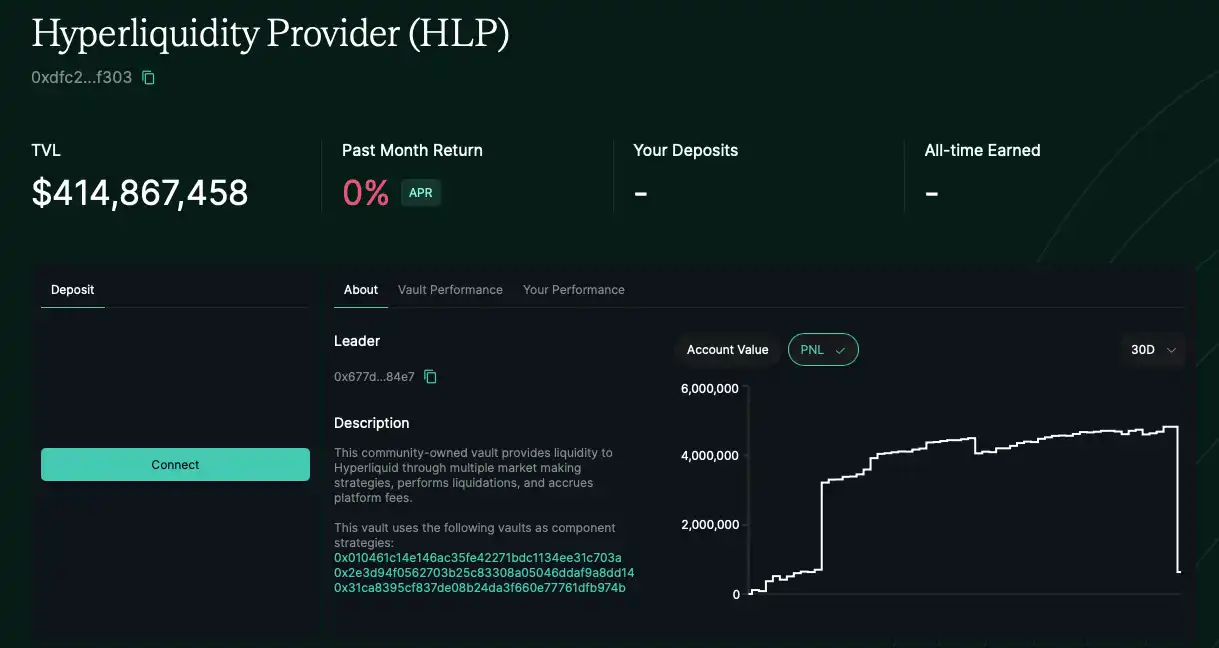
So how did this address, once seen by the community as having ultimate insider information, operate, and how did this whale drain liquidity from HyperLiquid? BlockBeats has combined whale operation interpretation and community analysis to outline the specific transaction path and arbitrage strategy.
One Person Drains $4 Million from HyperLiquid, What Did the Insider Do?
On the afternoon of March 12, the Insider (address: 0xf3f496c9486be5924a93d67e98298733bb47057c) deposited $5.22 million into HyperLiquid and opened long positions for ETH and BTC at 50x leverage at prices of $1,884.4 (liquidation price $1,838.2) and $82,003.9 (liquidation price $61,182), respectively. In the previous two days, this Insider executed two ETH ultra-short-term long operations with a 100% win rate, netting $2.2 million.
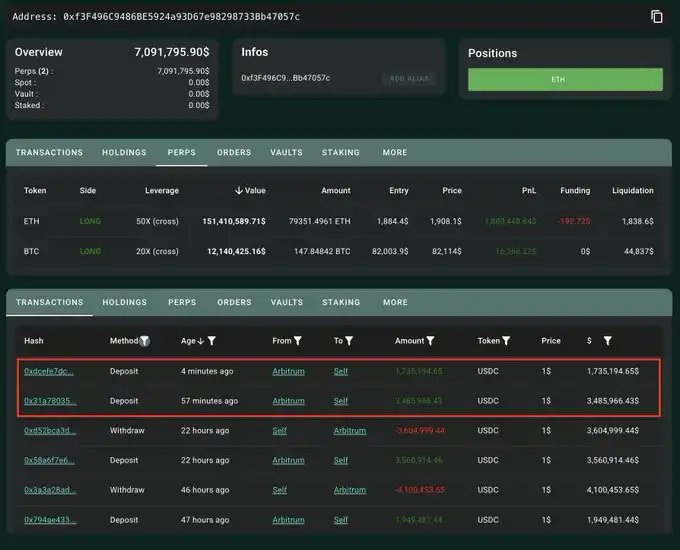
Subsequently, the Insider increased their ETH long position to 72,924.87 coins, worth approximately $138 million, reaching their personal record for the highest single-coin holding. A series of aggressive opening operations brought their unrealized gains to $993,000, but only $29 away from the liquidation price.
Next, the Insider converted all their BTC positions to ETH longs and further bridged $10 million to HyperLiquid as collateral, placing a long order for 5,508.08 ETH at a price of $1,921. At this point, they transferred a total of 15.23 million USDC to HyperLiquid as collateral, increased their ETH long position to 140,000 coins, valued at $270 million, accounting for 24.65% of HyperLiquid's ETH contract total position ($1.1 billion), with an unrealized gain of $3.1 million.

Up to this point, the "Insider" has been operating normally, with a liquidation price of $1,877, below the market price. However, he soon began a jaw-dropping maneuver that shocked everyone.
According to Hyperscan data, the Insider made three consecutive actions at 17:08: liquidation, liquidation, then being liquidated, and subsequently withdrew around $8 million USDC. The price of ETH also plummeted due to this whale trader's liquidation, dropping from around $1,970 to near $1,910 within just 5 minutes.
However, what caught the community's attention was not the massive fluctuation in ETH's price. Even in a highly leveraged situation, the Insider's liquidation price was around $1,877, still a distance from the market price of $1,970.
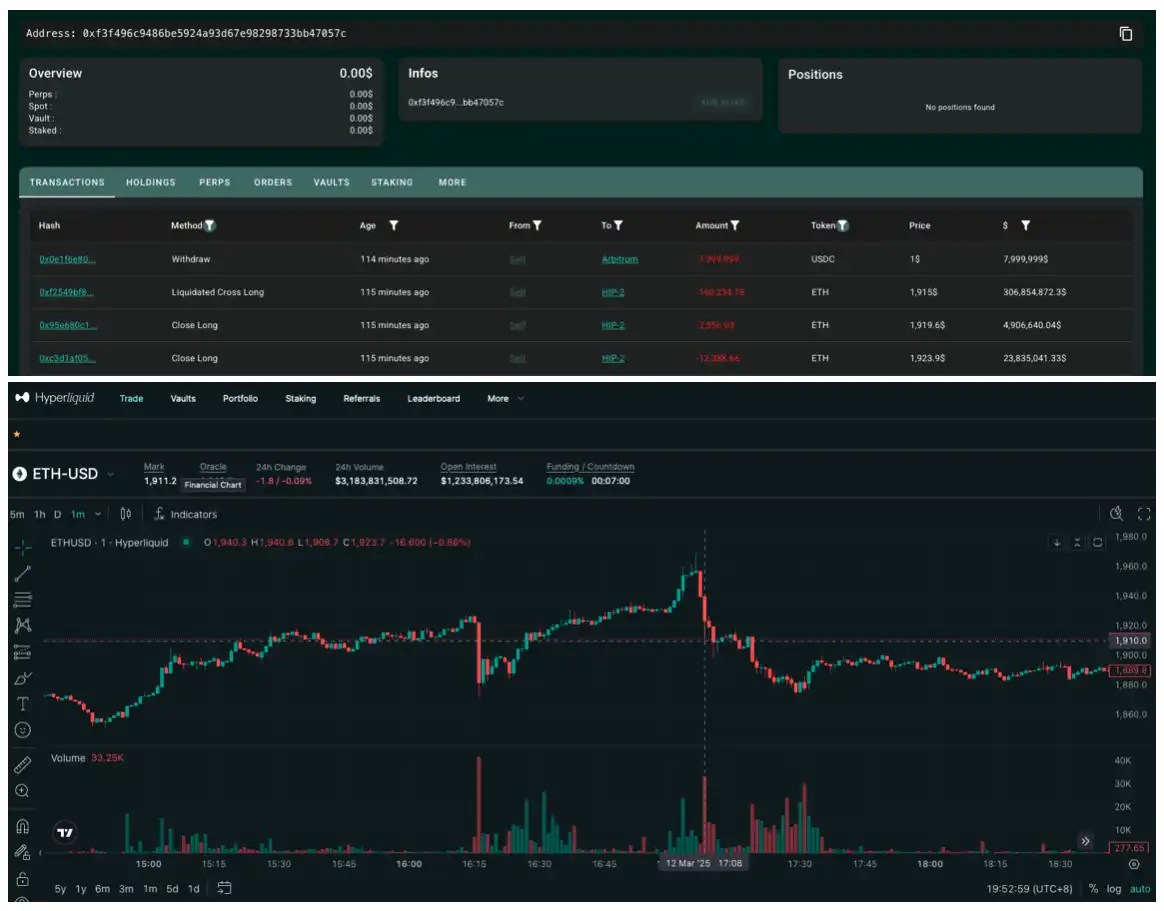
Why did this happen? Upon closer inspection of Hyperscan data, we discovered that the Insider had staged a retro-style "Asset Walkthrough" on-chain.
According to Hyper's blockchain records, while the Insider's long positions were not closed, he made three withdrawal attempts at 17:05. The first attempt failed, showing "Withdrawal amount exceeds single transaction limit" on the front end. The Insider then split the total amount of over $17 million USDC into two transactions of $8 million and $9 million to withdraw the funds.
This exceeded the approximately $15 million collateral provided by him for this operation by nearly $2 million. In other words, with all remaining positions liquidated, the Insider had securely locked in profits of nearly $2 million.
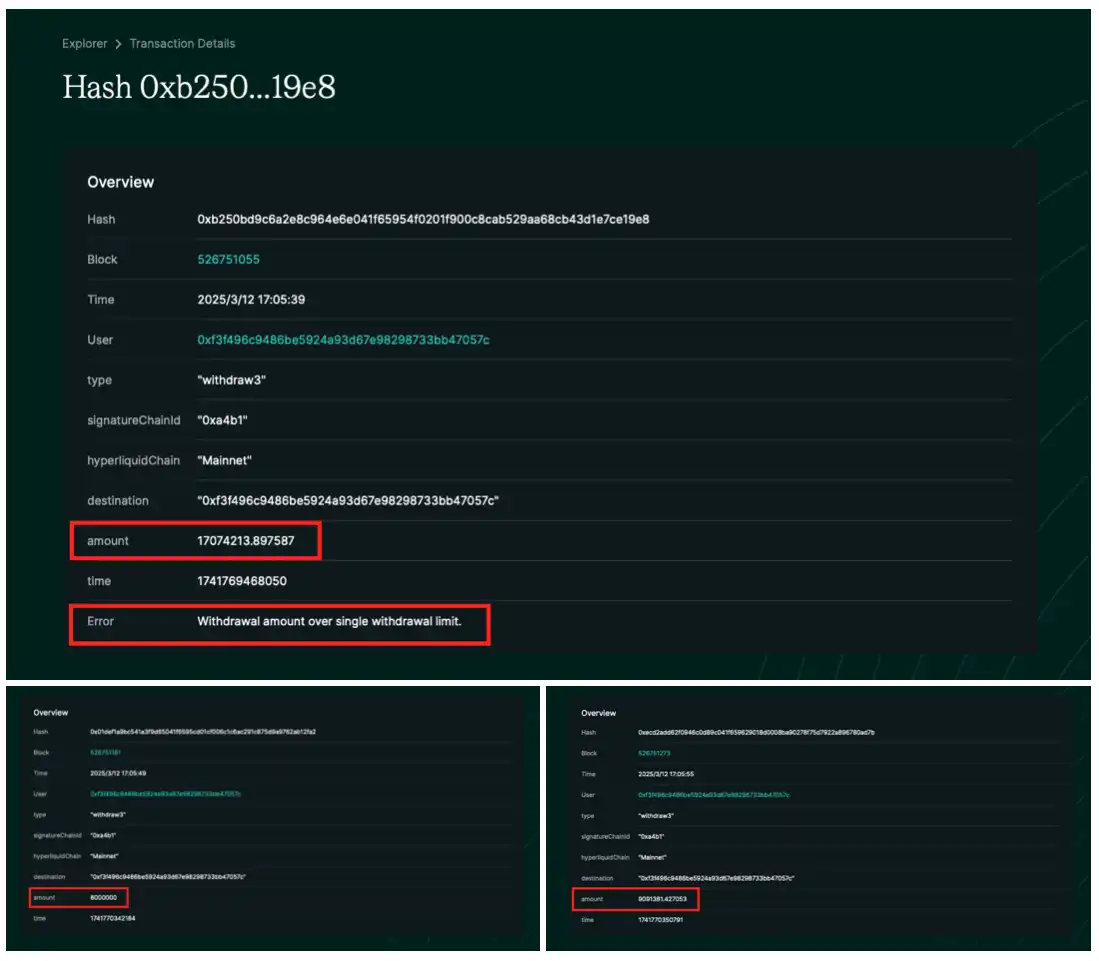
After a large amount of collateral was withdrawn, the liquidation price of the Insider's position quickly rose. At 17:08, over 100,000 ETH long positions were liquidated at $1,915, taken over by the Hyperliquid treasury to complete the liquidation. However, due to the substantial amount involved, the liquidation process resulted in continued ETH price drop losses, ultimately causing HLP to bear the entire loss of approximately $4 million.

After 7 Years, Perp DEX Leader Still Pays the "Tuition Fee"
Shortly after the liquidation event, Hyperliquid released a statement announcing that the maximum leverage for BTC and ETH would be updated to 40x and 25x, respectively, to increase the maintenance margin requirement for larger positions, providing better cushioning for larger position liquidations.
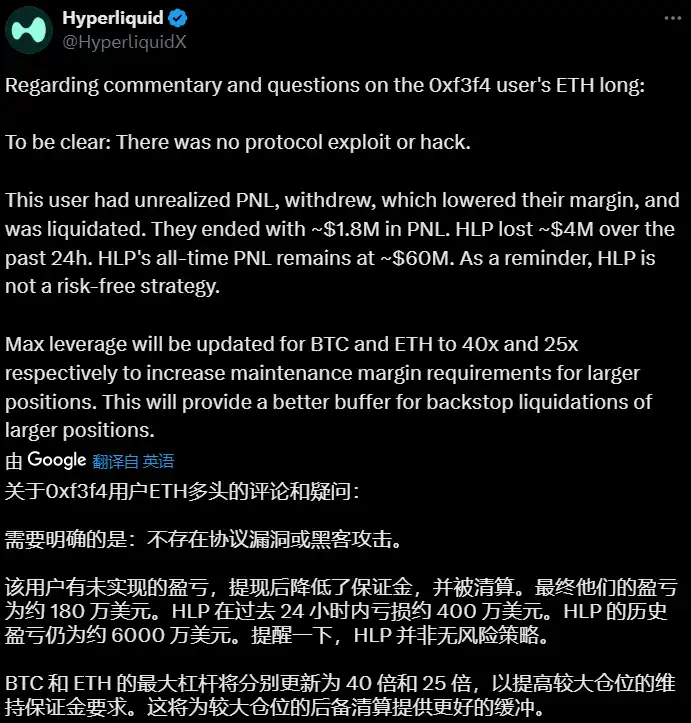
While people marveled at the "insider brother" manipulation, another point that intrigued many community members was: why should Hyperliquid bear the losses when others are liquidated?
HLP is essentially a liquidation fund, with the biggest potential victims being the deposit users of HLP. The main issue that led to this significant hyperliquid loss was the ability to freely withdraw unrealized profits. In addition, there was no restriction on opening leveraged positions with large orders, and the HLP insurance pool would take over the liquidated positions at a fixed price.
Currently, withdrawing unrealized profits is not allowed in most CEXs. Unrealized profits are considered unrealized gains, and withdrawing them without closing the contract is equivalent to advance profit-taking. Large unrealized profits being withdrawn in a short time can easily create significant liquidity risks.
Hyperliquid's liquidity mainly comes from Binance and some other exchanges' external accounts. Since there is no mechanism for positions being passed on in case of liquidation, after Hyperliquid takes over the liquidated orders, they are traded on the secondary market. The reason why the liquidation of 160,000 ETH did not crash the price is that this liquidation was conducted off-exchange and did not appear on the order book but was directly bought by the HLP fund. In the past, with small position liquidations, HLP could take advantage of the price difference after taking over the liquidation. However, this time, the amount of the liquidation was too huge, resulting in a massive loss for HLP after taking over.
Regarding this incident, the well-known KOL Foolish Dragon King explained why CEXs do not allow the withdrawal of unrealized profits. In his tweet, he mentioned that exchanges did not have a liquidation takeover mechanism in the past, and the liquidated positions were directly placed on the market depth. If the liquidated order was not closed, it would be a position transfer, which would be settled in the next settlement period, either downward or upward.
In July 2018, OKX encountered a whale who leveraged 20x from $7,000 BTC to go long and aggressively drove the price up to $8,400, then withdrew all the margin, causing the order to be liquidated. 50,000 unfulfilled BTC sell orders were directly placed at $8,020. If it continued to drop, short positions would profit more than long positions, and all short holders would collectively share the loss from the position transfer. Since then, OKX's futures system has gradually improved, prohibiting moving margin based on unrealized profits to limit such position transfer risks.
Before the liquidation event, HLP's liquidity providers were enjoying approximately a 20% APY. However, this significant loss caused all the liquidity providers to lose all their earnings from the previous month in just a few minutes. This also highlights the risks of investing in DeFi, as liquidity pools are susceptible to price manipulation. The smaller the pool, the greater the risk of price volatility and impermanent loss. Even a relatively liquid pool like HLP struggled to withstand the impact of a black swan event.
Therefore, not all mining opportunities with an APR are stable investments. Once the principal is at risk, withdrawal becomes the primary option.
From the perspective of the recent hyperliquid liquidation event, both HLP and its users suffered significant losses. Investing in DeFi is a high-yield but high-risk endeavor. While the main reason behind this substantial loss was the inadequate contract oversight by the platform, it exposed the immaturity of DeFi, leaving room for undiscovered vulnerabilities to be exploited. Fortunately, this event did not deal a devastating blow to the market. It served as a wake-up call for institutions, liquidity providers, and retail investors alike, reminding all participants to enhance risk management practices and scrutinize protocol vulnerabilities. It's never too late to mend the pen after the sheep are lost.
You may also like

Cardano (ADA) Price Review for February 3
Cardano’s ADA price dropped 1% in the last day, trading at $0.2999, amid a broader red zone for…

Ripple Participates in Critical White House Summit
Ripple joined key crypto firms and banking giants at a White House meeting focused on stablecoin regulation, highlighting…

SHIB Price Analysis on February 3
SHIB’s rate dropped 0.74% in the last 24 hours, showing bears still hold sway. Hourly chart reveals rising…

Crypto Market Review: Shiba Inu’s (SHIB) 1,000,000,000,000 Bull Market Trigger, Bitcoin (BTC) Crash Might Stop Here, Is Dogecoin (DOGE) in Mini-Bull Market?
Shiba Inu shows a green candle with volume spike after decline, hinting at potential recovery but not confirming…

Crypto Apocalypse Imminent, Expert Who Predicted 2008 Financial Crisis Warns
Nouriel Roubini predicts a full-blown apocalypse for the cryptocurrency market, claiming it lacks real use cases beyond crime…

Top 3 Meme Coins Price Prediction: Dogecoin, Shiba Inu And MemeCore Ahead of Market Recovery
Meme coins like Dogecoin, Shiba Inu, and MemeCore show recovery signs with price gains of 5.45%, 5%, and…

Trump Names Bitcoin-Friendly Kevin Warsh as Choice for Federal Reserve Chair
President Donald Trump nominated Kevin Warsh for Federal Reserve Chair, highlighting his pro-Bitcoin stance and policy experience. Warsh…
XRP Price Faces Slide to $1 Amid Slumping XRPL Metrics and Burn Rate
XRP price hit a low of $1.500 this week, marking its lowest point since November 2024, with a…

Cardano Price Prediction as the Upcoming CME’s ADA Futures Launch Nears
Cardano price trades under pressure, stabilizing below $0.30 after a decline, showing compression rather than new weakness. CME…

Jeffrey Epstein Invested in Bitcoin Firm Blockstream, Invited Founder Adam Back to Island
Adam Back confirmed Jeffrey Epstein’s investment in Blockstream via a 2014 seed round through Joi Ito’s fund at…

SEC Chair Paul Atkins to Create History as First Sitting Chair to Speak at The Bitcoin Conference in Las Vegas
SEC Chairman Paul Atkins will speak at the Bitcoin 2026 Conference, marking the first time a sitting SEC…

HYPE Price Outlook After Hyperliquid’s HIP-4 Rollout Ignites Prediction-Style Trading Boom
Hyperliquid’s HYPE token price jumped above $37 with a 20% gain, landing it in the top 10 cryptocurrencies…

Trump States Crypto Reserve Will Hold XRP, Solana, Cardano—And ‘Obviously’ Bitcoin and Ethereum
President Trump announced a U.S. strategic crypto reserve including XRP, Solana, Cardano, Bitcoin, and Ethereum to position the…
Strategy Stock ($MSTR) Reaches 52-Week Low As Bitcoin Craters Below $84,000
Strategy ($MSTR) stock hit a 52-week low of $140.25 amid a sharp Bitcoin price drop below $84,000, with…

Jeffrey Epstein’s Strange Bitcoin Connections
The US Department of Justice released new Epstein Files detailing Jeffrey Epstein’s ties to Brock Pierce, a key…
Moonbirds NFTs Now Soaring Again: What’s Behind the Price Surge
Moonbirds NFTs, launched in 2022 by Kevin Rose’s Proof, saw their floor price crash from double-digit ETH to…
The Best Airdrop Hunts of the Month: January 2026
This guide spotlights five promising tokenless protocols for early airdrop opportunities in January 2026, curated to help users…

Is It a Crypto Winter? Burry Says $50K, Tiger Says No
Michael Burry predicts Bitcoin could drop to $50,000, triggering mining firm bankruptcies and a collapse in tokenized metals…
Cardano (ADA) Price Review for February 3
Cardano’s ADA price dropped 1% in the last day, trading at $0.2999, amid a broader red zone for…
Ripple Participates in Critical White House Summit
Ripple joined key crypto firms and banking giants at a White House meeting focused on stablecoin regulation, highlighting…
SHIB Price Analysis on February 3
SHIB’s rate dropped 0.74% in the last 24 hours, showing bears still hold sway. Hourly chart reveals rising…
Crypto Market Review: Shiba Inu’s (SHIB) 1,000,000,000,000 Bull Market Trigger, Bitcoin (BTC) Crash Might Stop Here, Is Dogecoin (DOGE) in Mini-Bull Market?
Shiba Inu shows a green candle with volume spike after decline, hinting at potential recovery but not confirming…
Crypto Apocalypse Imminent, Expert Who Predicted 2008 Financial Crisis Warns
Nouriel Roubini predicts a full-blown apocalypse for the cryptocurrency market, claiming it lacks real use cases beyond crime…
Top 3 Meme Coins Price Prediction: Dogecoin, Shiba Inu And MemeCore Ahead of Market Recovery
Meme coins like Dogecoin, Shiba Inu, and MemeCore show recovery signs with price gains of 5.45%, 5%, and…


 App
App