
- Buy Crypto
- Markets
- Futures
- Spot
- Copy Trade
 Earn
Earn- More
Ethereum Announces New Framework: Open Intents Framework, Why Discuss Layer 2 Scalability?

On February 20, the Ethereum Foundation announced the launch of the Open Intents Framework, driven by over 30 teams from various fields within the Ethereum ecosystem to accelerate ecosystem-wide interoperability. According to the EF, this is a modular, open framework designed to enable any chain to seamlessly convey intents to users and enhance cross-chain user experience.
Apparently, the EF's new framework aims to further integrate liquidity and reduce fees between its L2 ecosystem. In recent months, discussions about "L2 feeding back into L1 capabilities" have been frequent. As the price of ETH has continued to show weakness, dissatisfaction with the Ethereum ecosystem's economic structure has grown stronger in the market. Many believe that L2, as an essential part of the ecosystem, cannot and will not capture value from ETH itself.
L2 Crisis Goes Beyond Just "Feeding Back"
L2 feeding back into L1 to help ETH capture value has been the dominant imagination of the crypto industry for the Ethereum ecosystem in the coming years. However, over the past year, Ethereum L1's "rent-seeking situation" has been far from the initial vision.
Take Arbitrum, for example, which charges a 10% fee to Layer 3 platforms within the ecosystem while only paying a 2% fee to Ethereum as a Layer 2 platform. After the launch of the Blob mechanism, the average operating cost of L2 plummeted even further.
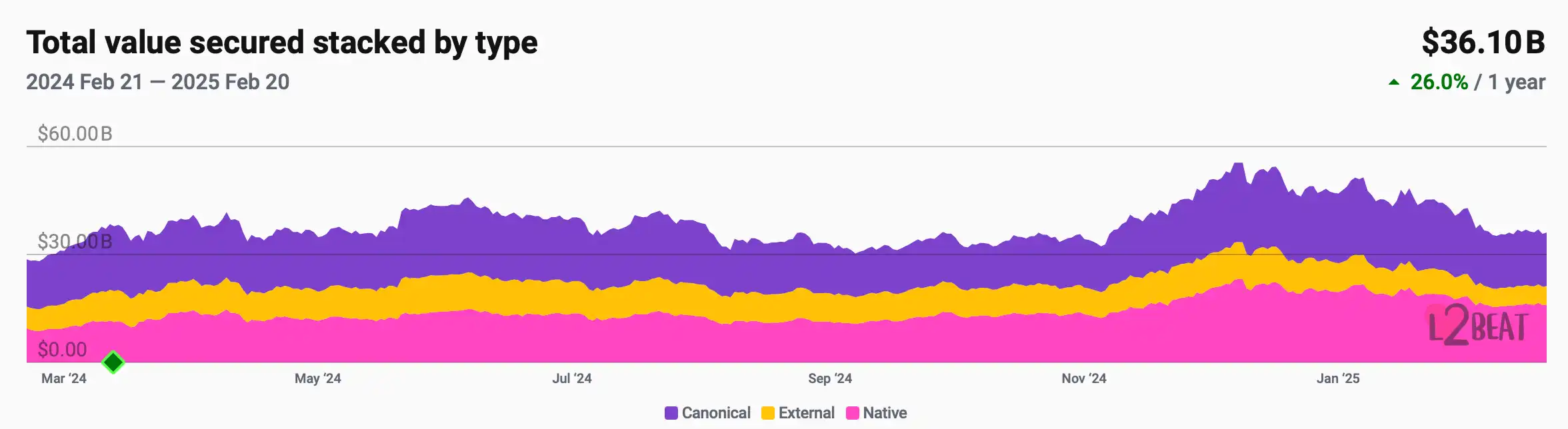
Meanwhile, facing strong competition from the Solana ecosystem, the overall weak performance of the Ethereum ecosystem has been directly reflected in the entire L2 sector. According to L2BEAT data, the total L2 TVL has been continuously declining since the end of last year. In just one week in early February, the top L2 TVL, including OP, ZKsync, and Starknet, dropped by about 5%. The activity level and gas consumption of the L2 sector hit rock bottom.
However, in this scenario, the EF has continued to adhere to the scaling and upgrading path of L2 in recent months. In a recent official blog post, the EF announced that the Ethereum Pectra network hard fork upgrade plan will go live on the Ethereum testnet Holesky on February 25 at 05:55 Beijing time. Pectra is another significant upgrade following last year's Dencun, and its main goal is to improve the scaling capabilities of the L2 ecosystem.
Why is this happening?
In fact, even with the help of blob, L2 still faces the issue of fee escalation. In October last year, Scroll initiated an SCR short squeeze, instantly driving up the Ethereum network's blob fee to $4.52, reaching a high point in months. As L2 activity slowed down, the blob fee quickly dropped back to near-zero cost.
Previously, there have been two significant increases in blob fees, once during the L2 activity surge in July last year, and another earlier in March during the Blobscriptions craze.
Research analysts pointed out that the increase in blob fees is a double-edged sword for Ethereum. Higher blob costs lead to paying more blob gas to the network, but they also drive up the cost for users to execute transactions and transfers on L2. In reality, whenever there is high activity in the Ethereum ecosystem, this scaling mechanism of blob is almost nonexistent.
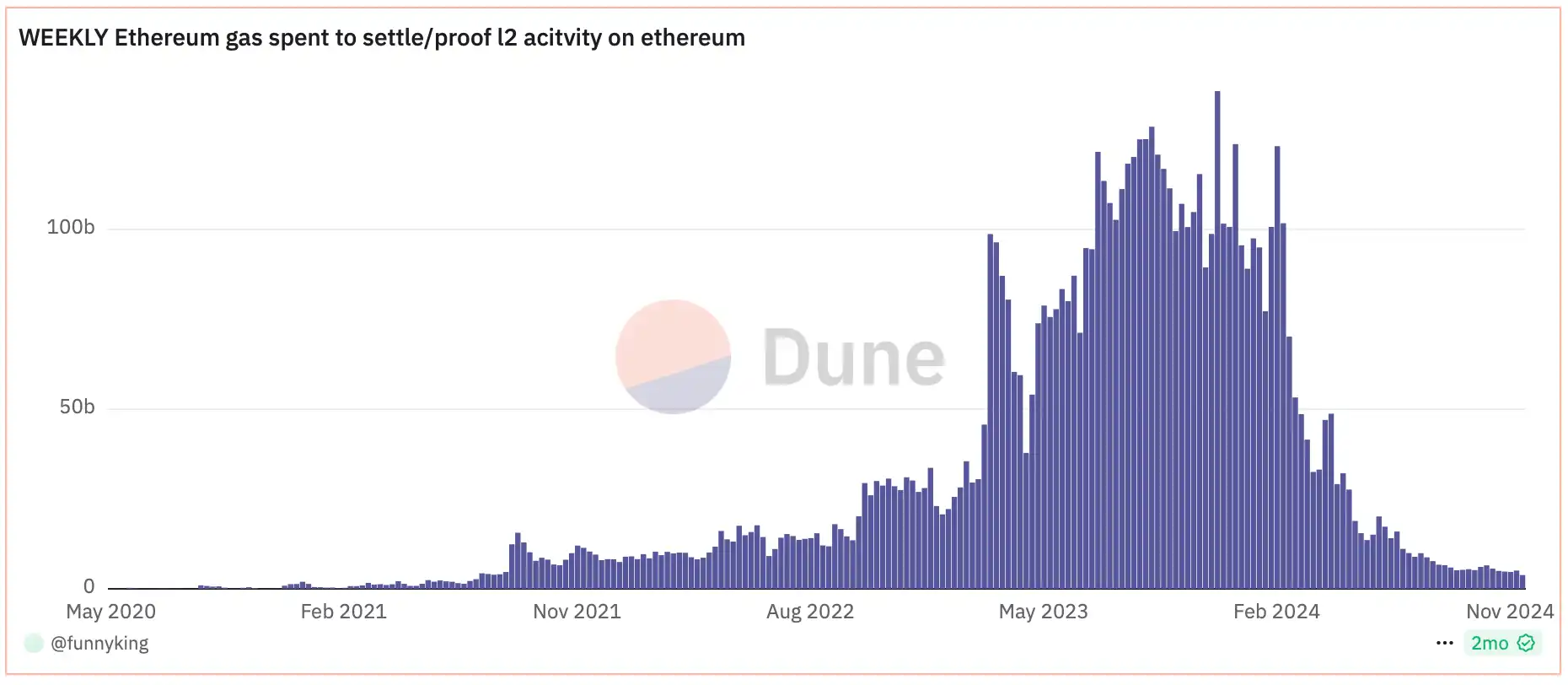
On the other hand, the battle for blob space has also put great pressure on Base, the leader of L2 and the "sole hope of Ethereum."
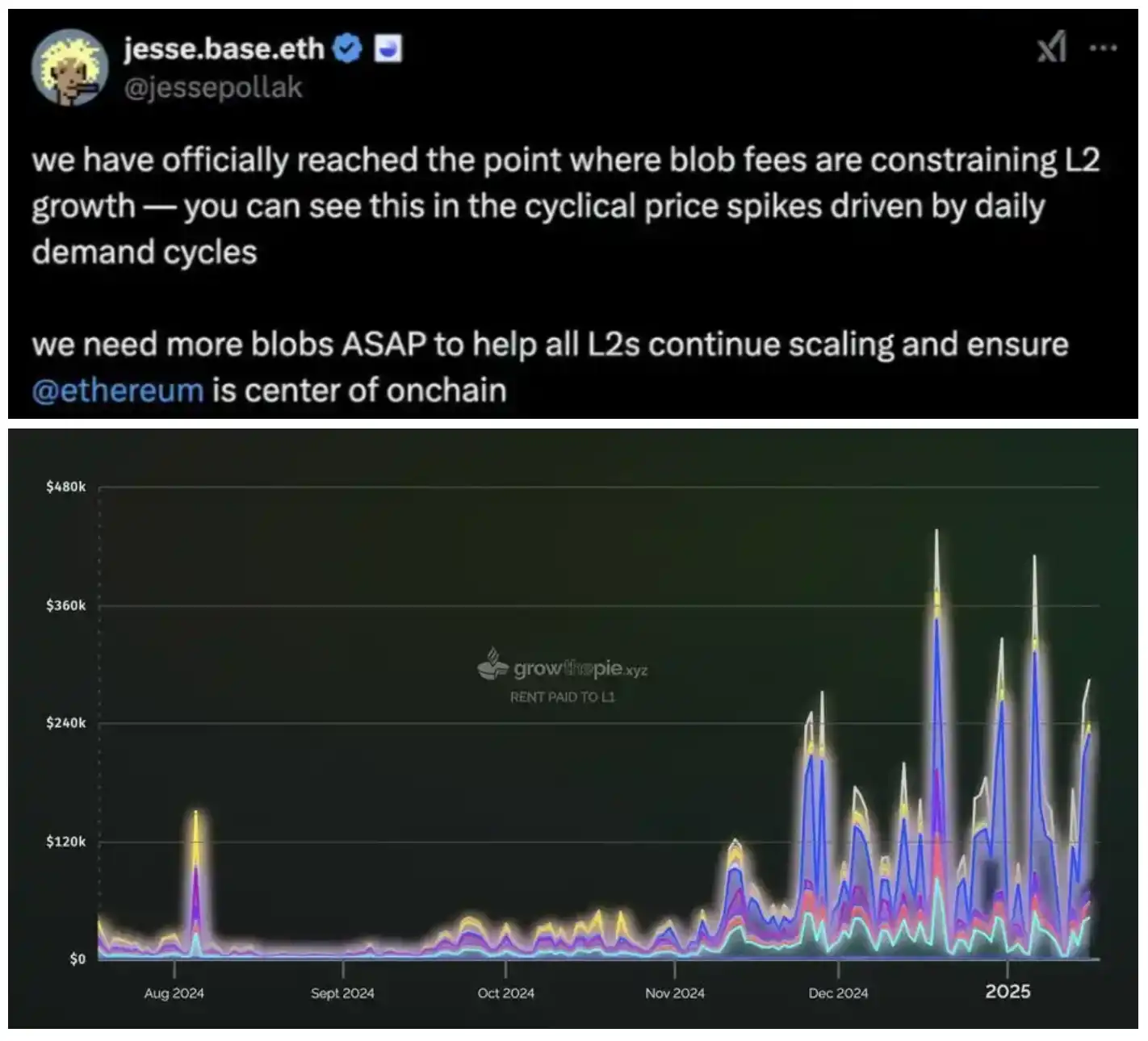
In January this year, Base co-founder Jesse stated in a tweet that the growth of L2 has been severely affected by the restrictions of blob fees. Some pressures driven by daily demands have caused periodic spikes in network fees. It is worth noting that since mid-September last year, Jesse has been emphasizing that solving the scalability issue is Base's current top priority, and the solution does not rely on the native mechanism of the Ethereum network.
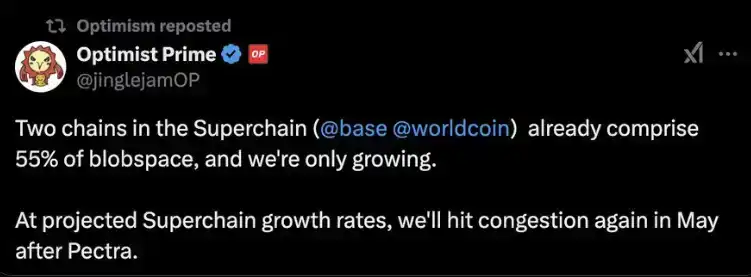
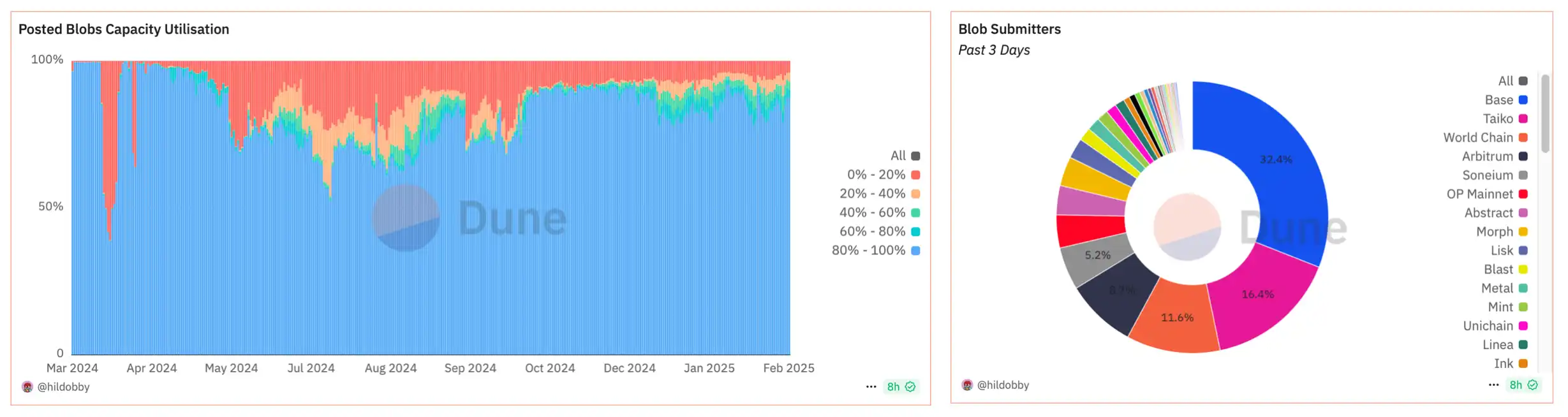
In January this year, gauthamzzz, co-founder of polynomialfi, mentioned in a blog post that Ethereum L2 is facing a severe bottleneck. Currently, 55% of blob space is completely consumed by a few L2 chains. Following the current growth trend of L2, the Ethereum L2 ecosystem will reach maximum capacity in May 2025. If this issue is not resolved by then, the Ethereum ecosystem will face a collapse.
《Blob Space Shortage, Is Ethereum L2 on the Brink of Collapse?》
Currently, Ethereum has only 3 blobs per block, while in reality, dozens of L2s are competing for these 3 precious storage slots. This is akin to multiple rapidly growing cities vying for a three-lane highway.
Currently, the average utilization rate of blobs is nearing 100%, with the usage of these blobs highly concentrated in a few key L2s like Base. More L2s either see little to no activity or exhibit exorbitant transaction costs when under load. Many community members believe that even with the Pectra upgrade increasing the number of blobs per block from 3 to 6, it will be challenging to address the current L2 predicament.
Can "L2 Interoperability" Solve the Issue?
In this context, "L2 interoperability" has become a crucial way to alleviate the crisis. On the one hand, this can address the reality of Ethereum's ecosystem liquidity fragmentation, and on the other hand, it can redistribute the storage demands of key L2s to other L2s in need.
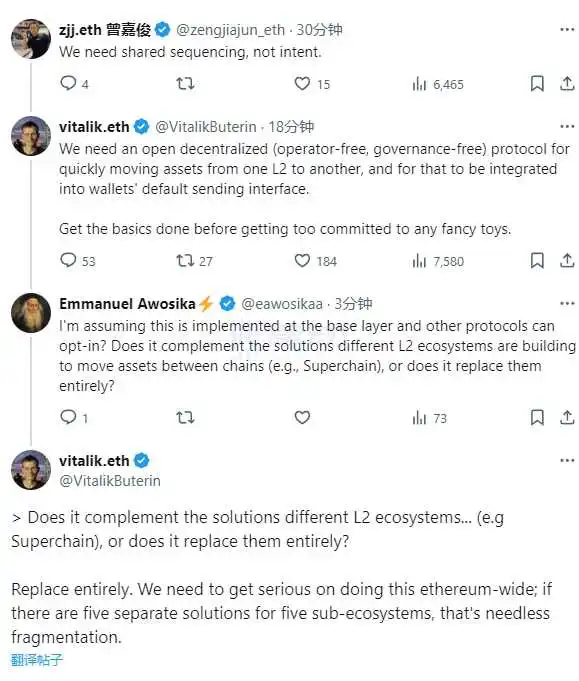
Last May, Vitalik stated: "We need an open, decentralized (no operators, no managers) protocol for moving assets quickly from one L2 to another and integrating into the default send interface of wallets. But before being too fixated on any fancy toys, lay the groundwork first." Vitalik noted that the biggest current user experience problem is that the L2-verse doesn't feel "like a united Ethereum."
In January of this year, Vitalik once again emphasized the necessity of strengthening interoperability between L2s in a blog post. He stated that L2s face two main challenges: scaling and heterogeneity challenges. In addition to enhancing the hardware scaling capabilities of L1 and L2, acceleration of improvements and standardization of interoperability between each Layer 2 and wallets are needed to make Ethereum more like a "single ecosystem rather than 34 different blockchains."
However, the reality may not be that simple. Among the many L2 solutions that have already gone live, most of them have issued their own native tokens. This means that these L2 solutions have already indirectly decoupled from ETH and the Ethereum ecosystem on an economic level. In other words, the current majority of L2 profit models still primarily rely on "token sales" rather than generating revenue solely through sequencer fees, as in the case of Base.
This situation has led most L2 solutions to prioritize considering the value capture of their native tokens in future "economic alignment" discussions. They are more inclined to compete rather than collaborate with other L2 solutions, and their tribute to ETH itself seems to be merely superficial. On the path to achieving a "unified sovereignty," the Ethereum dynasty appears to lack strong leverage, and the actual results of "L2 interoperability" still require time for validation.
You may also like

Trump Says He Was Unaware of $500M UAE Investment in World Liberty Financial
Key Takeaways: US President Donald Trump denied knowledge of a $500 million UAE investment in World Liberty Financial.…

Crypto Industry and Banks at a Stalemate Over Stablecoin Yield Deal
Key Takeaways The White House has urged a compromise on stablecoin yields to progress Senate crypto legislation. Crypto…

Why Vitalik Buterin Sold Over 700 Ethereum (ETH) Despite Market Recovery
Key Takeaways Vitalik Buterin sold over 700 Ethereum not for market reasons but to finance long-term projects. The…

Binance Withdrawals Restored Following Temporary Disruption
Key Takeaways Binance faced technical difficulties affecting withdrawals, but services were quickly restored within 20 minutes. The disruption…

Asian Markets Stabilize as Bitcoin Trades Around $78K
Key Takeaways Bitcoin steadies at approximately $78,000 as Asian markets recover from recent volatility. Regional equities, including Japan’s…

Bitcoin Price Prediction: The Warsh Shock & The Stablecoin Summit—Is the Bull Case Dead?
Key Takeaways Kevin Warsh’s nomination as Federal Reserve Chair has caused a drop in liquidity for riskier assets,…

White House Continues to Negotiate Over Crypto Market Structure Bill
Key Takeaways The White House is pushing for a compromise on the contentious issue of stablecoin yields in…
Billionaire Michael Saylor’s Strategy Acquires $75M More Bitcoin – Is This a Bullish Sign?
Key Takeaways Michael Saylor’s Strategy has expanded its Bitcoin holdings by purchasing an additional 855 BTC for $75.3…
Polymarket Bettors Assign Over 70% Probability of Bitcoin Dropping Below $65K — Are They Correct?
Key Takeaways Polymarket users predict Bitcoin has a 71% chance of falling below $65,000 in 2026, reflecting market…
CFTC Regulatory Shift Could Unlock New Growth for Coinbase Prediction Markets
Key Takeaways Newly appointed CFTC Chair, Michael Selig, aims for a unified federal oversight approach for crypto-linked prediction…

We Hacked Perplexity AI to Predict the Price of XRP, Bitcoin, and Ethereum By the End of 2026
Key Takeaways Perplexity AI predicts XRP may soar to $8 by 2026, fueled by legal victories and supportive…
Current Crypto Price Predictions: An In-Depth Analysis of XRP, Dogecoin, and Shiba Inu
Key Takeaways XRP, Dogecoin, and Shiba Inu are experiencing significant price declines amid geopolitical uncertainties and general market…

Pepe Coin Forecast: Price Appears Dismal, Yet Savvy Investors Rally Behind the Scenes
Key Takeaways Pepe Coin has experienced significant price drops, yet indicators suggest it may soon bottom out, with…

BitMine Reports 4.285M ETH Holdings, Expands Staked Position With Massive Reward Outlook
Key Takeaways BitMine Immersion Technologies has reported significant crypto holdings valued at $10.7 billion. The company’s Ethereum holdings…

Crypto Exchanges’ Stock Plunge 60% as Trading Volumes Dwindle – Is the Decline Ending or Just Beginning?
Key Takeaways Trading volumes on major crypto exchanges have drastically fallen, with a nearly 90% drop from October…

Best Crypto to Acquire Now February 2 – XRP, Solana, Ethereum
Key Takeaways Recent market turmoil saw Bitcoin plunge dramatically, affecting all major cryptocurrencies. XRP, Solana, and Ethereum are…

Ethereum Price Prediction: Top ETH Bulls Face $7.6 Billion in Paper Losses as Price Drops Below $2,400
Key Takeaways Ethereum has faced a downturn, dropping 19% below $2,400, resulting in significant paper losses for major…

Shiba Inu Price Prediction: SHIB Just Crashed to a 3-Year Low – Is SHIB Heading Towards Zero?
Key Takeaways Shiba Inu has recently hit a significant low, experiencing a 15% drop that places it at…
Trump Says He Was Unaware of $500M UAE Investment in World Liberty Financial
Key Takeaways: US President Donald Trump denied knowledge of a $500 million UAE investment in World Liberty Financial.…
Crypto Industry and Banks at a Stalemate Over Stablecoin Yield Deal
Key Takeaways The White House has urged a compromise on stablecoin yields to progress Senate crypto legislation. Crypto…
Why Vitalik Buterin Sold Over 700 Ethereum (ETH) Despite Market Recovery
Key Takeaways Vitalik Buterin sold over 700 Ethereum not for market reasons but to finance long-term projects. The…
Binance Withdrawals Restored Following Temporary Disruption
Key Takeaways Binance faced technical difficulties affecting withdrawals, but services were quickly restored within 20 minutes. The disruption…
Asian Markets Stabilize as Bitcoin Trades Around $78K
Key Takeaways Bitcoin steadies at approximately $78,000 as Asian markets recover from recent volatility. Regional equities, including Japan’s…
Bitcoin Price Prediction: The Warsh Shock & The Stablecoin Summit—Is the Bull Case Dead?
Key Takeaways Kevin Warsh’s nomination as Federal Reserve Chair has caused a drop in liquidity for riskier assets,…


 App
App