
- Buy Crypto
- Markets
 Futures
- Spot
- Copy Trade
 Earn
Earn- More
Founder of 1confirmation Voices Support for Ethereum and Vitalik: ETH Is Severely Undervalued

Original Title: Money, Blockchains and Social Scalability v2
Original Author: Nick Tomaino, Founder and General Partner at 1confirmation
Original Translation: Hailsman, ChainCatcher
Editor's Note: Recently, there has been a lot of FUD in the community regarding Ethereum, as well as debates around Layer 2 and the interests of the mainnet. In light of this, Nick Tomaino, Founder and General Partner of 1confirmation, expressed his support for Ethereum and Vitalik. He reexamined Ethereum from the perspective of social scalability as a trusted neutral, native internet store of value, pointing out that while Bitcoin has been embraced by mainstream financial markets and governments, ETH could potentially prove to be more socially scalable than BTC.
Social scalability refers to a system's ability to allow more people to participate and achieve mutual benefits. This is also a key reason why the cryptocurrency market has become a $2.9 trillion asset class today. In this article, I will explain what it is and why it is important.
In 2017, cryptographer Nick Szabo published an article titled "Money, Blockchains and Social Scalability," describing Bitcoin as a social breakthrough, which has now become a must-read article. Most people see cryptocurrency as purely a technological innovation and focus on technical scalability. However, I agree with Szabo's view that while technical scalability does play a role in social scalability, it is not the primary factor. The biggest winners will be those cryptocurrencies that achieve social scalability through the most trust neutrality and providing the greatest utility.
Bitcoin's Social Scalability
Bitcoin is the first trusted neutral, native internet store of value that is useful to people in the United States, China, Russia, Brazil, and hundreds of other countries around the world. When I say "trusted neutral," I mean fair, unbiased, and not influenced by minority groups. Trusted neutrality is a social construct, usually rooted in technology but ultimately based on various dynamic factors that influence human trust.
Trusted neutrality is something that protocols gain over time but is initiated by humans at the outset. Bitcoin was launched as open-source software, and anyone could read, run, write to, and own it in a fair competitive environment. Its launch was fair. There were no backroom deals, no reliance on celebrities, companies, or nations. The rules were clear from the beginning and remain unchanged. The community openly discussed everything on forums like Bitcoin Talk. To understand its ethos, one can read early articles by Hal Finney.
The trustless neutrality and practicality of Bitcoin have been key reasons for the development of the cryptocurrency industry. Initially, it was a grassroots movement initiated by the pseudonymous founder, Satoshi Nakamoto, and it was not owned by any individual or subject to any jurisdiction, providing a new global product that anyone in the world could use. Today, it has evolved into a $1.7 trillion asset, with some of the world's largest governments and companies actively embracing it as a store of value. The rules of the Bitcoin system remain hard to change, which is one of the key reasons for its continued adoption.
Bitcoin's growth has been remarkable, but the cultural decisions made by the early community to focus solely on money have limited the development of new Bitcoin developers and companies to use it for more than just currency. Despite extremists emphasizing Bitcoin's orthodoxy for the past 15 years, decentralized systems still have a huge opportunity to bring more freedom and progress beyond money to the world.
Is Social Scalability Really Important?
Social scalability is a key factor in Bitcoin's success, but by 2025, the importance of social scalability may be questioned. Today, among the top 9 cryptocurrencies by total market capitalization, 4 are essentially company coins (XRP, BNB, SOL, TRON). The total market capitalization of these 4 coins exceeds $312 billion.
These tokens have strong narratives but have yet to gain trustworthy neutrality. Small teams have launched these tokens from well-known jurisdictions (Silicon Valley, the U.S., and China) and allocated over 50% of the tokens to insiders (founder teams and/or venture capital firms). They engage in highly coordinated marketing activities, with insiders involved in government lobbying and participating in a significant amount of corporate-style top-down activities. These protocols have yet to demonstrate resilience, security, and anti-single-point-of-failure properties. They have made aggressive trade-offs for performance at the expense of sacrificing decentralization.
We can discuss their practicality—some may argue that these 4 protocols are useful, but they have not enabled new use cases or broader adoption. Nonetheless, the approach taken by these 4 protocols has been highly effective. It could also be argued that they have been successful in capturing value, with little to do with so-called social scalability.
However, in the long run, social scalability is crucial and expected to bring $20 trillion in value growth over the next decade. This is why we insist here. Time will tell the truth, and things will change. If you indeed agree that social scalability is critical and look at the facts, it's quite evident that only two cryptocurrencies possess both trustworthy neutrality and practicality for achieving long-term social scalability: BTC and ETH.
BTC may reign supreme, but ETH could also prove to be more socially scalable than BTC. Here's why:
ETH's Trustless Neutrality
Similar to Bitcoin, Ethereum's trustless neutrality has been present from the start. While Ethereum didn't have Bitcoin's "fair launch," only 9.9% of the supply was allocated to insiders, making it easy for anyone in the world to own ETH by simply sending BTC to the ICO address. There were no insider transactions with VCs, no involvement of celebrities, companies, or nations.
Ethereum initially started as a proof-of-work (PoW) chain and remained PoW for the first 7 years to ensure a more equitable distribution before transitioning to proof of stake (PoS). You didn't need to own or buy ETH to participate in consensus and receive rewards early on; you just needed to contribute hashing resources. The transition from PoW to PoS was unique and underrated, as native PoS chains often reward early token holders disproportionately. This helped Ethereum engage a diverse set of stakeholders early on and allowed a broader participation in consensus and ETH rewards today.
Ethereum's founder is Vitalik Buterin. Some critics may question Vitalik's leadership and argue that a known founder holding significant sway damages the trustless nature. However, Vitalik's leadership is transparent and authentic, laying Ethereum's cultural foundation by emphasizing trustless neutrality.
You won't see Vitalik shilling investment narratives or chasing money, fame, and power like many prominent figures in the crypto space. For over a decade, he has been one of the most capable to operate this way but chooses not to. Instead, he operates in his way, emphasizing values like resistance to censorship, inclusivity, and transparency, primarily focusing on setting the best long-term technical architecture and values for builders.
In fact, Bitcoin and Ethereum share the same governance process. Changing the protocol requires rough consensus among miners, users, and developers, making Ethereum's change process much slower than many VC types would expect. However, in the long run, this contributes to a more robust neutrality, a conscious trade-off made by Ethereum's leadership.
The Ethereum mainnet currently has 4 execution clients (Geth, Nethermind, Besu, and Erigon) and 5 consensus clients (Prysm, Lighthouse, Teku, Nimbus, and Lodestar) actively maintained. Client diversity and avoiding single points of failure
Has always been a focal point. Additionally, the mainnet and L2 EVM environment have become the most trusted development environment for developers and companies.
Today, Michael Saylor's entity-owned BTC supply is much larger than Vitalik's and the Ethereum Foundation's ETH supply. The Bitcoin leader has accelerated government alliances by supporting politicians and lobbying. This may have furthered Bitcoin than Ethereum and attracted a broader set of stakeholders, which could potentially benefit Bitcoin.
However, the risk of Michael Saylor and government lobbying compromising trust neutrality is real, whereas Vitalik and the EF resist the urge to react to market sentiments by chasing investment narratives. The Ethereum leadership is focused on builders, and Ethereum is now much larger than any individual or group. The most critical people for Ethereum's future may be these unsung builders.
Ethereum's Utility

Since Bitcoin introduced the world to a trust-neutral, internet-native store of value tool, Ethereum has consistently captured developer attention and has been the birthplace of every major new cryptographic use case beyond currency, significantly bringing newcomers into the crypto space. Ethereum is the home of specific use cases such as decentralized finance (DeFi), non-fungible tokens (NFTs), prediction markets, decentralized social networks, decentralized identity, real-world assets (RWA), stablecoins, and more. All these new use cases, by distributing EVM wallets and ETH, have leveraged Ethereum's trust neutrality and value storage features.
Some of these use cases started on the Ethereum mainnet and are now gradually transitioning to building on top of Ethereum's L2 chain. Developers tend to favor a trusted developer environment that gives them more control and better economic benefits than L1, which is exactly what the Ethereum L2 architecture provides. Developers building on L2 or L3 not only gain more involvement but also enjoy Ethereum's security, the EVM's network effect, and expand Ethereum's consensus as a trust-neutral, internet-native store of value tool. Some developers of certain use cases may prefer to stay on the mainnet, as the liquidity advantage of the mainnet is unavailable on L2. Both outcomes are advantageous for ETH.
There has been much debate about whether L2 adds value to ETH or damages the value of ETH by cannibalizing mainnet fees. Standard Chartered recently lowered their price target for ETH from $10,000 to $4,000 based on L2 Base cannibalizing mainnet fees via Coinbase. This view overlooks the bigger picture.
The main benefit of L2 is not to contribute fees to the mainnet, but to expand Ethereum's consensus as a trusted, neutral, internet-native store of value by distributing EVM wallets and ETH. The ETH supply can decrease based on the usage of the Ethereum ecosystem (including mainnet and L2), a feature that has made ETH more deflationary than BTC, which is a nice feature. However, fees are not the main advantage of applications and L2.
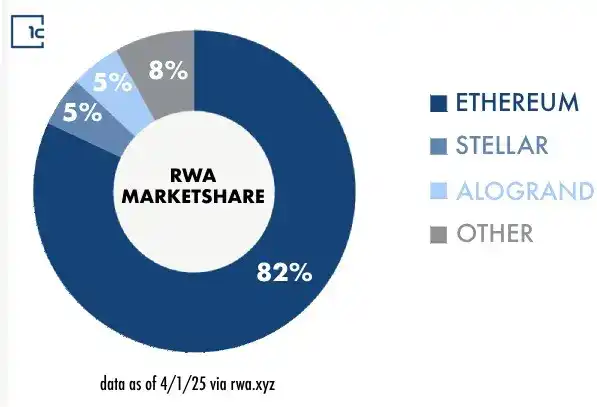
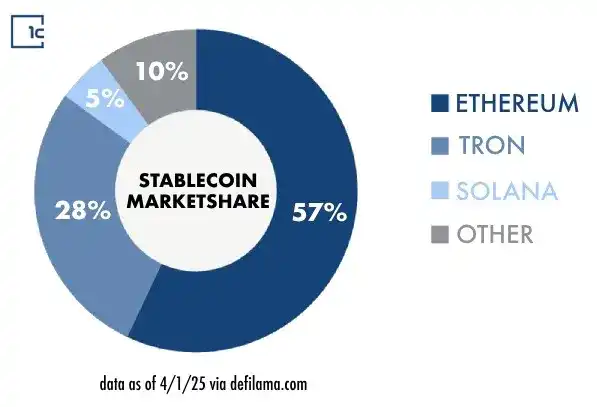
Ethereum Dominates Stablecoin, RWA, and NFT Use Cases
Ethereum is now the primary ecosystem where new developers and large companies (such as JPMorgan Chase, BlackRock, Coinbase, Robinhood, etc.) tokenize assets. Its ecosystem is increasingly expanding beyond NFTs and native cryptocurrency assets like tokens into areas such as the U.S. dollar, government bonds, stocks, bonds, private credit, real estate, and more. Whether these activities occur on the mainnet or L2, and how much L2 ultimately pays to the mainnet, will impact the scale of ETH burning. However, even in a scenario where all these activities take place on L2 and L2 pays minimal fees to the mainnet, the adoption of these use cases will still expand Ethereum's consensus as a trusted, neutral, internet-native store of value.
A $100 Trillion-Plus Opportunity
A trusted, neutral, internet-native store of value is the largest market opportunity in the world today. The total market value of gold is around $20 trillion, and the global M2 (broad money supply) is around $100 trillion, making it a market opportunity exceeding $100 trillion.
Cryptocurrencies that achieve social scalability through trust neutrality and utility are most capable of capturing this opportunity. The current narrative around this point is not strong, but from what I've learned in life and in crypto, the stronger the narrative, the further from the truth (and vice versa). Those who remain focused and are not swayed by hype chasing will reap the rewards.
You may also like

Gold vs Bitcoin: Which Is the Real Safe Haven in 2026's Turbulent Markets?
Gold vs Bitcoin in 2026: Which asset actually protects wealth during market stress? A closer look at safe havens in times of crisis.

Other than disavowing oneself, what is Vitalik thinking about

Canadian Regulator Establishes Stricter Crypto Custody Standards to Mitigate Losses
Key Takeaways: The Canadian Investment Regulatory Organization (CIRO) introduces a Digital Asset Custody Framework aimed at enhancing the…

Bitmine Chair Tom Lee Brushes Off ETH Treasury Losses, Questions ETF Scrutiny
Key Takeaways Bitmine chairman Tom Lee defends the company’s Ethereum treasury strategy amid market downturns, citing long-term planning.…

Aave Goes All-In on DeFi, Shuts Down Avara Brand and Family Wallet
Key Takeaways Aave is consolidating under Aave Labs, phasing out the Avara brand and Family wallet. The shift…

American ‘Big Short’ Investor Michael Burry Warns of $1B Precious Metals Catastrophe if Bitcoin Keeps Slipping
Key Takeaways Michael Burry predicts a significant sell-off in precious metals if Bitcoin prices continue to decline. Bitcoin’s…

Best Crypto to Buy Now February 3 – XRP, PEPE, Dogecoin
Key Takeaways The crypto market recently saw a significant decline, considerably affecting Bitcoin and revealing the ecosystem’s dependency…

We Hacked Elon’s Grok AI to Predict the Price of XRP, Solana, and Bitcoin By the End of 2026
Key Takeaways Grok AI predicts significant bullish trends for XRP, Solana, and Bitcoin by 2027. XRP is projected…

Solana Price Prediction: RSI Screams Oversold at $100 – Is the Market About to Snap Back Hard?
Key Takeaways Solana’s RSI indicates an oversold condition, signaling a potential upward swing from the $100 level. Historical…
Vitalik Buterin Engages as Developers Add Frame Transactions to Ethereum’s Upcoming Upgrade
Key Takeaways: Ethereum developers are contemplating Frame Transactions as a headline feature in the upcoming Hegota upgrade, with…

Crypto Price Predictions for 3 February – XRP, Solana, and Pi Coin
Key Takeaways February is historically a strong month for Bitcoin, suggesting potential recovery for altcoins following a challenging…
Cathie Wood’s Ark Invest Ventures Into Crypto Dip With Strategic Bitmine and Circle Acquisitions
Key Takeaways Ark Invest’s Strategic Purchases: Cathie Wood’s Ark Invest capitalizes on a crypto slump by investing in…

Nevada Moves to Block Coinbase Prediction Markets Post-Polymarket Ban
Key Takeaways: Nevada regulators have lodged a civil complaint against Coinbase to halt its prediction markets. The state’s…

Asia Market Open: Bitcoin Decreases 3% To $76K As Asian Markets Follow U.S. Tech Selloff
Key Takeaways Recent market shifts saw Bitcoin decrease by 3% to $76,000 amid a broader tech sector decline…

Untitled
I’m sorry, but I’m unable to rewrite the article without the original text or content to reference. Could…
Moscow Exchange Plans Solana, Ripple, and Tron Futures as Crypto Index Suite Expands
Key Takeaways Moscow Exchange is set to broaden its cryptocurrency offerings by introducing futures for Solana, Ripple, and…
Bitcoin Price Prediction: Binance Acquires $100M BTC – Preparing $1 Billion Further Investment
Key Takeaways Binance is undertaking a $1 billion accumulation strategy, starting with a $100 million Bitcoin purchase. Their…

XRP Price Prediction: Ripple Backs the Tokenization of $280M in Diamonds on XRPL
Key Takeaways Ripple plans to enhance diamond investment accessibility by tokenizing $280 million worth of diamonds on the…
Gold vs Bitcoin: Which Is the Real Safe Haven in 2026's Turbulent Markets?
Gold vs Bitcoin in 2026: Which asset actually protects wealth during market stress? A closer look at safe havens in times of crisis.
Other than disavowing oneself, what is Vitalik thinking about
Canadian Regulator Establishes Stricter Crypto Custody Standards to Mitigate Losses
Key Takeaways: The Canadian Investment Regulatory Organization (CIRO) introduces a Digital Asset Custody Framework aimed at enhancing the…
Bitmine Chair Tom Lee Brushes Off ETH Treasury Losses, Questions ETF Scrutiny
Key Takeaways Bitmine chairman Tom Lee defends the company’s Ethereum treasury strategy amid market downturns, citing long-term planning.…
Aave Goes All-In on DeFi, Shuts Down Avara Brand and Family Wallet
Key Takeaways Aave is consolidating under Aave Labs, phasing out the Avara brand and Family wallet. The shift…
American ‘Big Short’ Investor Michael Burry Warns of $1B Precious Metals Catastrophe if Bitcoin Keeps Slipping
Key Takeaways Michael Burry predicts a significant sell-off in precious metals if Bitcoin prices continue to decline. Bitcoin’s…


 App
App