
- Buy Crypto
- Markets
 Futures
- Spot
- Copy Trade
- Earn
- More
India is finalizing a trade deal with Trump, but it’ll cost it an economic arm and a leg
By: bitcoin ethereum news|2025/05/08 19:30:05
0
Share
India is on the verge of signing a major trade agreement with US President Donald Trump, but behind the shiny headlines lies the blunt reality—this deal could slice straight through India’s long-protected economic armor. The country once known for its proud “tariff king” reputation is preparing to drop its guard. The cost? Potential blows to its manufacturing base, local industries, and possibly even sovereignty over economic choices. Trump, who slapped a 26% tariff on Indian exports last month before hitting pause, has called India’s trade barriers outrageous more than once. The new draft deal being discussed is India’s sharp pivot. CNBC claims New Delhi has offered to remove import taxes on pharmaceuticals, auto parts, and steel from the US, at least for a capped amount. On the surface, it looks mutual. In reality, it’s not. India has kept those duties high for a reason—to keep its domestic factories alive. Slashing those now, just to stay in Washington’s good books, could wreck entire sectors. India’s tariff wall is crumbling fast India’s average tariff rate still stands at 17%, according to the World Trade Organization—five times what the US charges on incoming goods. India’s duties help protect everything from agriculture and IT hardware to footwear, car parts, gold, and jewelry. If zero-tariff doors swing open for US products, those protective layers vanish. Trump knows that, and he’s using the threat of suspended tariffs to pressure India into compliance. So far, it’s working. He recently said the deal was “coming along great.” And of course it is—for him. But this isn’t just about diplomatic ego. India needs the deal. Trade with the US hit $129 billion in 2024. India held a $45.7 billion surplus, something Trump has been itching to crush. With economic growth stuck around 6%, India is desperate to scale higher. Pushing it to 8 or 9% means the country needs to attract more foreign capital and expand into global markets. And let’s be honest: Washington’s nod helps with both. But the fine print will be a pain. There’s a fear that the US might flood India with its products under the new structure. Sure, zero duties sound good on paper. But what does that mean for India’s “Make in India” push? Analysts argue that the real damage might be industry-specific, but that doesn’t mean it’s harmless. Trump’s deal could wreck India’s core industries India might not need to panic over every sector. For example, importing steel from the US makes zero economic sense for Americans. It’s a losing game after factoring in freight costs. Even if the tariff wall drops, US steel isn’t likely to flood Indian markets. But that’s just one small win in a sea of losses. In pharma, the US mainly exports high-end, patented drugs priced for the elite. Indian consumers won’t buy that stuff at scale, even without tariffs. So again, maybe no direct danger there. The bigger nightmare is if India’s generic drug makers—who already operate on razor-thin margins—get forced to build factories in the US. That would wreck their cost model. Worse, if Washington slashes imports of Indian generics under this “new deal,” it could cripple one of India’s strongest export engines. Then there’s automobiles. American carmakers like Ford and General Motors have tried and failed to win over Indian drivers. The demand gap is too wide. Most people want either ultra-cheap Indian brands or high-end European rides. Americans sit awkwardly in the middle. So it’s not like there’ll be a stampede for US cars. Still, offering zero-tariff access opens the door, even if nobody walks through it. Local players like Tata, or Japanese and Korean giants like Toyota, Suzuki, and Hyundai are already deeply embedded in the market. But make no mistake—this deal won’t be painless. India’s economy runs on careful protectionism. Letting go of that structure risks long-term pain. If the government caves too hard, it could set off a chain reaction, forcing domestic businesses into cost-cutting or shutdowns. And yet, Wall Street’s smiling. Investors are already placing bets. Across the stock market, banking, materials, and healthcare stocks are all flashing green in anticipation. Financials, especially, are expected to boom if the deal closes. Your crypto news deserves attention – KEY Difference Wire puts you on 250+ top sites Source: https://www.cryptopolitan.com/india-trade-deal-trump-will-have-huge-costs/
You may also like

Particle Founder: The entrepreneurial insights I have gained the most from in the past year
Stop lean startup, stop lightning entrepreneurship, and think carefully about what your product aspirations are.

Huang Renxun's latest podcast transcript: The future of Nvidia, the development of embodied intelligence and agents, the explosion of inference demand, and the public relations crisis of artificial intelligence
The competition in the future is not just about whose model is larger or whose computing power is stronger, but also about who understands the industry better, who can embed AI more deeply into real processes, and who can organize these capabilities into a runnable and scalable system.

OKX Ventures Research Report: AI Agent Economic Infrastructure Research Report (Part 1)
The existing infrastructure is hostile to the Agent economy. Agents can think and act independently at the "capability level," but at the "economic level," they are still locked into infrastructure designed for humans.

The migration of settlement rights: B18 and the institutional starting point of on-chain banks
In the traditional system, banks decide the settlement; in the on-chain system, code begins to take over this responsibility.

From Tencent and Circle: Looking at the Simple and Difficult Questions of Investment
The AI narrative continues to ferment, but the recent performance of related stocks varies, with some in the midst of summer and others as if in winter.

The second half of stablecoins no longer belongs to the crypto circle
What Coinbase doesn't want, Mastercard is eager to buy.

Cursor "Shell" Kimi Controversy Reversed: From Copyright Infringement Allegations to Authorized Collaboration, China's Open Source Model Once Again Becomes a Global AI Foundation
Cursor was accused of being based on Kimi K2.5, which sparked controversy, and was later confirmed to be compliant through Fireworks AI due diligence.

The Real Reason Tokens Don't Sell: 90% of Crypto Projects Overlook Investor Relations
Provide an Investor Relations Best Practices Guide for Crypto Projects.

Is the income of pump.fun real, earning a million dollars a day despite the market downturn?
If it can really earn this much, what is the reason for the low price of $PUMP?

The real reason why tokens are not selling: 90% of crypto projects neglect investor relations
Investor Relations Practice Guide for Cryptocurrency Projects.

Who is the true winner of the "Tokenization" narrative?
Virtually everyone benefits, but the reason for the benefit, the timing, and the underlying logic are completely different.

Moss: The Era of AI-Traded by Anyone | Project Introduction
AI Trading Agent is rapidly growing its infrastructure.

Chip Smuggling Case Exposes Regulatory Loophole | Rewire News Evening Update
AI chips have become a strategic asset more sensitive than missiles

How a Structured AI Crypto Trading Bot Won at the WEEX Hackathon
Ritmex demonstrates how disciplined risk control and structured signals can make an AI crypto trading bot more stable and reliable on WEEX, highlighting the importance of combining execution discipline with scalable AI trading systems.

Old Indicator Fails, Three Major New Signals Emerge: BTC True Bottom May Still Be Below $60K
When the grocery shopping auntie on the subway, or Tony the hairdresser, start asking you about BTC, crypto, and cryptocurrency investments, selling immediately will be the only best option.

Meeting OpenClaw Founder at a Hackathon: What Else Can Lobsters Do?
Imperial College London MetaGame: AI Agent × Web3 Landing Three Major Directions.
Huang Renxun's Latest Podcast Transcript: NVIDIA's Future, Embodied Intelligence and Agent Development, Soaring Demand for Inferencing, and AI's PR Crisis
The future of competition is not only about whose model is bigger, whose computing power is stronger, but also about who understands the industry better, who can more deeply integrate AI into real processes, and who can organize these capabilities into a set of executable, scalable systems
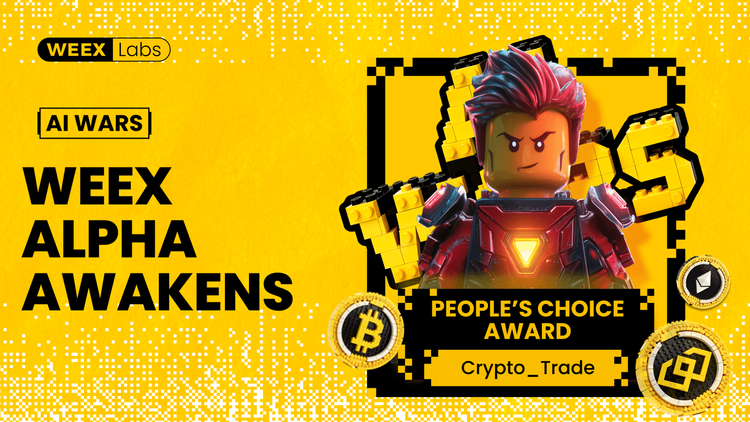
How a Structured AI Crypto Trading Bot Won at the WEEX Hackathon
Crypto_Trade shows how structured inputs and controlled adaptability can build a more stable and reliable AI crypto trading bot within the WEEX AI Trading Hackathon, highlighting a practical path toward scalable AI trading systems.
Particle Founder: The entrepreneurial insights I have gained the most from in the past year
Stop lean startup, stop lightning entrepreneurship, and think carefully about what your product aspirations are.
Huang Renxun's latest podcast transcript: The future of Nvidia, the development of embodied intelligence and agents, the explosion of inference demand, and the public relations crisis of artificial intelligence
The competition in the future is not just about whose model is larger or whose computing power is stronger, but also about who understands the industry better, who can embed AI more deeply into real processes, and who can organize these capabilities into a runnable and scalable system.
OKX Ventures Research Report: AI Agent Economic Infrastructure Research Report (Part 1)
The existing infrastructure is hostile to the Agent economy. Agents can think and act independently at the "capability level," but at the "economic level," they are still locked into infrastructure designed for humans.
The migration of settlement rights: B18 and the institutional starting point of on-chain banks
In the traditional system, banks decide the settlement; in the on-chain system, code begins to take over this responsibility.
From Tencent and Circle: Looking at the Simple and Difficult Questions of Investment
The AI narrative continues to ferment, but the recent performance of related stocks varies, with some in the midst of summer and others as if in winter.
The second half of stablecoins no longer belongs to the crypto circle
What Coinbase doesn't want, Mastercard is eager to buy.


 App
App