
 Buy Crypto
- Markets
 Futures
- Spot
- Copy Trade
- Earn
- More
Only 43% ROI on $1, why are 87% of Polymarket traders in the red?

Original Title: Game Theory on Polymarket: The 5 Formulas tested on 72 million trades
Original Author: Movez, Polymarket Analyst
Original Translation: Asher, Odaily Planet Daily
On the Las Vegas Strip, the average slot machine return rate is about 93%, meaning that for every $1 wagered, on average only $0.93 is returned; however, on Polymarket, traders willingly accept returns as low as $0.43, staking $1 on outcomes with odds even worse than those in a casino.
This is not a metaphor, but is based on real data. Researcher Jonathan Becker analyzed all settled markets on Kalshi, covering 72.1 million trades with a total trading volume of $18.26 billion. The patterns he found apply equally to Polymarket—the same mechanism, the same bias, and thus the same opportunity. The data's conclusion is straightforward: about 87% of prediction market wallets end up losing, but the remaining 13% do not win by luck but rather by mastering a set of mathematical methods that most traders are unaware of.
This article will break down 5 game theory formulas that separate winners from losers, each accompanied by the corresponding mathematical principles, real-world examples, and directly executable Python code. Some traders who have already applied these methods in practice include:
· RN (Polymarket Profile: https://polymarket.com/profile/%40rn1): A Polymarket algorithmic trading bot that realized over $6 million in total profits in sports markets based on the model presented in the article.
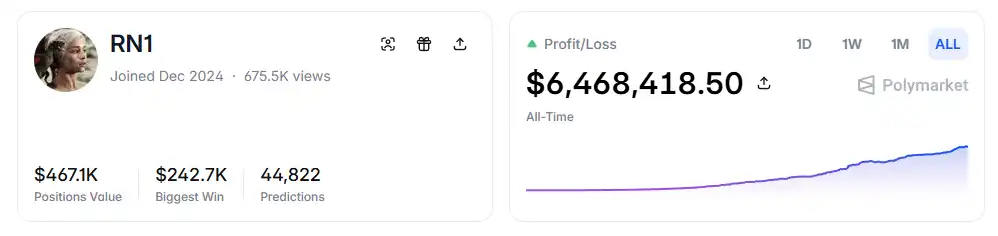
· distinct-baguette (Polymarket Profile: https://polymarket.com/profile/%40distinct-baguette): By providing liquidity in UP/DOWN markets, turned $560 into $812,000.
<1. Expected Value: The Most Fundamental Formula
On Polymarket, every trade is essentially a judgment of expected value. While most traders rely on intuition, the 13% of winners make decisions using math. Expected Value (EV) measures not a single outcome, but the average return after multiple repetitions, used to assess whether a trade is worth participating in.
Using an actual market as an example, "Will Bitcoin reach $150,000 by June 2026?" The current YES price is 12¢, corresponding to an implied market probability of 12%. If based on on-chain data, halving cycles, and ETF flows, the estimated true probability is around 20%, then this trade has a positive expected value. Calculated this way, for every contract purchased at 12¢, you can expect to earn 8¢ in the long run; buying 100 contracts, costing $12, would result in an expected return of $8, with a return rate of approximately +66.7%.
However, data shows that most prediction market traders do not perform such calculations. In a sample covering 72 million trades, takers (market buyers) averaged about a 1.12% loss per trade, while makers (limit order placers) averaged about a 1.12% profit per trade. The difference between the two lies not in information but in patience—makers wait for positive expected value opportunities, while takers are more prone to impulsive trading.
2. Mispricing: The Low-Price Contract Trap
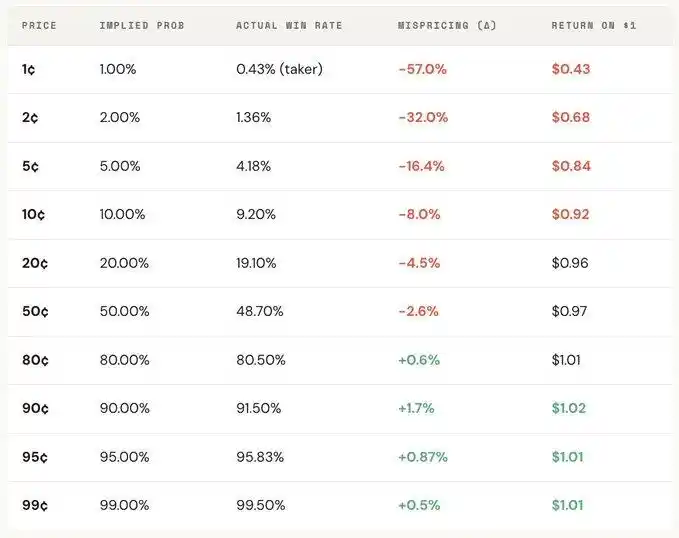
“Longshot bias” is one of the costliest errors in prediction markets, where traders systematically overestimate the likelihood of low-probability events, paying a disproportionately high price for seemingly cheap contracts. A contract priced at 5¢, theoretically should have a 5% win rate, but on Kalshi, the actual win rate is only 4.18%, resulting in a -16.36% pricing deviation; in more extreme cases, a 1¢ contract that should have a 1% win rate, in reality, has only a 0.43% win rate for takers, with a deviation as high as -57%.
Looking at the overall distribution, pricing is relatively accurate in the mid-range (30¢–70¢), but significant deviations appear at the extremes: contracts priced below 20¢ generally have win rates lower than the implied pricing probability; contracts priced above 80¢ often have win rates higher than the reflected probability.
In other words, market inefficiency is mainly concentrated at the extremes, precisely where emotional trading is most prevalent. Specifically, there are two formulas:
Formula One: Mispricing (Mispricing, δ)
Mispricing is used to measure the deviation between the actual win rate of a contract and its implied probability. Taking a 5¢ contract as an example, in all settled markets, assuming there were a total of 100,000 trades executed at 5¢, with 4180 trades resulting in YES, the actual win rate would be 4.18%, while the price corresponds to an implied probability of 5.00%. The difference between the two is -0.82 percentage points, with a relative deviation of about -16.36%. This means that for every purchase of a 5¢ contract, you are effectively paying a premium of around 16.36%.
Formula Two: Gross Excess Return (Gross Excess Return, rᵢ)
If mispricing reflects an overall bias, then the gross excess return reveals the actual return structure of each individual trade, where behavioral biases become clearly visible. When purchasing a 5¢ contract, two outcomes are possible: if the contract hits, the return can reach +1900% (about 20x return); if it misses, there is a direct loss of 100%, and the invested 5¢ is lost entirely.
This is why the "long shot bias" is attractive. Once it hits, the return is very high, easily remembered, amplified, and spread. However, overall, its actual hit rate is lower than the probability implied by the price, and the asymmetric structure between "total loss" and "very high return" creates negative expected value in a large number of trades, essentially equivalent to buying an overpriced lottery ticket.
From an overall distribution perspective, this bias exhibits a clear price gradient, where the lower the contract price, the worse the return. For example, as a taker, for every $1 invested in a 1¢ contract, you can only expect to receive around $0.43 on average; whereas in a 90¢ contract, for every $1 invested, you can expect to receive around $1.02. The cheaper the price, the more unfavorable the actual trading conditions.
Further breakdown of roles reveals that this structure is almost a mirror image relationship. The taker's losses in the low-price range (up to -57% at the lowest) directly correspond to the maker's gains in the same range; the overall market's pricing deviation lies between the two. In other words, for every penny lost by the taker, it is almost entirely gained by the maker.
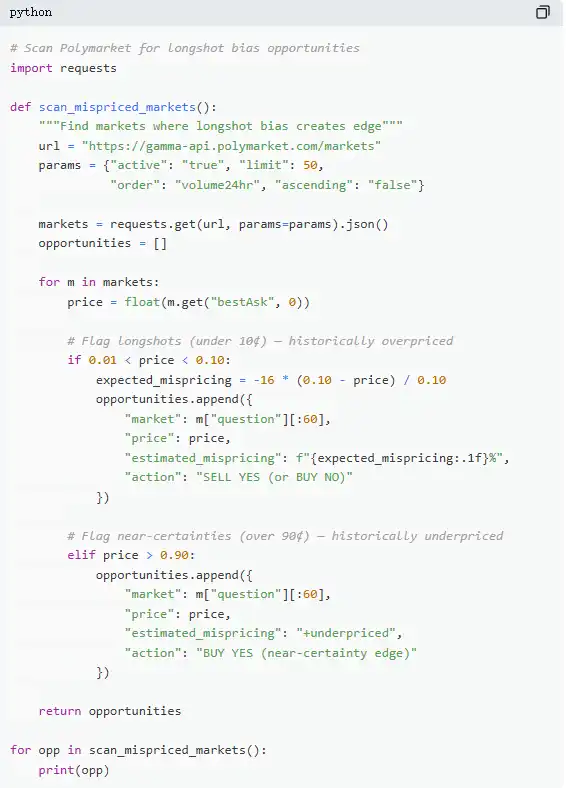
From a game theory perspective, low-probability contracts are usually systematically overvalued, while high-probability contracts are often undervalued. The real strategy is not to chase long shots but to sell them and buy high certainty.
3. Kelly Criterion: How Much to Bet
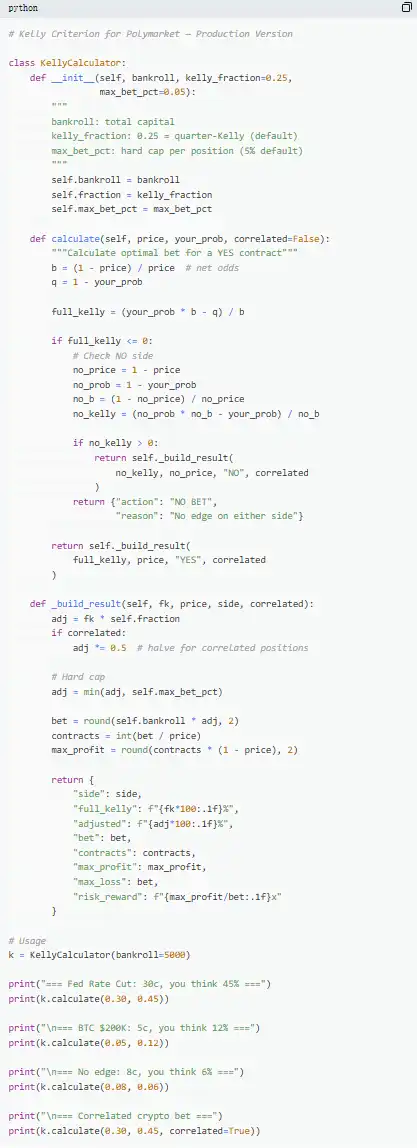
When a trade with positive expected value is found, the real question arises: how much should a trader bet? A too large position can wipe out several weeks of gains with a single loss; a too small position, even with an edge, will grow so slowly that it is almost meaningless. Between "all in" and "not betting at all," there is a mathematically optimal bet size, known as the Kelly Criterion.
The Kelly Criterion was proposed by John Kelly Jr. in 1956, initially to optimize communication signal noise issues, and later proven to be one of the most effective position sizing methods in gambling, trading, and market prediction. Professional poker players, sports bettors, and Wall Street quant funds almost all use some form of Kelly strategy.

In prediction markets, where contracts have a binary structure (outcome is $1 or $0), and the price itself represents probability, the application of the Kelly Criterion is more direct. The key is to understand the odds (b): if you buy a YES contract at 30¢, you are actually using $0.30 to win $0.70, corresponding to odds of 0.70 / 0.30 ≈ 2.33; odds are 1 at a price of 50¢; 9 at 10¢; and only 0.25 at 80¢. The higher the odds, the larger the bet size recommended by Kelly when there is an edge.
But a key principle is not to use full Kelly. Although mathematically full Kelly can maximize long-term wealth growth rate, in practice, its volatility is extreme, with drawdowns often exceeding 50%. While it may offer the highest returns over a long period, the sharp fluctuations along the way make it hard for most people to stick with. Therefore, the more common practice is to use fractional Kelly (such as 1/2 or 1/4 Kelly). For example, under stable win rate conditions, although full Kelly has the highest final equity curve, the volatility is high; 1/4 Kelly shows smoother growth with manageable drawdowns; 1/2 Kelly falls in between.
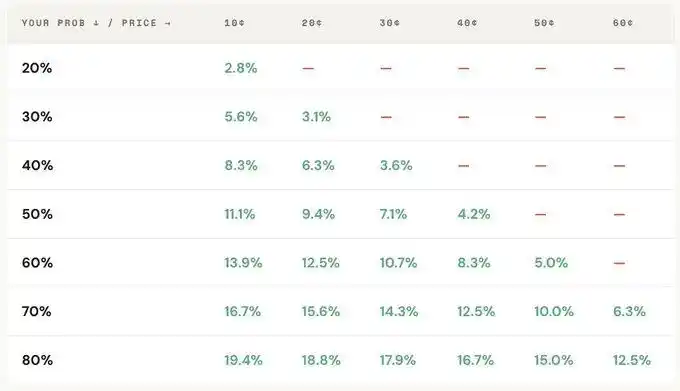
Essentially, the Kelly Criterion provides a set of discipline: first assess whether there is an edge (i.e., subjective probability higher than market implied probability), and based on this, decide how much to invest. Only when "whether to bet" and "how much to bet" are mathematically constrained does trading truly move from gambling to strategy.
4. Bayesian Updating: Changing Your Mind Like an Expert
The reason why prediction markets fluctuate is fundamentally because new information keeps coming in. The key is not whether the initial judgment was correct, but how to adjust one's perception when the evidence changes. Most traders either ignore new information or overreact to it, and Bayesian updating provides a mathematical method for "how much adjustment is reasonable."
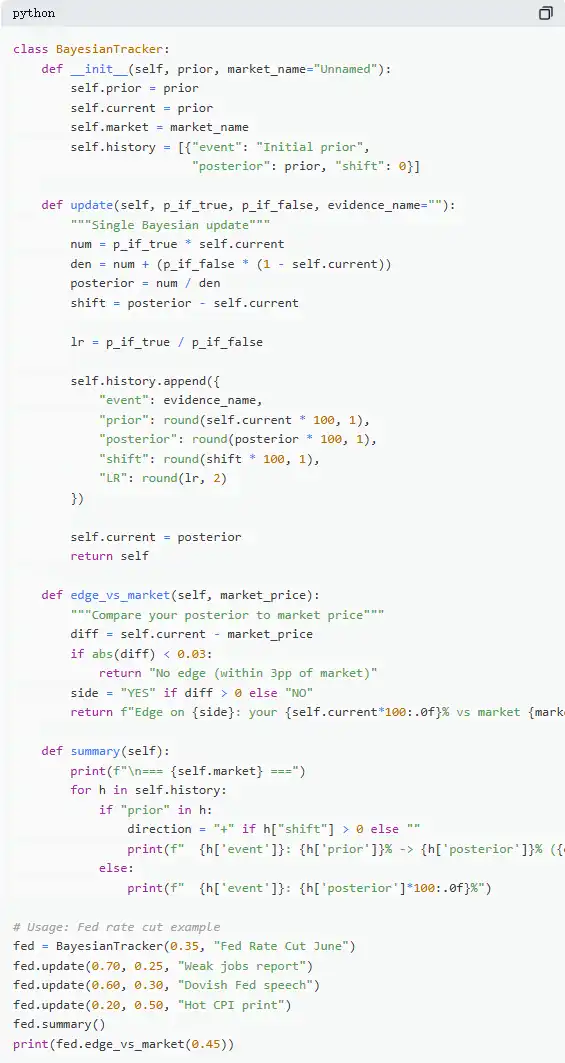
The core logic can be easily understood as New Belief = Support for the Evidence given the prior belief × Prior Belief ÷ Overall Probability of the Evidence. In practice, the full probability formula is usually expanded to a more computationally friendly form.
Using a typical market example, "Will the Fed cut interest rates at the June meeting?" The current market price is 35¢, corresponding to a 35% probability, as the initial judgment. Subsequently, non-farm payrolls data is released, showing only 120,000 new jobs (expectation was 200,000), rising unemployment, and slowing wage growth. In this scenario, if the Fed is indeed going to cut rates, the probability of weak jobs data is high, estimated at 70%; if the Fed is not going to cut rates, such data appearing is less likely but still possible, estimated at 25%.
After applying Bayesian updating, the new probability is around 60.1%, meaning a one-time increase from 35% to 60.1%, a rise of approximately 25 percentage points. This implies that a key piece of information is enough to significantly alter market judgment.
In practical terms, it is not necessary to fully calculate the formula each time. A more commonly used method is the "likelihood ratio." The same piece of information (e.g., LR = 3) has different effects depending on the initial judgment: starting from 10%, it may increase to about 25%; starting from 50%, it can rise to 75%; but starting from 90%, it only rises to around 96%. The higher the uncertainty, the greater the impact of the information.
Traders who truly outperform the prediction market in the long run are not necessarily the most "accurate judges" but those who can adjust their judgment the fastest and most reasonably when new evidence emerges. The Bayesian method fundamentally provides a scale for this "adjustment speed."
5. Nash Equilibrium: The "Poker Strategy" in Prediction Markets
In poker, bluffing is never a random act but a strategy that can be precisely calculated. There is theoretically an optimal bluffing frequency, and once deviated from, skillful opponents can exploit it. The same logic applies to prediction markets. On Polymarket, "bluffing" corresponds to contrarian trading—when there is a pricing discrepancy, choosing to stand against the majority; while "folding" is similar to being a passive taker, continuously paying a premium for market sentiment.
In Polymarket, makers and takers form a similar adversarial relationship. Contrarian trading (against market consensus) is akin to "bluffing," while trend trading (following mainstream judgment) is akin to "value betting." From an equilibrium perspective, the market should make marginal participants indifferent between being a maker and being a taker, a state that corresponds to Nash equilibrium in the prediction market.
However, this equilibrium is not fixed but dynamically adjusts with changes in participant structure. Data shows that different market categories correspond to different optimal strategies: in domains with more rational information and efficient pricing (such as financial markets), the contrarian space is smaller; whereas in domains with stronger emotions and more concentrated irrationality (such as entertainment, sports), the market is more prone to pricing discrepancies, thus providing opportunities for contrarian trading.
More importantly, this equilibrium has also undergone significant changes over time. In the early days (2021–2023), takers were actually the profitable group, and the optimal strategy leaned towards active trading; however, after the surge in trading volume in Q4 of 2024, many professional market makers entered, altering the market structure, shifting the equilibrium strategy towards being predominantly maker-driven (around 65%–70%). This is a typical outcome of game theory, where the optimal strategy evolves with changes in participant structure. Strategies that were effective in a "novice environment" may quickly become ineffective in the face of "professional opponents," leading to continuous market strategy iteration.
Conclusion
87% of prediction market wallets end up losing money, not because the market is manipulated, but because these traders never truly did the math. They buy into unpopular contracts at prices worse than slot machines, determine position sizes based on gut feeling, ignore new information changes, and pay for "optimism" in every market order.
The 13% of participants who continue to be profitable are not luckier; they treat these five formulas as a comprehensive system, from analysis to execution, built on top of 72.1 million real trading data points.
This window will not always be open. With the entry of professional market makers, market spreads are rapidly narrowing. In 2022, takers had approximately a +2.0% advantage, which has now turned into -1.12%.
The question is whether to evolve with the market or continue using a $0.43 return to buy a $1 lottery ticket.
You may also like

OpenClaw 3.28 Update: Potential Security Risks with Axios
Key Takeaways Recent findings suggest OpenClaw version 3.28 may contain a compromised version of the Axios library. Dependency…

Steakhouse Financial Experiences Phishing Attack: A Comprehensive Overview
Key Takeaways Steakhouse Financial’s domain experienced a phishing attack, prompting user safety advisories. Depositors’ funds and smart contracts…

DeFi Risk Management in Turmoil: Gauntlet’s Bold Move Amidst Resolv Exploit
Key Takeaways Gauntlet, a leading DeFi risk manager, is engaging in full recovery efforts after Resolv Labs’ exploit.…
FTX/Alameda Wallet Transfers Over $8 Million in ZRO Tokens to Wintermute
Key Takeaways An FTX/Alameda-associated wallet moved 4.126 million ZRO tokens to market maker Wintermute, with an approximate value…

Analysis of Recent Ethereum Short Position Activity on HyperLiquid
Key Takeaways Recently, a newly created wallet deposited $4.89 million into HyperLiquid, opening a short ETH position with…

After L2 Fraud, Ethereum Turns to ‘Economic Zone’ Self-Help

AI has simultaneously created a shortage and surplus of memory

How Can the Average Person Win in the 2026 AI Boom?

When Wall Street Meets Crypto, Here's Your "Stock Market Beginner & Advanced Guide"
StandX Introduces SIP1 and SIP2: Holding Subsidy Mechanism Launched, Reshaping On-Chain Trading and Reward Structure
Decoding Aave V4: A Shift from Product to "Banking"

Huobi HTX Releases "2026 Digital Asset Trends Whitepaper": Global Liquidity Reconfiguration, Defining the New Era of "On-Chain Finance"

PUMP Valuation Breakdown: Debunking On-Chain Data “Wash Trading” Narrative, Where Does the Real Discount Come From?

StandX launches SIP1 and SIP2: Position subsidy mechanism goes live, reshaping on-chain trading and revenue structure

Huobi HTX Releases the "2026 Digital Asset Trend White Paper": Global Liquidity Restructuring, Defining a New Sovereign Era of "On-Chain Finance"

DeFi Governance Revolution

Encrypted CEX is becoming a historical species

Who Pays for War? | Rewire News Morning Digest
OpenClaw 3.28 Update: Potential Security Risks with Axios
Key Takeaways Recent findings suggest OpenClaw version 3.28 may contain a compromised version of the Axios library. Dependency…
Steakhouse Financial Experiences Phishing Attack: A Comprehensive Overview
Key Takeaways Steakhouse Financial’s domain experienced a phishing attack, prompting user safety advisories. Depositors’ funds and smart contracts…
DeFi Risk Management in Turmoil: Gauntlet’s Bold Move Amidst Resolv Exploit
Key Takeaways Gauntlet, a leading DeFi risk manager, is engaging in full recovery efforts after Resolv Labs’ exploit.…
FTX/Alameda Wallet Transfers Over $8 Million in ZRO Tokens to Wintermute
Key Takeaways An FTX/Alameda-associated wallet moved 4.126 million ZRO tokens to market maker Wintermute, with an approximate value…
Analysis of Recent Ethereum Short Position Activity on HyperLiquid
Key Takeaways Recently, a newly created wallet deposited $4.89 million into HyperLiquid, opening a short ETH position with…


 App
App