
 Buy Crypto
- Markets
 Futures
- Spot
- Copy Trade
- Earn
- More
Pantera Partner: Future Opportunities in the Trillion-Dollar Stablecoin Market

Original Article Title: The Trillion Dollar Opportunity
Original Article Authors: Ryan Barney, Mason Nystrom, Partners at Pantera Capital
Original Article Translation: 0xjs, Golden Finance
A stablecoin represents a trillion-dollar opportunity.
This is not an exaggeration.
While people often think of cryptocurrencies as volatile tokens with liquidity, there is another side to cryptocurrency that is quietly waving the flag of adoption: stablecoins. For newcomers, these crypto dollars are pegged 1:1 to underlying fiat currency, maintaining the peg through algorithms (less common) or reserves (more common).
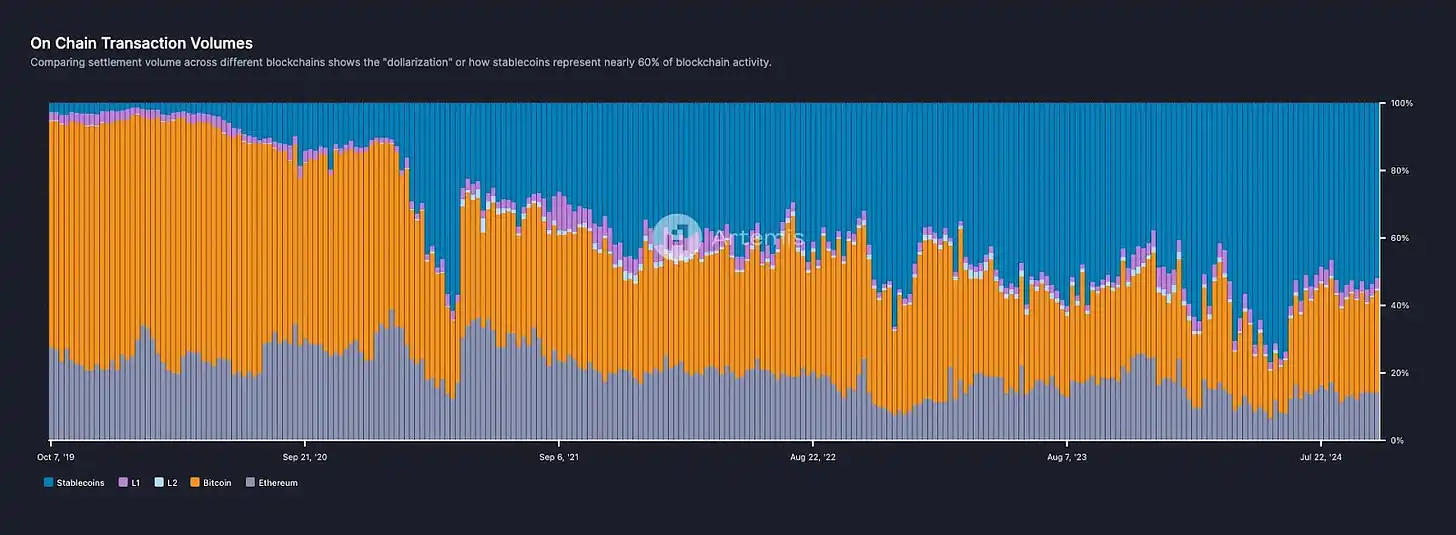
Stablecoins have seen their share of blockchain transactions rise from 3% in 2020 to over 50% now. Stablecoins are touted as killer applications for cryptocurrencies and, unlike many cryptocurrencies, stablecoins are inherently non-speculative.
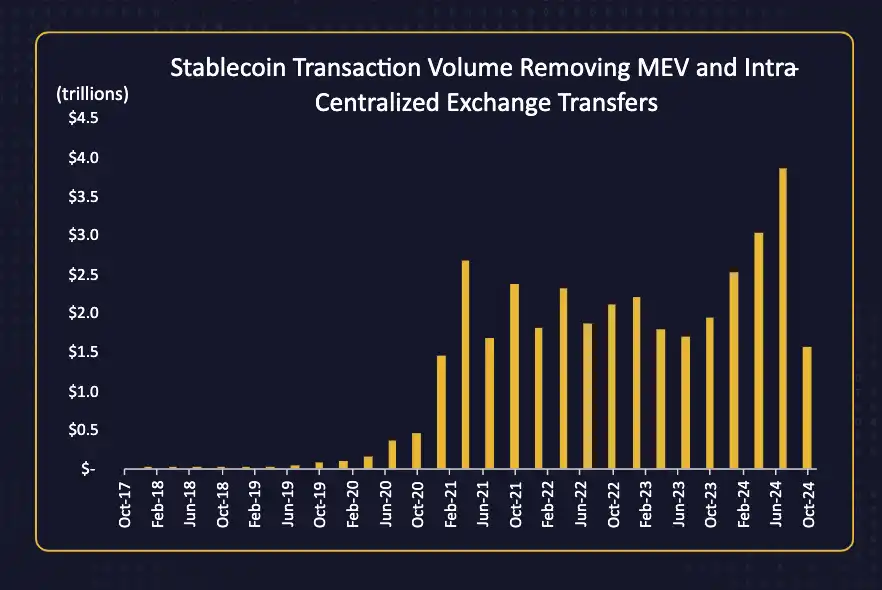
In a short amount of time, stablecoins have demonstrated their ability to be one of the transformative innovations in the cryptocurrency space. By 2024, stablecoins hit a milestone, with adjusted transaction volumes exceeding around $5 trillion, transaction values surpassing $1 billion, and involving nearly 200 million accounts.
In the previous cryptocurrency bull market, stablecoins saw notable growth, but this time around, the use cases of stablecoins have expanded beyond the DeFi ecosystem. Over the past few years, stablecoins have showcased their core value proposition—seamless cross-border payments, initially achieved through capturing the dollar. Accordingly, the fastest-growing regions for stablecoins are emerging markets with a high demand for dollars.
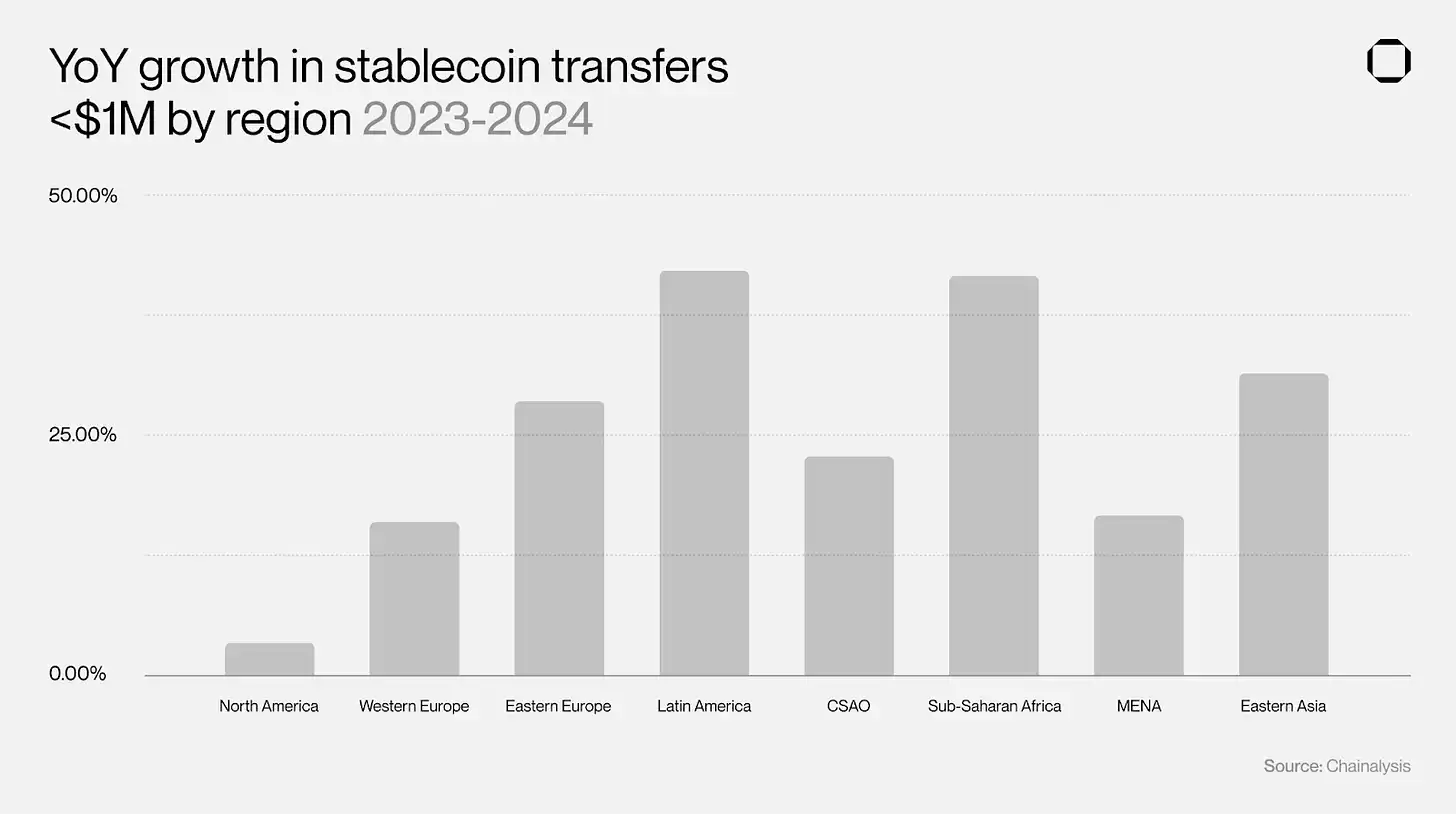
Stablecoins offer a 10x value proposition for B2C payments (e.g., remittances) and traditional payment methods for B2B cross-border transactions.
Cryptocurrencies have long held the promise of providing solutions for the trillion-dollar cross-border payments market. By 2024, B2B cross-border payments conducted via traditional payment channels are projected to reach around $40 trillion (excluding wholesale B2B payments) (Juniper Research). In the consumer payment market, global remittance revenues reach billions of dollars annually. Now, stablecoins offer a means to achieve global cross-border remittance payments through crypto channels.
With the adoption of stablecoins accelerating in the B2C and B2B payment space, the supply and transaction volume of on-chain stablecoins have reached an all-time high.
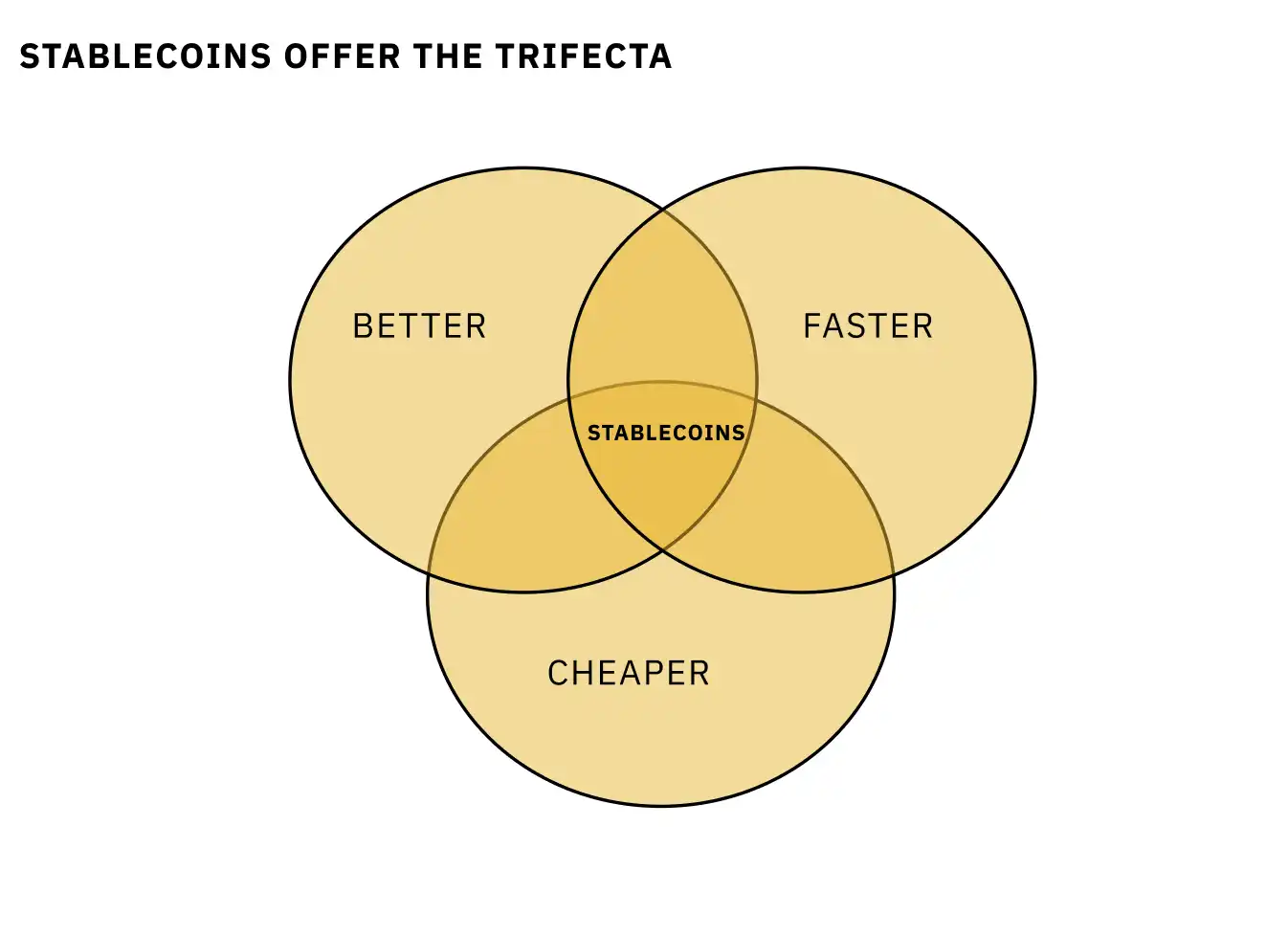
The Stablecoin Triad: Better. Faster. Cheaper.
A saying in the business world goes: Few products can offer something that is simultaneously better, faster, and cheaper. Typically, a product can meet two of these conditions at the same time, but not all three. Stablecoins provide a better, faster, and cheaper global fund transfer method.
For businesses and consumers, stablecoins offer a value proposition 10 times greater than the traditional US dollar.
Better: Stablecoins are a more accessible product, available 24/7, 365 days a year. They facilitate seamless global cross-border transfers and are programmable, making stablecoins a superior product to fiat currencies.
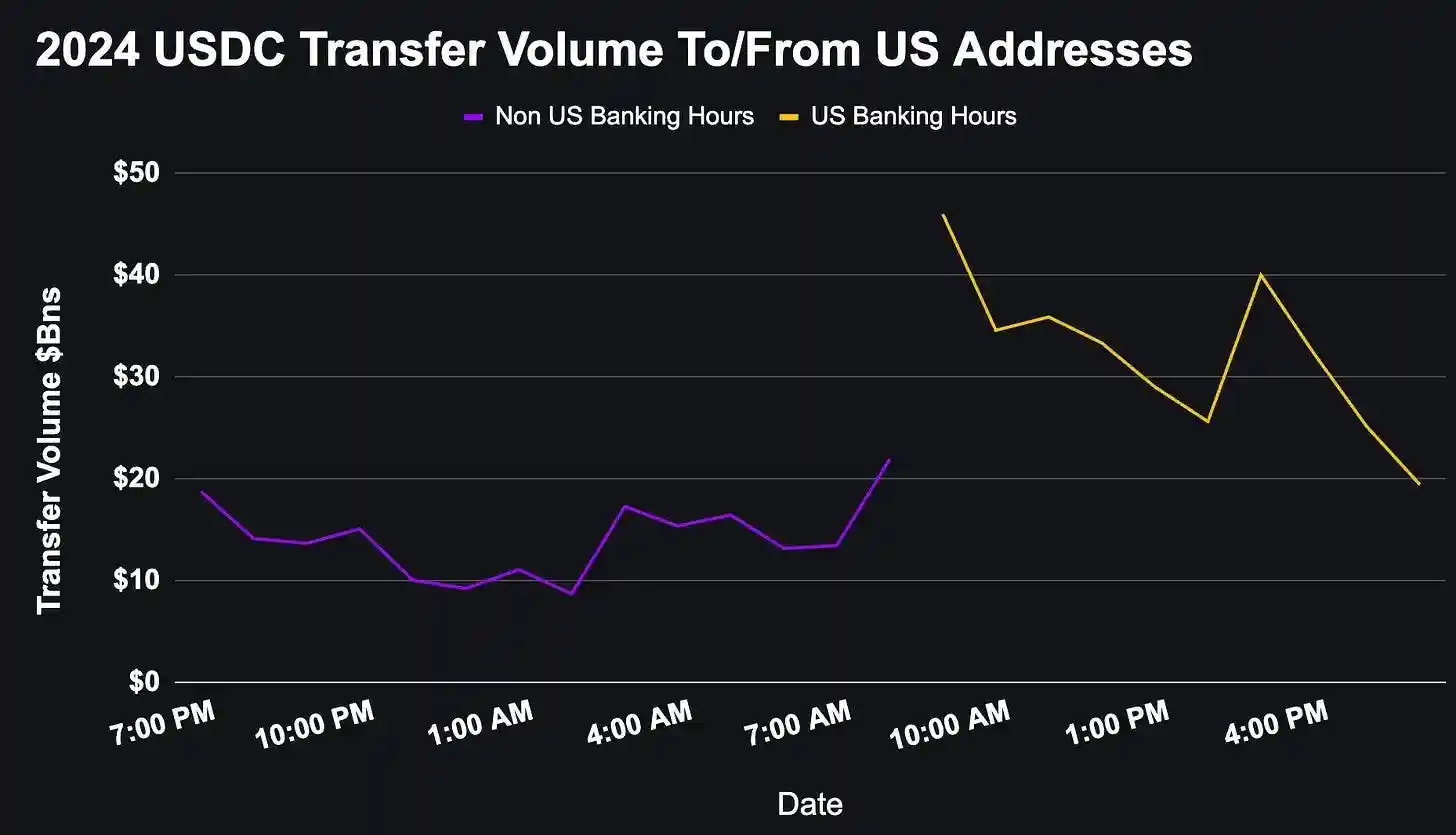
Faster: Stablecoins are undoubtedly faster, settling instantly rather than requiring T-minus 2 or T-minus 1 days to settle.
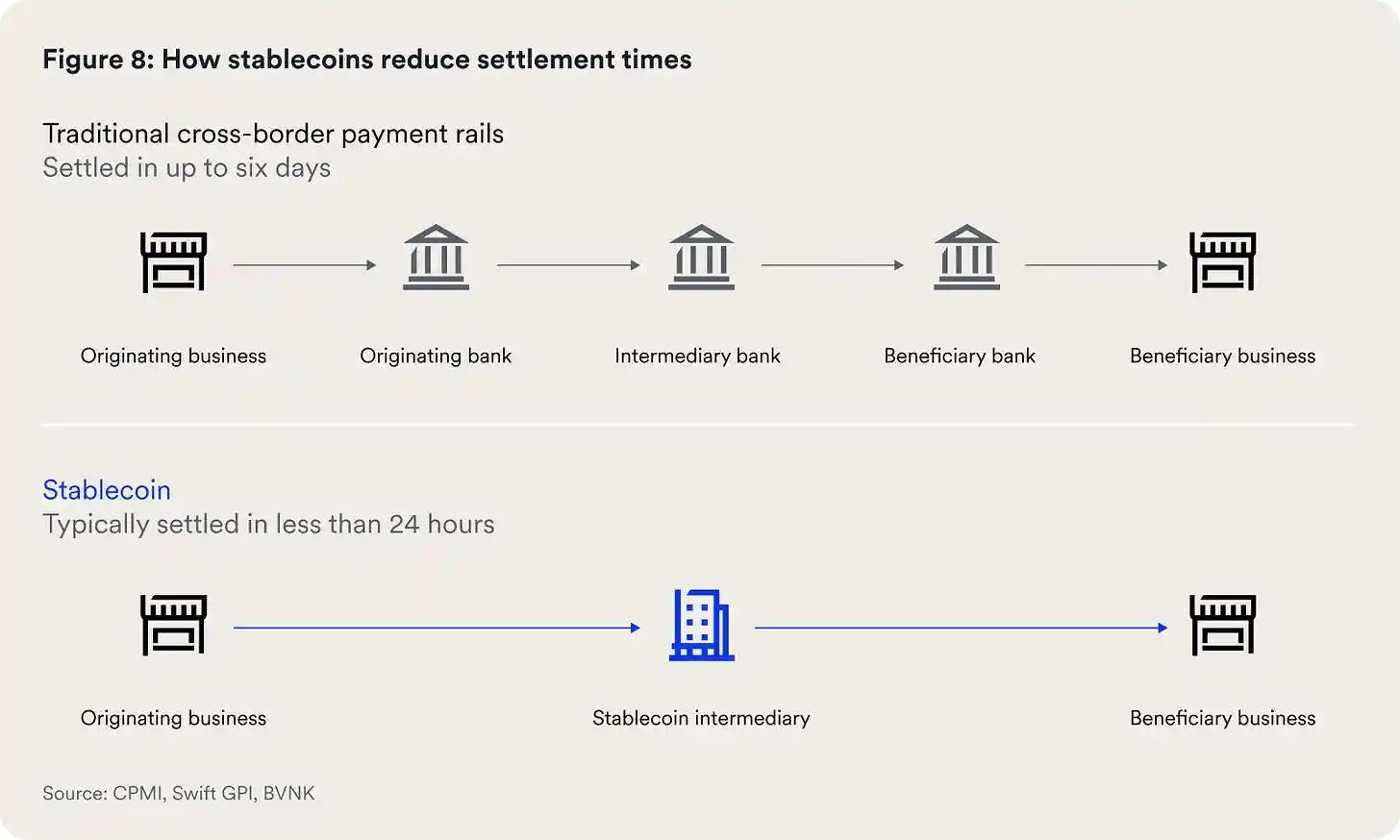
Image Source: BVNK Report
Cheaper: The issuance, transfer, and maintenance costs of stablecoins are lower than fiat currencies. In 2023, Stripe facilitated over $1 trillion in payments, starting at a 2.9% fee with an additional 30 cents for domestic card transactions. On high-throughput blockchains like Solana or Layer 2 solutions like Base on Ethereum, the average stablecoin payment cost is less than one cent.
Emerging Stablecoin Stack
While the stablecoin stack continues to evolve, some new emergent layers have appeared:
· Merchant Layer – Applications and interfaces facilitating retail or commercial transactions
· Stablecoin Orchestration – Providers offering the final mile in/out channels, virtual accounts, cross-border stablecoin transfers, or stablecoin-to-fiat currency exchange
· FX and Liquidity – Providers offering cross-border stablecoin to other USD-pegged stablecoins, fiat currencies, or regional stablecoin exchanges.
· Stablecoin Issuance — Companies or protocols issuing white-label stablecoins or first-party stablecoins with unique characteristics
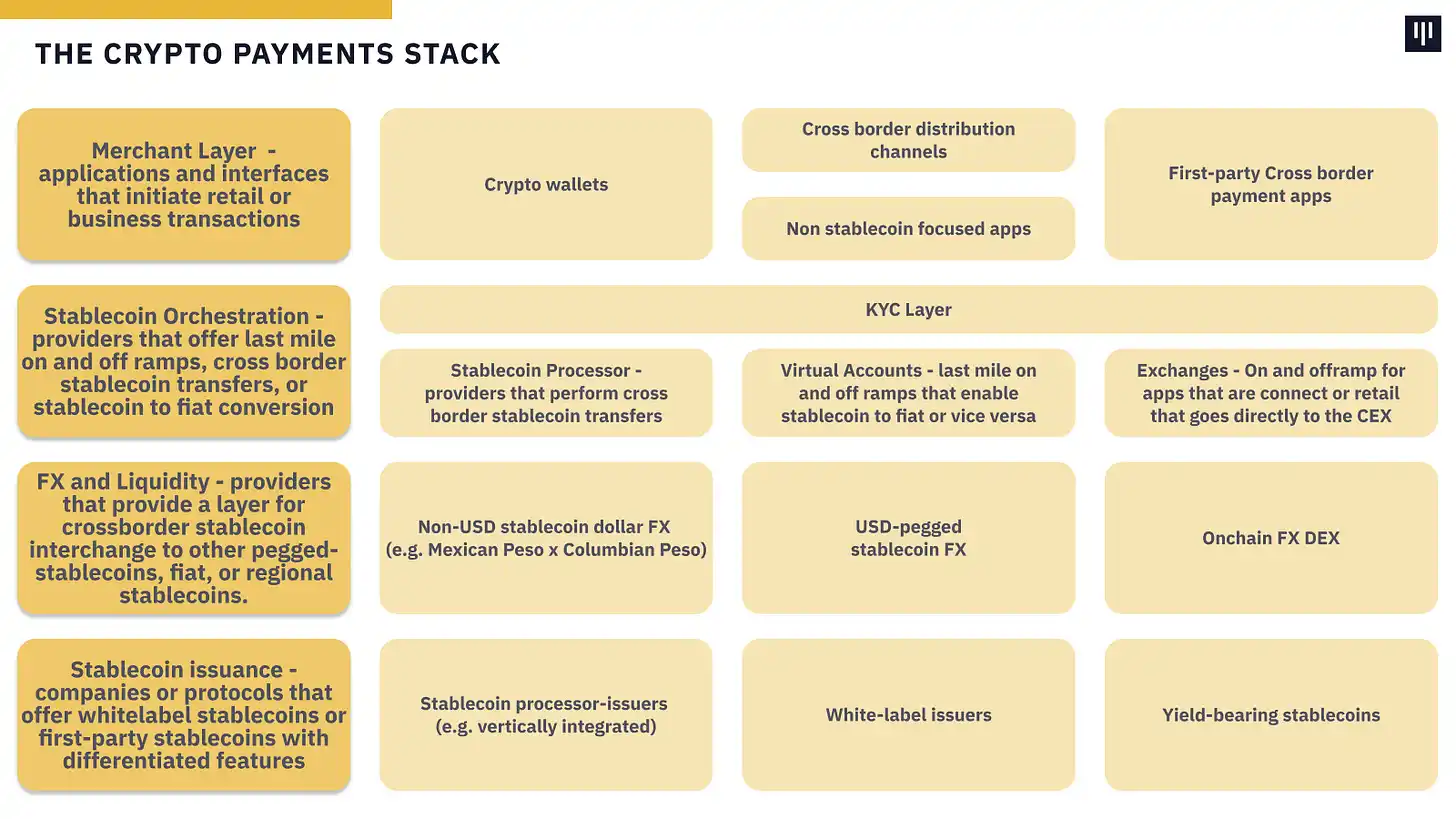
Similar to how cryptocurrency exchanges have emerged around the world to cater to local participants, we anticipate various cryptocurrency cross-border applications and processors to emerge as they cater to specific stablecoin markets.
Just like in traditional finance and payments, building moats at every layer of the stack is crucial to expanding beyond the initial value proposition. We have considered which moats are defensible and can be expanded at each layer over time:
· Merchant Layer — The moat is built through owning the stablecoin flow of users or businesses. This provides opportunities for upselling other services, selling user flows, and owning an end-to-end customer experience. The Robinhood of stablecoins will follow a similar strategy.
· Stablecoin Integration — Licensing! Who gets licensed will obtain the most reliable, cheapest global coverage. Is it developer-friendly? Look at the Stripe x Bridge acquisition to understand where the moat lies here and how it forms.
· Forex and Liquidity — Liquidity begets liquidity, traffic begets value accrual. Any participant who can access proprietary liquidity and price it efficiently will outcompete newcomers without it. That's why some major exchanges today serve most of the stablecoin flows for certain key channels. We also believe the transition from over-the-counter forex to exchange-based forex to on-chain forex will facilitate faster payments and transactions in this layer.
· Stablecoin Issuance — Over time, issuance will become commoditized, inevitably leading to the launch of dozens of major branded stablecoins (e.g., PYUSD). As other layers of the stack grow (i.e., merchants, business flows, and liquidity), we expect these layers to be capable of launching their own stablecoins, whether to capture yield, build their own branded stablecoins, or construct proprietary stablecoin liquidity and flow.
As the layers of the stack gradually intertwine, these layers will merge over time. The merchant layer is best suited to aggregate the other layers of the stack, providing more value to end-users, increasing profits, and creating additional revenue streams. They will have the option to choose which forex trades they conduct, own or lease which on/off ramps, and which issuers they use.
Furthermore, we anticipate that stablecoin issuance will become increasingly prevalent for large fintechs and e-commerce providers that facilitate significant capital flows. The next generation of neo-banks and fintech companies will be defined by stablecoins. Just this month, we've heard of major credit card networks like Visa, banks like JPM, and asset managers like Blackrock expressing interest in exploring their stablecoin projects.
error· Stablecoin Support for Fund Management and Operations — As the fintech space extends beyond PayPal payments, it has created billions of dollars in opportunities in wealth management, personal finance, payroll, corporate expenses and cost management, neobanking, financial accounting and reporting, loans/mortgages, etc. Similarly, stablecoins present an opportunity to rebuild many of these cumbersome processes on a better track supported by stablecoins. In the short term, fund management and operations have complex operations to handle, which makes the value proposition of stablecoins potentially disruptive.
Conclusion
Stablecoins represent a trillion-dollar business opportunity. We aim to support founders and visionaries who can see the future prospects of stablecoins and are unaffected by the financial system.
You may also like

Refutation of Yang Haipo's "The End of Cryptocurrency"

Can a hairdryer earn $34,000? Interpreting the reflexivity paradox of prediction markets

6MV Founder: In 2026, the "landmark turning point" for crypto investment has arrived

Abraxas Capital Mints $2.89 Billion USDT: Liquidity Boost or Just More Stablecoin Arbitrage?
Abraxas Capital just received $2.89 billion in freshly minted USDT from Tether. Is this a bullish liquidity injection for crypto markets, or is it business as usual for a stablecoin arbitrage giant? We analyze the data and the likely impact on Bitcoin, altcoins, and DeFi.
A VC from the Crypto world said AI is too crazy, and they are very conservative
The Evolutionary History of Contract Algorithms: A Decade of Perpetual Contracts, the Curtain Has Yet to Fall

Kicked out by PayPal, Musk aims to make a comeback in the cryptocurrency market

Solana ETF News: What Is a Solana ETF and Why Is Goldman Sachs Betting $108 Million on SOL?
Solana ETF news today shows Goldman Sachs disclosed a $108M position while total SOL ETF inflows reached $1.45B. Analysts now expect up to $6B in institutional demand as Solana trades 71% below its all-time high.

Bitcoin ETF News Today: $2.1B Inflows Signal Strong Institutional Demand for BTC
Bitcoin ETFs news recorded $2.1B inflows over 8 consecutive days, marking one of the strongest recent accumulation streaks. Here’s what the latest Bitcoin ETF news means for BTC price and whether the $80K breakout level is next.
Michael Saylor: Winter is Over – Is He Right? 5 Key Data Points (2026)
Michael Saylor tweeted yesterday “Winter‘s Over.” It is short. It is bold. And it has the crypto world talking.
But is he right? Or is this just another CEO pumping his bags?
Let us look at the data. Let us be neutral. Let us see if the ice has really melted.

WEEX Bubbles App Now Live Visualizes the Crypto Market at a Glance
WEEX Bubbles is a standalone app designed to help users quickly understand complex crypto market movements through an intuitive bubble visualization.

Polygon co-founder Sandeep: Writing after the chain bridge chain explosion

Major Upgrade on Web: 10+ Advanced Chart Styles for Deeper Market Insights
To deliver more powerful and professional analysis tools, WEEX has rolled out a major upgrade to its web trading charts—now supporting up to 14 advanced chart styles.

Morning Report | Aethir secures a $260 million enterprise contract with Axe Compute; New Fire Technology acquires Avenir Group's trading team; Polymarket's trading volume surpassed by Kalshi

Why a Million-Follower Crypto KOL Chooses WEEX VIP?
Discover why top crypto KOL Carl Moon partnered with WEEX. Explore the WEEX VIP ecosystem, 1,000 BTC protection fund, and exclusive rewards for serious traders.

CoinEx Founder: The Crypto Endgame in My Eyes

Spark Coin (SPK): Explodes 73% as Aave Bleeds $15B, A Good Investment Now?
Spark coin (SPK) surged 73% as $15 billion fled Aave after the KelpDAO hack. This article explains what Spark is, why it’s pumping, and whether it is a good investment right now.

As Aave's building collapses, Spark's high-rise is rising
Refutation of Yang Haipo's "The End of Cryptocurrency"
Can a hairdryer earn $34,000? Interpreting the reflexivity paradox of prediction markets
6MV Founder: In 2026, the "landmark turning point" for crypto investment has arrived
Abraxas Capital Mints $2.89 Billion USDT: Liquidity Boost or Just More Stablecoin Arbitrage?
Abraxas Capital just received $2.89 billion in freshly minted USDT from Tether. Is this a bullish liquidity injection for crypto markets, or is it business as usual for a stablecoin arbitrage giant? We analyze the data and the likely impact on Bitcoin, altcoins, and DeFi.


 App
App