
- Buy Crypto
- Markets
 Futures
- Spot
- Copy Trade
- Earn
- More
The Ethereum Pectra Update Improves Wallet Functionality Significantly
By: bitcoinleef|2025/05/08 20:15:02
0
Share
SummaryEthereum’s Pectra upgrade is now active on the mainnet, introducing significant functional changes to wallets and raising validator stake limits from 32 ETH to 2,048 ETH to simplify large-scale staking.A key feature, EIP-7702, allows standard wallets to behave like smart contracts, enabling non-ETH fee payments, transaction batching, and session keys for improved dApp interaction, aiming for a smoother user experience.While developers anticipate benefits from increased Layer 2 data capacity leading to faster and cheaper transactions, some security experts, like Vladimir S., warn that new message-signing mechanisms (even for off-chain messages) could create fresh vulnerabilities for wallet security.Concerns have also been raised by figures like Mikko Ohtamaa regarding the lack of clear standardization for certain new dApp permission features, potentially leading to inconsistent implementations across different wallets and a frustrating experience for developers and users.A pivotal development for the Ethereum blockchain, the Pectra upgrade, has been successfully implemented on its mainnet, heralding substantial changes. The activation of this upgrade was recorded at epoch 364032 on May 7, approximately at 10:05 UTC.Tim Beiko, leading Protocol Support at the Ethereum Foundation, affirmed the successful launch and finalization of Pectra. He also indicated that comprehensive testing of the newly integrated Ethereum Improvement Proposals (EIPs) would persist in the subsequent days. Joseph Lubin, a co-founder of Ethereum and CEO of Consensys, also weighed in, reflecting on the network’s considerable evolution over time. He characterized Ethereum as a platform boasting nearly a decade of uninterrupted operation and lauded the Pectra upgrade as a significant advancement in establishing the groundwork for a global, decentralized framework.Lubin elaborated on their long-term strategy: “[We are] patiently building the foundational substrate for the emerging decentralized global economy and system of the world, ensuring that we adhere to the sacred principles of credible neutrality, progressive rigorous decentralization and intrinsic censorship resistance.”Core Enhancements Delivered by the Pectra UpgradeThe Pectra upgrade is set to transform how users, network validators, and software developers engage with the Ethereum platform. It notably combines two major development streams: “Prague,” focusing on the execution layer, and “Electra,” targeting the consensus layer.A central innovation within this upgrade is EIP-7702, which will empower standard user wallets with capabilities akin to smart contracts. This enhancement will allow users to settle transaction fees using tokens other than ETH, bundle multiple transactions into a single operation, and utilize session keys for more seamless interactions with decentralized applications (dApps). Consequently, Ethereum users are anticipated to benefit from a more fluid experience across DeFi, gaming, and payment applications.Furthermore, Pectra introduces a significant escalation in the validator stake limit, increasing it from 32 ETH to 2,048 ETH. This change is expected to simplify operational procedures for institutional entities and large-scale stakers. Developers working on Ethereum are also poised to gain from augmented data capacity on Layer 2 networks, which should translate into quicker and more cost-effective transactions. Collectively, these modifications introduced by Pectra aim to bolster network performance, alleviate congestion, and refine the economic incentives for participation.Voices of Caution Amidst Widespread AcclaimDespite the broadly positive reception of the Pectra upgrade, certain security professionals have articulated reservations concerning potential risks associated with its new functionalities. Vladimir S., a respected blockchain security analyst, issued a warning that the novel message-signing mechanisms incorporated in the upgrade might inadvertently expose users to new types of vulnerabilities. He specifically cautioned that the act of signing even off-chain messages could now potentially render wallets susceptible to malicious exploitation, a departure from previous security assumptions primarily focused on transaction-based threats.He starkly noted, “Now with PECTRA ethereum upgrade, you only need to sign a message to get completely drained! Before, you actually had to sign the TX.”In a similar vein, Mikko Ohtamaa, co-founder of the cryptocurrency trading platform Trading Protocol, raised questions about the adequacy of standardization for certain Pectra features, particularly those concerning dApp permissions. He suggested that an absence of clear, universally adopted implementation guidelines could foster inconsistent user experiences across various wallet services, potentially leading to frustration for both users and developers.Ohtamaa commented, “Pectra is live with EIP-7715. But will it live up to its name? There doesn’t seem to be a standard for the simplest thing that everyone is advertising: batched approve + transfer. It’s ‘up for the wallets to decide.” Going to be another developer experience shitshow.”Also Read: Ethereum Developers Activate 11 Pectra Upgrades to Enhance UX and Layer 2 Scalability *Disclaimer*: We at Bitcoinleef.com present you with the latest information in the crypto market. However, this information should not be regarded as financial advice and viewers should consult their financial advisors before investing.The post The Ethereum Pectra Update Improves Wallet Functionality Significantly first appeared on Bitcoinleef.
You may also like

Particle Founder: The entrepreneurial insights I have gained the most from in the past year
Stop lean startup, stop lightning entrepreneurship, and think carefully about what your product aspirations are.

Huang Renxun's latest podcast transcript: The future of Nvidia, the development of embodied intelligence and agents, the explosion of inference demand, and the public relations crisis of artificial intelligence
The competition in the future is not just about whose model is larger or whose computing power is stronger, but also about who understands the industry better, who can embed AI more deeply into real processes, and who can organize these capabilities into a runnable and scalable system.

OKX Ventures Research Report: AI Agent Economic Infrastructure Research Report (Part 1)
The existing infrastructure is hostile to the Agent economy. Agents can think and act independently at the "capability level," but at the "economic level," they are still locked into infrastructure designed for humans.

The migration of settlement rights: B18 and the institutional starting point of on-chain banks
In the traditional system, banks decide the settlement; in the on-chain system, code begins to take over this responsibility.

From Tencent and Circle: Looking at the Simple and Difficult Questions of Investment
The AI narrative continues to ferment, but the recent performance of related stocks varies, with some in the midst of summer and others as if in winter.

The second half of stablecoins no longer belongs to the crypto circle
What Coinbase doesn't want, Mastercard is eager to buy.

Cursor "Shell" Kimi Controversy Reversed: From Copyright Infringement Allegations to Authorized Collaboration, China's Open Source Model Once Again Becomes a Global AI Foundation
Cursor was accused of being based on Kimi K2.5, which sparked controversy, and was later confirmed to be compliant through Fireworks AI due diligence.

The Real Reason Tokens Don't Sell: 90% of Crypto Projects Overlook Investor Relations
Provide an Investor Relations Best Practices Guide for Crypto Projects.

Is the income of pump.fun real, earning a million dollars a day despite the market downturn?
If it can really earn this much, what is the reason for the low price of $PUMP?

The real reason why tokens are not selling: 90% of crypto projects neglect investor relations
Investor Relations Practice Guide for Cryptocurrency Projects.

Who is the true winner of the "Tokenization" narrative?
Virtually everyone benefits, but the reason for the benefit, the timing, and the underlying logic are completely different.

Moss: The Era of AI-Traded by Anyone | Project Introduction
AI Trading Agent is rapidly growing its infrastructure.

Chip Smuggling Case Exposes Regulatory Loophole | Rewire News Evening Update
AI chips have become a strategic asset more sensitive than missiles

How a Structured AI Crypto Trading Bot Won at the WEEX Hackathon
Ritmex demonstrates how disciplined risk control and structured signals can make an AI crypto trading bot more stable and reliable on WEEX, highlighting the importance of combining execution discipline with scalable AI trading systems.

Old Indicator Fails, Three Major New Signals Emerge: BTC True Bottom May Still Be Below $60K
When the grocery shopping auntie on the subway, or Tony the hairdresser, start asking you about BTC, crypto, and cryptocurrency investments, selling immediately will be the only best option.

Meeting OpenClaw Founder at a Hackathon: What Else Can Lobsters Do?
Imperial College London MetaGame: AI Agent × Web3 Landing Three Major Directions.
Huang Renxun's Latest Podcast Transcript: NVIDIA's Future, Embodied Intelligence and Agent Development, Soaring Demand for Inferencing, and AI's PR Crisis
The future of competition is not only about whose model is bigger, whose computing power is stronger, but also about who understands the industry better, who can more deeply integrate AI into real processes, and who can organize these capabilities into a set of executable, scalable systems
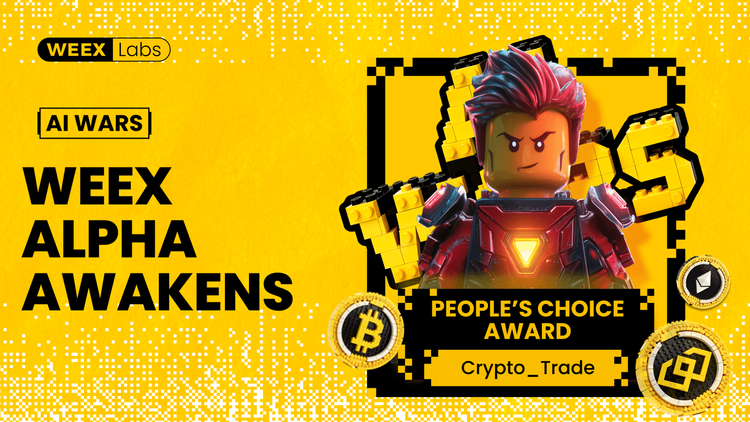
How a Structured AI Crypto Trading Bot Won at the WEEX Hackathon
Crypto_Trade shows how structured inputs and controlled adaptability can build a more stable and reliable AI crypto trading bot within the WEEX AI Trading Hackathon, highlighting a practical path toward scalable AI trading systems.
Particle Founder: The entrepreneurial insights I have gained the most from in the past year
Stop lean startup, stop lightning entrepreneurship, and think carefully about what your product aspirations are.
Huang Renxun's latest podcast transcript: The future of Nvidia, the development of embodied intelligence and agents, the explosion of inference demand, and the public relations crisis of artificial intelligence
The competition in the future is not just about whose model is larger or whose computing power is stronger, but also about who understands the industry better, who can embed AI more deeply into real processes, and who can organize these capabilities into a runnable and scalable system.
OKX Ventures Research Report: AI Agent Economic Infrastructure Research Report (Part 1)
The existing infrastructure is hostile to the Agent economy. Agents can think and act independently at the "capability level," but at the "economic level," they are still locked into infrastructure designed for humans.
The migration of settlement rights: B18 and the institutional starting point of on-chain banks
In the traditional system, banks decide the settlement; in the on-chain system, code begins to take over this responsibility.
From Tencent and Circle: Looking at the Simple and Difficult Questions of Investment
The AI narrative continues to ferment, but the recent performance of related stocks varies, with some in the midst of summer and others as if in winter.
The second half of stablecoins no longer belongs to the crypto circle
What Coinbase doesn't want, Mastercard is eager to buy.


 App
App