
- Buy Crypto
- Markets
 Futures
- Spot
- Copy Trade
 Earn
Earn- More
The Money-Making Effect is Over, Enter the Post-Crypto Twitter Era

Original Title: Welcome to Post-CT
Original Author: Lauris, Multiplier
Original Translation: Deep Tide TechFlow
Welcome to the era of "Post-Crypto Twitter"
Here, the term "Crypto Twitter" (CT) refers to Twitter as a market discovery and capital allocation engine, rather than the entire cryptocurrency community on Twitter.
"Post-Crypto Twitter" (Post-CT) does not mean the end of discussions, but rather signifies that Crypto Twitter, as a "mechanism of coordination through discourse," is gradually losing its ability to repeatedly orchestrate significant market events.
If a singular culture can no longer produce enough notable winners, it cannot sustainably attract the next wave of new participants.
The "significant market events" mentioned here do not refer to scenarios like "a token's price tripled," but rather to the majority of liquidity market participants focusing their attention on the same thing. In this framework, Crypto Twitter was once a mechanism that transformed public narratives into a coordinated flow around a dominant metanarrative. The significance of the "Post-Crypto Twitter" era is that this transformation mechanism no longer reliably functions.
I am not trying to predict what will happen next. Frankly, I do not have a clear answer either. The focus of this article is to explain why the previous pattern worked, why it is declining, and what this reorganization means for the cryptocurrency industry.
Why Was Crypto Twitter Effective?
The reason Crypto Twitter (CT) was important is that it compressed three market functions into one interface.
The first function of Crypto Twitter is narrative discovery. CT is a high-bandwidth salience mechanism. "Salience" is not just an "interesting" academic expression, but a market term referring to how the spectrum converges on what is currently worth paying attention to.
In practice, Crypto Twitter created a point of focus. It compressed a vast hypothesis space into a small subset of "actionable now" objects. This compression solved a coordination problem.
In a more mechanistic sense: Crypto Twitter transformed scattered, private attention into visible, public common knowledge. If you see ten reputable traders discussing the same object, you not only know of its existence but also know that others are aware of it and know that others know you are aware of it. In liquidity markets, this common knowledge is crucial.
As Herbert A. Simon once said:
“A wealth of information creates a poverty of attention.”
The second function of Crypto Twitter is to serve as a trust router. In the crypto market, most assets do not have the near-term ability to provide a strong intrinsic value anchor. As a result, capital cannot rely solely on fundamentals for allocation but flows through people, reputation, and ongoing signals. “Trust routing” is an informal infrastructure that determines whose claims can be believed early enough to have an impact.
This is not a mystical phenomenon but rather a rough reputation function calculated by thousands of participants continuously in public. People infer who the early entrants are, who has good foresight, who has resource channels, and whose actions are aligned with positive expected value (Positive EV). This reputation layer enables capital allocation to occur without formal due diligence as it serves as a simplifying tool for selecting counterparties.
It's worth noting that the trust mechanism in Crypto Twitter is not solely based on “number of followers.” It is a combination of follower count, who follows you, the quality of replies, credible interactions, and whether your predictions withstand real-world validation. Crypto Twitter makes these signals easy to observe at an extremely low cost.
Crypto Twitter holds both public trust, and over time, certain communities have gradually trended toward a more privacy-focused trust.
The third function of Crypto Twitter is to transform narratives into capital allocation through reflexivity. Reflexivity is key to this core loop: narratives drive prices, prices validate narratives, validation attracts more attention, attention brings in more buyers, and this loop continuously reinforces itself until it collapses.
At this point, the microstructure of the market comes into play. Narratives do not abstractly drive the “market” but the order flow. If a large group is convinced by a narrative that a certain object is “key,” marginal participants will express this belief by buying.
When this loop is strong enough, the market temporarily leans more towards rewarding behavior that aligns with consensus rather than deep analytical ability. In hindsight, Crypto Twitter is almost like a “low-intelligence version of the Bloomberg Terminal”: a single information stream that integrates salience, trust, and capital allocation.
Why is the “Monoculture” Era Possible?
The reason the “Monoculture” era can exist is due to its replicable structure. Each cycle revolves around an object simple enough for a massive group to understand yet broad enough to engage most of the ecosystem’s attention and liquidity. I like to refer to these objects as “toys.”
Here, the term "Toy" is not pejorative but a structural description. It can be understood as a kind of game—easy to explain, easy to engage with, and fundamentally social in nature (almost like an expansion pack for a large multiplayer online role-playing game). A "Toy" has a low barrier to entry and high narrative compressibility, allowing you to explain what it is in just one sentence to a friend.
"Metanarrative" (Meta) is the expression of when the "Toy" becomes a shared game board. Meta refers to the dominant set of strategies and the dominant object around which the majority of participants revolve. The reason why a "Single Culture" is powerful is that this metanarrative is not simply "popular" but a shared game across users, developers, traders, and venture capitalists. Everyone is playing the same game, just at different levels of the stack.
@icobeast has written a brilliant article on the cyclical nature and changing essence of "Trend Things"; I highly recommend reading it.
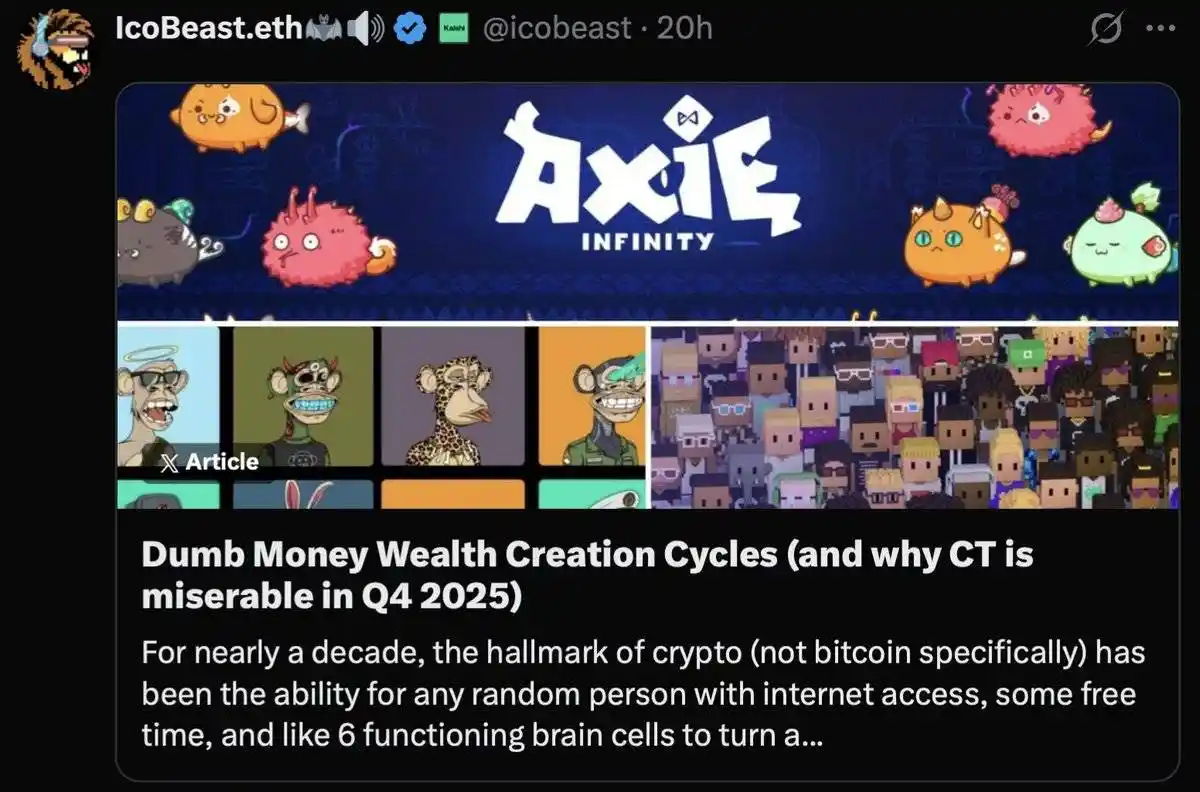
The market system we are experiencing requires an "inefficiency window" for people to rapidly earn "incredible wealth."
In the early stages of each cycle, the market is not yet fully efficient as the foundational infrastructure for massive participation in the metanarrative (Meta) has not been fully built. While opportunities exist at this point, the niche space in the market is not fully filled. This is crucial because the widespread accumulation of wealth requires a window where a large number of participants can enter the market rather than facing a hostile environment from the start.
As George Akerlof said in "The Market for Lemons":
"Asymmetric information between buyers and sellers leads markets away from efficiency."
The key is, to make this system work, you need to provide a highly efficient market for some while for others, this market is a typical "lemon market" (one filled with asymmetric information and inefficiencies).
A Single Culture system also requires a massive shared context, and Crypto Twitter (CT) provides this context. Shared contexts are rare on the internet as attention is usually fragmented. However, when a single culture forms, attention tends to concentrate. This focus can reduce coordination costs and amplify reflexivity effects.
As F. A. Hayek stated in "The Use of Knowledge in Society":
「The information we must leverage in those situations never exists in a centralized or integrated form, but only as dispersed, incomplete, and often contradictory fragments of knowledge held by all individuals.」
In other words, the formation of a shared context enables market participants to more efficiently coordinate their actions, thereby driving the prosperity and development of a single culture.
Why was the 「single narrative」 once so credible? When fundamentals have less constraint on the market, salience becomes a more important constraint than valuation. The primary question in the market is not 「How much is it worth?」 but 「What are we all paying attention to? Is this trade already too crowded?」
A rough analogy is that popular culture used to concentrate attention on only a few shared objects (such as the same TV shows, music on the charts, or celebrities). Today, attention is dispersed across various niche fields and subcultures, and people no longer share the same frame of reference on a large scale. Similarly, Crypto Twitter (CT) as a mechanism is also undergoing a similar transformation: the top-level shared context is diminishing, and more localized contexts are emerging within smaller circles.
Why is the "Post-Crypto Twitter" Era Emerging?
The reason for the emergence of the 「Post-Crypto Twitter」 (Post-CT) is that the conditions supporting the 「single culture」 are gradually failing.
The first failure is that the 「toy」 is being cracked faster.
In previous cycles, the market had already learned the rules of the game and industrialized these rules. When the rules of the game are industrialized, the window of inefficiency closes faster, and its duration becomes shorter. The result is that the distribution of returns becomes more extreme: there are increasingly fewer winners and more structural failures.
Meme coins are a typical example of this dynamic. As an asset class, they are effective because of their low complexity and high reflexivity. However, it is precisely this feature that makes meme coins easy to mass-produce. Once the production line is mature, the meta-narrative becomes an assembly line.
As the market evolves, there has been a change in microstructure. The median participant is no longer trading with other ordinary people but against the system. When they enter the market, information has already been widely disseminated, liquidity pools have been 「front-run,」 trade paths have been optimized, insiders have positioned themselves, and even exit paths have been precalculated. In such an environment, the expected return for the median participant is compressed to an extreme low.
In other words, most of the time, you are just becoming someone else's "Exit Liquidity."
A useful mental model is this: early-cycle order flow is mainly driven by naive retail investors, while late-cycle order flow increasingly takes on adversarial and mechanistic characteristics. The same "toy" can evolve into a completely different game at different stages.
A single culture cannot sustain itself if it fails to produce enough significant winners to attract the next wave of new participants.
The second failure is that value extraction overwhelms value creation
Here, "extraction" refers to those actors and mechanisms that capture liquidity value rather than create new liquidity.
In the early stages of the cycle, new participants can increase net liquidity while benefiting from it because the market's expansion rate is faster than the harvest rate of the extraction layer. However, in the later stages of the cycle, new participants often become net contributors to the extraction layer. When this sentiment is widely recognized, market participation begins to decline. The decline in participation weakens the reflexivity loop.
This is also why market sentiment changes so consistently. If a market no longer offers a broad, clear winning path, overall sentiment will gradually deteriorate. In a market where the median participant's experience is "I am just someone else's liquidity," cynicism is often rational.
To understand the overall market sentiment of current retail participants, you can refer to the post by @Chilearmy123.

The third failure is the distraction of attention. When no single entity can attract the entire ecosystem's attention, the market's "discovery layer" loses clear significance. Participants begin to diverge into narrower fields. This diversification is not only at the cultural level but also brings significant market consequences: liquidity is dispersed into different niche areas, price signals become less intuitively visible, and the dynamic of "everyone doing the same trade" disappears.
Furthermore, there is one more factor that needs to be briefly mentioned: Macro economic conditions will affect the strength of the reflexivity loop. The "single culture" era coincides with a period of strong global risk appetite and liquidity environment, making speculative reflexivity look like a "norm." However, as capital costs rise and marginal buyers become more cautious, narrative-driven fund flows are more difficult to sustain in the long run.
What Does "Post-Crypto Twitter" Mean?
“Post-Crypto Twitter” (Post-CT) refers to a new market environment where crypto Twitter is no longer the primary coordination mechanism for capital allocation across the entire ecosystem, nor is it the core engine around a single Meta narrative in the on-chain markets.
In the era of the “single culture,” crypto Twitter repeatedly and at scale tied narrative consensus to liquidity. In the “Post-Crypto Twitter” era, this tie becomes weaker and more intermittent. Crypto Twitter still matters as a discovery platform and reputation signal, but it is no longer the reliably synchronous driving engine for the entire ecosystem around “a trade,” “a toy,” “a shared context.”
In other words, crypto Twitter can still generate narratives, but only a few narratives can scale to become “common knowledge” at scale, and fewer “common knowledge” narratives can further convert into synchronized flow. When this conversion mechanism breaks down, even though there is still a lot of activity happening in the market, the overall sense feels “quieter.”
This is also why subjective experiences have changed. The market now feels slower, more specialized, as broad coordination has dissipated. Emotional shifts are mostly reactions to expected value (EV) conditions. The “quietness” of the market does not mean there is no activity; it is because of the absence of narratives that can catalyze a global resonance and synchronized action.
The Evolution of Crypto Twitter: From Engine to Interface
Crypto Twitter (CT) is not disappearing but rather undergoing a functional shift.
In earlier market systems, crypto Twitter was upstream in capital flows, somewhat determining the market direction. In the current market system, crypto Twitter is more akin to an “interface layer”: broadcasting reputation signals, surfacing narratives, and aiding trust routing, but actual capital allocation decisions are increasingly happening in higher-trust “subgraphs.”
These subgraphs are not opaque. They are dense networks of higher-quality information, with frequent interactions among participants, such as small trading circles, specific community spaces, private group chats, and institutional discussion spaces. In this system, crypto Twitter looks more like a surface-level “facade,” while real social and transactional activities take place in the social network layer behind.
This also explains a common misconception: “Crypto Twitter is fading” often actually means “Crypto Twitter is no longer the primary venue where the average participant makes money.” Wealth now accumulates more in places of higher information quality, restricted access, and more private trust mechanisms, rather than through public, noisy trust computations.
Nevertheless, you can still achieve significant earnings by posting on Crypto Twitter and building your personal brand (some of my friends and nodes have done this and are still doing so). However, the real value accrual comes from building your social graph, becoming a trusted participant, and gaining more exposure to the opportunities of the "backchannel layer."
In other words, while surface-level brand building remains important, the core competency has shifted towards constructing and engaging in the "backchannel trust network."
I Don't Know What Will Happen Next
I won't pretend to accurately predict what the next "Monoculture" will be. In fact, I am skeptical that a "Monoculture" will form in the same way again, at least under current market conditions. The key is that the mechanisms that once fostered the "Monoculture" have degraded.
My intuition may carry some subjectivity and contextuality as it is based on the phenomena I am currently observing. Nevertheless, the formation of these dynamics has actually started to manifest earlier this year.
There are indeed some active areas currently, and listing categories that attract attention is not difficult. But I won't mention these areas as it wouldn't contribute substantially to the discussion. In general, apart from presales and some initial distributions, the trend we are now seeing is that the most overvalued categories are often "adjacent" to Crypto Twitter (CT), rather than directly driven by Crypto Twitter itself.
Argument
We have entered the "Post-Crypto Twitter" (Post-CT) era.
This is not because Crypto Twitter is "dead" or because the discussions have lost meaning, but because the structural conditions that supported the recurrent "Monoculture" have been weakened. The game has become more efficient, value extraction mechanisms more mature, attention more dispersed, and reflexivity has gradually shifted from systemic to local.
The crypto industry is still ongoing, and Crypto Twitter still exists. My viewpoint is more specific: the era when Crypto Twitter could reliably coordinate the entire market into a shared metanarrative and create a broad, low-barrier-to-entry nonlinear income has at least for now come to an end. Moreover, I believe the likelihood of this phenomenon reemerging in the next few years is significantly reduced.
This doesn't mean you can't make money or that the crypto industry is coming to an end. This is neither a pessimistic point of view nor a conclusion of cynicism. In fact, I have never been as optimistic about the future of this industry as I am now. My view is that the future market distribution and significance mechanisms will be fundamentally different from the past few years.
You may also like

Token Cannot Compound, Where Is the Real Investment Opportunity?

February 6th Market Key Intelligence, How Much Did You Miss?

China's Central Bank and Eight Other Departments' Latest Regulatory Focus: Key Attention to RWA Tokenized Asset Risk
Foreword: Today, the People's Bank of China's website published the "Notice of the People's Bank of China, National Development and Reform Commission, Ministry of Industry and Information Technology, Ministry of Public Security, State Administration for Market Regulation, China Banking and Insurance Regulatory Commission, China Securities Regulatory Commission, State Administration of Foreign Exchange on Further Preventing and Dealing with Risks Related to Virtual Currency and Others (Yinfa [2026] No. 42)", the latest regulatory requirements from the eight departments including the central bank, which are basically consistent with the regulatory requirements of recent years. The main focus of the regulation is on speculative activities such as virtual currency trading, exchanges, ICOs, overseas platform services, and this time, regulatory oversight of RWA has been added, explicitly prohibiting RWA tokenization, stablecoins (especially those pegged to the RMB). The following is the full text:
To the people's governments of all provinces, autonomous regions, and municipalities directly under the Central Government, the Xinjiang Production and Construction Corps:
Recently, there have been speculative activities related to virtual currency and Real-World Assets (RWA) tokenization, disrupting the economic and financial order and jeopardizing the property security of the people. In order to further prevent and address the risks related to virtual currency and Real-World Assets tokenization, effectively safeguard national security and social stability, in accordance with the "Law of the People's Republic of China on the People's Bank of China," "Law of the People's Republic of China on Commercial Banks," "Securities Law of the People's Republic of China," "Law of the People's Republic of China on Securities Investment Funds," "Law of the People's Republic of China on Futures and Derivatives," "Cybersecurity Law of the People's Republic of China," "Regulations of the People's Republic of China on the Administration of Renminbi," "Regulations on Prevention and Disposal of Illegal Fundraising," "Regulations of the People's Republic of China on Foreign Exchange Administration," "Telecommunications Regulations of the People's Republic of China," and other provisions, after reaching consensus with the Cyberspace Administration of China, the Supreme People's Court, and the Supreme People's Procuratorate, and with the approval of the State Council, the relevant matters are notified as follows:
(I) Virtual currency does not possess the legal status equivalent to fiat currency. Virtual currencies such as Bitcoin, Ether, Tether, etc., have the main characteristics of being issued by non-monetary authorities, using encryption technology and distributed ledger or similar technology, existing in digital form, etc. They do not have legal tender status, should not and cannot be circulated and used as currency in the market.
The business activities related to virtual currency are classified as illegal financial activities. The exchange of fiat currency and virtual currency within the territory, exchange of virtual currencies, acting as a central counterparty in buying and selling virtual currencies, providing information intermediary and pricing services for virtual currency transactions, token issuance financing, and trading of virtual currency-related financial products, etc., fall under illegal financial activities, such as suspected illegal issuance of token vouchers, unauthorized public issuance of securities, illegal operation of securities and futures business, illegal fundraising, etc., are strictly prohibited across the board and resolutely banned in accordance with the law. Overseas entities and individuals are not allowed to provide virtual currency-related services to domestic entities in any form.
A stablecoin pegged to a fiat currency indirectly fulfills some functions of the fiat currency in circulation. Without the consent of relevant authorities in accordance with the law and regulations, any domestic or foreign entity or individual is not allowed to issue a RMB-pegged stablecoin overseas.
(II)Tokenization of Real-World Assets refers to the use of encryption technology and distributed ledger or similar technologies to transform ownership rights, income rights, etc., of assets into tokens (tokens) or other interests or bond certificates with token (token) characteristics, and carry out issuance and trading activities.
Engaging in the tokenization of real-world assets domestically, as well as providing related intermediary, information technology services, etc., which are suspected of illegal issuance of token vouchers, unauthorized public offering of securities, illegal operation of securities and futures business, illegal fundraising, and other illegal financial activities, shall be prohibited; except for relevant business activities carried out with the approval of the competent authorities in accordance with the law and regulations and relying on specific financial infrastructures. Overseas entities and individuals are not allowed to illegally provide services related to the tokenization of real-world assets to domestic entities in any form.
(III) Inter-agency Coordination. The People's Bank of China, together with the National Development and Reform Commission, the Ministry of Industry and Information Technology, the Ministry of Public Security, the State Administration for Market Regulation, the China Banking and Insurance Regulatory Commission, the China Securities Regulatory Commission, the State Administration of Foreign Exchange, and other departments, will improve the work mechanism, strengthen coordination with the Cyberspace Administration of China, the Supreme People's Court, and the Supreme People's Procuratorate, coordinate efforts, and overall guide regions to carry out risk prevention and disposal of virtual currency-related illegal financial activities.
The China Securities Regulatory Commission, together with the National Development and Reform Commission, the Ministry of Industry and Information Technology, the Ministry of Public Security, the People's Bank of China, the State Administration for Market Regulation, the China Banking and Insurance Regulatory Commission, the State Administration of Foreign Exchange, and other departments, will improve the work mechanism, strengthen coordination with the Cyberspace Administration of China, the Supreme People's Court, and the Supreme People's Procuratorate, coordinate efforts, and overall guide regions to carry out risk prevention and disposal of illegal financial activities related to the tokenization of real-world assets.
(IV) Strengthening Local Implementation. The people's governments at the provincial level are overall responsible for the prevention and disposal of risks related to virtual currencies and the tokenization of real-world assets in their respective administrative regions. The specific leading department is the local financial regulatory department, with participation from branches and dispatched institutions of the State Council's financial regulatory department, telecommunications regulators, public security, market supervision, and other departments, in coordination with cyberspace departments, courts, and procuratorates, to improve the normalization of the work mechanism, effectively connect with the relevant work mechanisms of central departments, form a cooperative and coordinated working pattern between central and local governments, effectively prevent and properly handle risks related to virtual currencies and the tokenization of real-world assets, and maintain economic and financial order and social stability.
(5) Enhanced Risk Monitoring. The People's Bank of China, China Securities Regulatory Commission, National Development and Reform Commission, Ministry of Industry and Information Technology, Ministry of Public Security, State Administration of Foreign Exchange, Cyberspace Administration of China, and other departments continue to improve monitoring techniques and system support, enhance cross-departmental data analysis and sharing, establish sound information sharing and cross-validation mechanisms, promptly grasp the risk situation of activities related to virtual currency and real-world asset tokenization. Local governments at all levels give full play to the role of local monitoring and early warning mechanisms. Local financial regulatory authorities, together with branches and agencies of the State Council's financial regulatory authorities, as well as departments of cyberspace and public security, ensure effective connection between online monitoring, offline investigation, and fund tracking, efficiently and accurately identify activities related to virtual currency and real-world asset tokenization, promptly share risk information, improve early warning information dissemination, verification, and rapid response mechanisms.
(6) Strengthened Oversight of Financial Institutions, Intermediaries, and Technology Service Providers. Financial institutions (including non-bank payment institutions) are prohibited from providing account opening, fund transfer, and clearing services for virtual currency-related business activities, issuing and selling financial products related to virtual currency, including virtual currency and related financial products in the scope of collateral, conducting insurance business related to virtual currency, or including virtual currency in the scope of insurance liability. Financial institutions (including non-bank payment institutions) are prohibited from providing custody, clearing, and settlement services for unauthorized real-world asset tokenization-related business and related financial products. Relevant intermediary institutions and information technology service providers are prohibited from providing intermediary, technical, or other services for unauthorized real-world asset tokenization-related businesses and related financial products.
(7) Enhanced Management of Internet Information Content and Access. Internet enterprises are prohibited from providing online business venues, commercial displays, marketing, advertising, or paid traffic diversion services for virtual currency and real-world asset tokenization-related business activities. Upon discovering clues of illegal activities, they should promptly report to relevant departments and provide technical support and assistance for related investigations and inquiries. Based on the clues transferred by the financial regulatory authorities, the cyberspace administration, telecommunications authorities, and public security departments should promptly close and deal with websites, mobile applications (including mini-programs), and public accounts engaged in virtual currency and real-world asset tokenization-related business activities in accordance with the law.
(8) Strengthened Entity Registration and Advertisement Management. Market supervision departments strengthen entity registration and management, and enterprise and individual business registrations must not contain terms such as "virtual currency," "virtual asset," "cryptocurrency," "crypto asset," "stablecoin," "real-world asset tokenization," or "RWA" in their names or business scopes. Market supervision departments, together with financial regulatory authorities, legally enhance the supervision of advertisements related to virtual currency and real-world asset tokenization, promptly investigating and handling relevant illegal advertisements.
(IX) Continued Rectification of Virtual Currency Mining Activities. The National Development and Reform Commission, together with relevant departments, strictly controls virtual currency mining activities, continuously promotes the rectification of virtual currency mining activities. The people's governments of various provinces take overall responsibility for the rectification of "mining" within their respective administrative regions. In accordance with the requirements of the National Development and Reform Commission and other departments in the "Notice on the Rectification of Virtual Currency Mining Activities" (NDRC Energy-saving Building [2021] No. 1283) and the provisions of the "Guidance Catalog for Industrial Structure Adjustment (2024 Edition)," a comprehensive review, investigation, and closure of existing virtual currency mining projects are conducted, new mining projects are strictly prohibited, and mining machine production enterprises are strictly prohibited from providing mining machine sales and other services within the country.
(X) Severe Crackdown on Related Illegal Financial Activities. Upon discovering clues to illegal financial activities related to virtual currency and the tokenization of real-world assets, local financial regulatory authorities, branches of the State Council's financial regulatory authorities, and other relevant departments promptly investigate, determine, and properly handle the issues in accordance with the law, and seriously hold the relevant entities and individuals legally responsible. Those suspected of crimes are transferred to the judicial authorities for processing according to the law.
(XI) Severe Crackdown on Related Illegal and Criminal Activities. The Ministry of Public Security, the People's Bank of China, the State Administration for Market Regulation, the China Banking and Insurance Regulatory Commission, the China Securities Regulatory Commission, as well as judicial and procuratorial organs, in accordance with their respective responsibilities, rigorously crack down on illegal and criminal activities related to virtual currency, the tokenization of real-world assets, such as fraud, money laundering, illegal business operations, pyramid schemes, illegal fundraising, and other illegal and criminal activities carried out under the guise of virtual currency, the tokenization of real-world assets, etc.
(XII) Strengthen Industry Self-discipline. Relevant industry associations should enhance membership management and policy advocacy, based on their own responsibilities, advocate and urge member units to resist illegal financial activities related to virtual currency and the tokenization of real-world assets. Member units that violate regulatory policies and industry self-discipline rules are to be disciplined in accordance with relevant self-regulatory management regulations. By leveraging various industry infrastructure, conduct risk monitoring related to virtual currency, the tokenization of real-world assets, and promptly transfer issue clues to relevant departments.
(XIII) Without the approval of relevant departments in accordance with the law and regulations, domestic entities and foreign entities controlled by them may not issue virtual currency overseas.
(XIV) Domestic entities engaging directly or indirectly in overseas external debt-based tokenization of real-world assets, or conducting asset securitization activities abroad based on domestic ownership rights, income rights, etc. (hereinafter referred to as domestic equity), should be strictly regulated in accordance with the principles of "same business, same risk, same rules." The National Development and Reform Commission, the China Securities Regulatory Commission, the State Administration of Foreign Exchange, and other relevant departments regulate it according to their respective responsibilities. For other forms of overseas real-world asset tokenization activities based on domestic equity by domestic entities, the China Securities Regulatory Commission, together with relevant departments, supervise according to their division of responsibilities. Without the consent and filing of relevant departments, no unit or individual may engage in the above-mentioned business.
(15) Overseas subsidiaries and branches of domestic financial institutions providing Real World Asset Tokenization-related services overseas shall do so legally and prudently. They shall have professional personnel and systems in place to effectively mitigate business risks, strictly implement customer onboarding, suitability management, anti-money laundering requirements, and incorporate them into the domestic financial institutions' compliance and risk management system. Intermediaries and information technology service providers offering Real World Asset Tokenization services abroad based on domestic equity or conducting Real World Asset Tokenization business in the form of overseas debt for domestic entities directly or indirectly venturing abroad must strictly comply with relevant laws and regulations. They should establish and improve relevant compliance and internal control systems in accordance with relevant normative requirements, strengthen business and risk control, and report the business developments to the relevant regulatory authorities for approval or filing.
(16) Strengthen organizational leadership and overall coordination. All departments and regions should attach great importance to the prevention of risks related to virtual currencies and Real World Asset Tokenization, strengthen organizational leadership, clarify work responsibilities, form a long-term effective working mechanism with centralized coordination, local implementation, and shared responsibilities, maintain high pressure, dynamically monitor risks, effectively prevent and mitigate risks in an orderly and efficient manner, legally protect the property security of the people, and make every effort to maintain economic and financial order and social stability.
(17) Widely carry out publicity and education. All departments, regions, and industry associations should make full use of various media and other communication channels to disseminate information through legal and policy interpretation, analysis of typical cases, and education on investment risks, etc. They should promote the illegality and harm of virtual currencies and Real World Asset Tokenization-related businesses and their manifestations, fully alert to potential risks and hidden dangers, and enhance public awareness and identification capabilities for risk prevention.
(18) Engaging in illegal financial activities related to virtual currencies and Real World Asset Tokenization in violation of this notice, as well as providing services for virtual currencies and Real World Asset Tokenization-related businesses, shall be punished in accordance with relevant regulations. If it constitutes a crime, criminal liability shall be pursued according to the law. For domestic entities and individuals who knowingly or should have known that overseas entities illegally provided virtual currency or Real World Asset Tokenization-related services to domestic entities and still assisted them, relevant responsibilities shall be pursued according to the law. If it constitutes a crime, criminal liability shall be pursued according to the law.
(19) If any unit or individual invests in virtual currencies, Real World Asset Tokens, and related financial products against public order and good customs, the relevant civil legal actions shall be invalid, and any resulting losses shall be borne by them. If there are suspicions of disrupting financial order and jeopardizing financial security, the relevant departments shall deal with them according to the law.
This notice shall enter into force upon the date of its issuance. The People's Bank of China and ten other departments' "Notice on Further Preventing and Dealing with the Risks of Virtual Currency Trading Speculation" (Yinfa [2021] No. 237) is hereby repealed.

Former Partner's Perspective on Multicoin: Kyle's Exit, But the Game He Left Behind Just Getting Started

Why Bitcoin Is Falling Now: The Real Reasons Behind BTC's Crash & WEEX's Smart Profit Playbook
Bitcoin's ongoing crash explained: Discover the 5 hidden triggers behind BTC's plunge & how WEEX's Auto Earn and Trade to Earn strategies help traders profit from crypto market volatility.

Wall Street's Hottest Trades See Exodus

Vitalik Discusses Ethereum Scaling Path, Circle Announces Partnership with Polymarket, What's the Overseas Crypto Community Talking About Today?

Believing in the Capital Markets - The Essence and Core Value of Cryptocurrency

Polymarket's 'Weatherman': Predict Temperature, Win Million-Dollar Payout

$15K+ Profits: The 4 AI Trading Secrets WEEX Hackathon Prelim Winners Used to Dominate Volatile Crypto Markets
How WEEX Hackathon's top AI trading strategies made $15K+ in crypto markets: 4 proven rules for ETH/BTC trading, market structure analysis, and risk management in volatile conditions.

A nearly 20% one-day plunge, how long has it been since you last saw a $60,000 Bitcoin?

Raoul Pal: I've seen every single panic, and they are never the end.

Key Market Information Discrepancy on February 6th - A Must-Read! | Alpha Morning Report

2026 Crypto Industry's First Snowfall
The Harsh Reality Behind the $26 Billion Crypto Liquidation: Liquidity Is Killing the Market
Why Is Gold, US Stocks, Bitcoin All Falling?

Key Market Intelligence for February 5th, how much did you miss out on?

Wintermute: By 2026, crypto had gradually become the settlement layer of the Internet economy
Token Cannot Compound, Where Is the Real Investment Opportunity?
February 6th Market Key Intelligence, How Much Did You Miss?
China's Central Bank and Eight Other Departments' Latest Regulatory Focus: Key Attention to RWA Tokenized Asset Risk
Foreword: Today, the People's Bank of China's website published the "Notice of the People's Bank of China, National Development and Reform Commission, Ministry of Industry and Information Technology, Ministry of Public Security, State Administration for Market Regulation, China Banking and Insurance Regulatory Commission, China Securities Regulatory Commission, State Administration of Foreign Exchange on Further Preventing and Dealing with Risks Related to Virtual Currency and Others (Yinfa [2026] No. 42)", the latest regulatory requirements from the eight departments including the central bank, which are basically consistent with the regulatory requirements of recent years. The main focus of the regulation is on speculative activities such as virtual currency trading, exchanges, ICOs, overseas platform services, and this time, regulatory oversight of RWA has been added, explicitly prohibiting RWA tokenization, stablecoins (especially those pegged to the RMB). The following is the full text:
To the people's governments of all provinces, autonomous regions, and municipalities directly under the Central Government, the Xinjiang Production and Construction Corps:
Recently, there have been speculative activities related to virtual currency and Real-World Assets (RWA) tokenization, disrupting the economic and financial order and jeopardizing the property security of the people. In order to further prevent and address the risks related to virtual currency and Real-World Assets tokenization, effectively safeguard national security and social stability, in accordance with the "Law of the People's Republic of China on the People's Bank of China," "Law of the People's Republic of China on Commercial Banks," "Securities Law of the People's Republic of China," "Law of the People's Republic of China on Securities Investment Funds," "Law of the People's Republic of China on Futures and Derivatives," "Cybersecurity Law of the People's Republic of China," "Regulations of the People's Republic of China on the Administration of Renminbi," "Regulations on Prevention and Disposal of Illegal Fundraising," "Regulations of the People's Republic of China on Foreign Exchange Administration," "Telecommunications Regulations of the People's Republic of China," and other provisions, after reaching consensus with the Cyberspace Administration of China, the Supreme People's Court, and the Supreme People's Procuratorate, and with the approval of the State Council, the relevant matters are notified as follows:
(I) Virtual currency does not possess the legal status equivalent to fiat currency. Virtual currencies such as Bitcoin, Ether, Tether, etc., have the main characteristics of being issued by non-monetary authorities, using encryption technology and distributed ledger or similar technology, existing in digital form, etc. They do not have legal tender status, should not and cannot be circulated and used as currency in the market.
The business activities related to virtual currency are classified as illegal financial activities. The exchange of fiat currency and virtual currency within the territory, exchange of virtual currencies, acting as a central counterparty in buying and selling virtual currencies, providing information intermediary and pricing services for virtual currency transactions, token issuance financing, and trading of virtual currency-related financial products, etc., fall under illegal financial activities, such as suspected illegal issuance of token vouchers, unauthorized public issuance of securities, illegal operation of securities and futures business, illegal fundraising, etc., are strictly prohibited across the board and resolutely banned in accordance with the law. Overseas entities and individuals are not allowed to provide virtual currency-related services to domestic entities in any form.
A stablecoin pegged to a fiat currency indirectly fulfills some functions of the fiat currency in circulation. Without the consent of relevant authorities in accordance with the law and regulations, any domestic or foreign entity or individual is not allowed to issue a RMB-pegged stablecoin overseas.
(II)Tokenization of Real-World Assets refers to the use of encryption technology and distributed ledger or similar technologies to transform ownership rights, income rights, etc., of assets into tokens (tokens) or other interests or bond certificates with token (token) characteristics, and carry out issuance and trading activities.
Engaging in the tokenization of real-world assets domestically, as well as providing related intermediary, information technology services, etc., which are suspected of illegal issuance of token vouchers, unauthorized public offering of securities, illegal operation of securities and futures business, illegal fundraising, and other illegal financial activities, shall be prohibited; except for relevant business activities carried out with the approval of the competent authorities in accordance with the law and regulations and relying on specific financial infrastructures. Overseas entities and individuals are not allowed to illegally provide services related to the tokenization of real-world assets to domestic entities in any form.
(III) Inter-agency Coordination. The People's Bank of China, together with the National Development and Reform Commission, the Ministry of Industry and Information Technology, the Ministry of Public Security, the State Administration for Market Regulation, the China Banking and Insurance Regulatory Commission, the China Securities Regulatory Commission, the State Administration of Foreign Exchange, and other departments, will improve the work mechanism, strengthen coordination with the Cyberspace Administration of China, the Supreme People's Court, and the Supreme People's Procuratorate, coordinate efforts, and overall guide regions to carry out risk prevention and disposal of virtual currency-related illegal financial activities.
The China Securities Regulatory Commission, together with the National Development and Reform Commission, the Ministry of Industry and Information Technology, the Ministry of Public Security, the People's Bank of China, the State Administration for Market Regulation, the China Banking and Insurance Regulatory Commission, the State Administration of Foreign Exchange, and other departments, will improve the work mechanism, strengthen coordination with the Cyberspace Administration of China, the Supreme People's Court, and the Supreme People's Procuratorate, coordinate efforts, and overall guide regions to carry out risk prevention and disposal of illegal financial activities related to the tokenization of real-world assets.
(IV) Strengthening Local Implementation. The people's governments at the provincial level are overall responsible for the prevention and disposal of risks related to virtual currencies and the tokenization of real-world assets in their respective administrative regions. The specific leading department is the local financial regulatory department, with participation from branches and dispatched institutions of the State Council's financial regulatory department, telecommunications regulators, public security, market supervision, and other departments, in coordination with cyberspace departments, courts, and procuratorates, to improve the normalization of the work mechanism, effectively connect with the relevant work mechanisms of central departments, form a cooperative and coordinated working pattern between central and local governments, effectively prevent and properly handle risks related to virtual currencies and the tokenization of real-world assets, and maintain economic and financial order and social stability.
(5) Enhanced Risk Monitoring. The People's Bank of China, China Securities Regulatory Commission, National Development and Reform Commission, Ministry of Industry and Information Technology, Ministry of Public Security, State Administration of Foreign Exchange, Cyberspace Administration of China, and other departments continue to improve monitoring techniques and system support, enhance cross-departmental data analysis and sharing, establish sound information sharing and cross-validation mechanisms, promptly grasp the risk situation of activities related to virtual currency and real-world asset tokenization. Local governments at all levels give full play to the role of local monitoring and early warning mechanisms. Local financial regulatory authorities, together with branches and agencies of the State Council's financial regulatory authorities, as well as departments of cyberspace and public security, ensure effective connection between online monitoring, offline investigation, and fund tracking, efficiently and accurately identify activities related to virtual currency and real-world asset tokenization, promptly share risk information, improve early warning information dissemination, verification, and rapid response mechanisms.
(6) Strengthened Oversight of Financial Institutions, Intermediaries, and Technology Service Providers. Financial institutions (including non-bank payment institutions) are prohibited from providing account opening, fund transfer, and clearing services for virtual currency-related business activities, issuing and selling financial products related to virtual currency, including virtual currency and related financial products in the scope of collateral, conducting insurance business related to virtual currency, or including virtual currency in the scope of insurance liability. Financial institutions (including non-bank payment institutions) are prohibited from providing custody, clearing, and settlement services for unauthorized real-world asset tokenization-related business and related financial products. Relevant intermediary institutions and information technology service providers are prohibited from providing intermediary, technical, or other services for unauthorized real-world asset tokenization-related businesses and related financial products.
(7) Enhanced Management of Internet Information Content and Access. Internet enterprises are prohibited from providing online business venues, commercial displays, marketing, advertising, or paid traffic diversion services for virtual currency and real-world asset tokenization-related business activities. Upon discovering clues of illegal activities, they should promptly report to relevant departments and provide technical support and assistance for related investigations and inquiries. Based on the clues transferred by the financial regulatory authorities, the cyberspace administration, telecommunications authorities, and public security departments should promptly close and deal with websites, mobile applications (including mini-programs), and public accounts engaged in virtual currency and real-world asset tokenization-related business activities in accordance with the law.
(8) Strengthened Entity Registration and Advertisement Management. Market supervision departments strengthen entity registration and management, and enterprise and individual business registrations must not contain terms such as "virtual currency," "virtual asset," "cryptocurrency," "crypto asset," "stablecoin," "real-world asset tokenization," or "RWA" in their names or business scopes. Market supervision departments, together with financial regulatory authorities, legally enhance the supervision of advertisements related to virtual currency and real-world asset tokenization, promptly investigating and handling relevant illegal advertisements.
(IX) Continued Rectification of Virtual Currency Mining Activities. The National Development and Reform Commission, together with relevant departments, strictly controls virtual currency mining activities, continuously promotes the rectification of virtual currency mining activities. The people's governments of various provinces take overall responsibility for the rectification of "mining" within their respective administrative regions. In accordance with the requirements of the National Development and Reform Commission and other departments in the "Notice on the Rectification of Virtual Currency Mining Activities" (NDRC Energy-saving Building [2021] No. 1283) and the provisions of the "Guidance Catalog for Industrial Structure Adjustment (2024 Edition)," a comprehensive review, investigation, and closure of existing virtual currency mining projects are conducted, new mining projects are strictly prohibited, and mining machine production enterprises are strictly prohibited from providing mining machine sales and other services within the country.
(X) Severe Crackdown on Related Illegal Financial Activities. Upon discovering clues to illegal financial activities related to virtual currency and the tokenization of real-world assets, local financial regulatory authorities, branches of the State Council's financial regulatory authorities, and other relevant departments promptly investigate, determine, and properly handle the issues in accordance with the law, and seriously hold the relevant entities and individuals legally responsible. Those suspected of crimes are transferred to the judicial authorities for processing according to the law.
(XI) Severe Crackdown on Related Illegal and Criminal Activities. The Ministry of Public Security, the People's Bank of China, the State Administration for Market Regulation, the China Banking and Insurance Regulatory Commission, the China Securities Regulatory Commission, as well as judicial and procuratorial organs, in accordance with their respective responsibilities, rigorously crack down on illegal and criminal activities related to virtual currency, the tokenization of real-world assets, such as fraud, money laundering, illegal business operations, pyramid schemes, illegal fundraising, and other illegal and criminal activities carried out under the guise of virtual currency, the tokenization of real-world assets, etc.
(XII) Strengthen Industry Self-discipline. Relevant industry associations should enhance membership management and policy advocacy, based on their own responsibilities, advocate and urge member units to resist illegal financial activities related to virtual currency and the tokenization of real-world assets. Member units that violate regulatory policies and industry self-discipline rules are to be disciplined in accordance with relevant self-regulatory management regulations. By leveraging various industry infrastructure, conduct risk monitoring related to virtual currency, the tokenization of real-world assets, and promptly transfer issue clues to relevant departments.
(XIII) Without the approval of relevant departments in accordance with the law and regulations, domestic entities and foreign entities controlled by them may not issue virtual currency overseas.
(XIV) Domestic entities engaging directly or indirectly in overseas external debt-based tokenization of real-world assets, or conducting asset securitization activities abroad based on domestic ownership rights, income rights, etc. (hereinafter referred to as domestic equity), should be strictly regulated in accordance with the principles of "same business, same risk, same rules." The National Development and Reform Commission, the China Securities Regulatory Commission, the State Administration of Foreign Exchange, and other relevant departments regulate it according to their respective responsibilities. For other forms of overseas real-world asset tokenization activities based on domestic equity by domestic entities, the China Securities Regulatory Commission, together with relevant departments, supervise according to their division of responsibilities. Without the consent and filing of relevant departments, no unit or individual may engage in the above-mentioned business.
(15) Overseas subsidiaries and branches of domestic financial institutions providing Real World Asset Tokenization-related services overseas shall do so legally and prudently. They shall have professional personnel and systems in place to effectively mitigate business risks, strictly implement customer onboarding, suitability management, anti-money laundering requirements, and incorporate them into the domestic financial institutions' compliance and risk management system. Intermediaries and information technology service providers offering Real World Asset Tokenization services abroad based on domestic equity or conducting Real World Asset Tokenization business in the form of overseas debt for domestic entities directly or indirectly venturing abroad must strictly comply with relevant laws and regulations. They should establish and improve relevant compliance and internal control systems in accordance with relevant normative requirements, strengthen business and risk control, and report the business developments to the relevant regulatory authorities for approval or filing.
(16) Strengthen organizational leadership and overall coordination. All departments and regions should attach great importance to the prevention of risks related to virtual currencies and Real World Asset Tokenization, strengthen organizational leadership, clarify work responsibilities, form a long-term effective working mechanism with centralized coordination, local implementation, and shared responsibilities, maintain high pressure, dynamically monitor risks, effectively prevent and mitigate risks in an orderly and efficient manner, legally protect the property security of the people, and make every effort to maintain economic and financial order and social stability.
(17) Widely carry out publicity and education. All departments, regions, and industry associations should make full use of various media and other communication channels to disseminate information through legal and policy interpretation, analysis of typical cases, and education on investment risks, etc. They should promote the illegality and harm of virtual currencies and Real World Asset Tokenization-related businesses and their manifestations, fully alert to potential risks and hidden dangers, and enhance public awareness and identification capabilities for risk prevention.
(18) Engaging in illegal financial activities related to virtual currencies and Real World Asset Tokenization in violation of this notice, as well as providing services for virtual currencies and Real World Asset Tokenization-related businesses, shall be punished in accordance with relevant regulations. If it constitutes a crime, criminal liability shall be pursued according to the law. For domestic entities and individuals who knowingly or should have known that overseas entities illegally provided virtual currency or Real World Asset Tokenization-related services to domestic entities and still assisted them, relevant responsibilities shall be pursued according to the law. If it constitutes a crime, criminal liability shall be pursued according to the law.
(19) If any unit or individual invests in virtual currencies, Real World Asset Tokens, and related financial products against public order and good customs, the relevant civil legal actions shall be invalid, and any resulting losses shall be borne by them. If there are suspicions of disrupting financial order and jeopardizing financial security, the relevant departments shall deal with them according to the law.
This notice shall enter into force upon the date of its issuance. The People's Bank of China and ten other departments' "Notice on Further Preventing and Dealing with the Risks of Virtual Currency Trading Speculation" (Yinfa [2021] No. 237) is hereby repealed.
Former Partner's Perspective on Multicoin: Kyle's Exit, But the Game He Left Behind Just Getting Started
Why Bitcoin Is Falling Now: The Real Reasons Behind BTC's Crash & WEEX's Smart Profit Playbook
Bitcoin's ongoing crash explained: Discover the 5 hidden triggers behind BTC's plunge & how WEEX's Auto Earn and Trade to Earn strategies help traders profit from crypto market volatility.


 App
App